
 0
 0
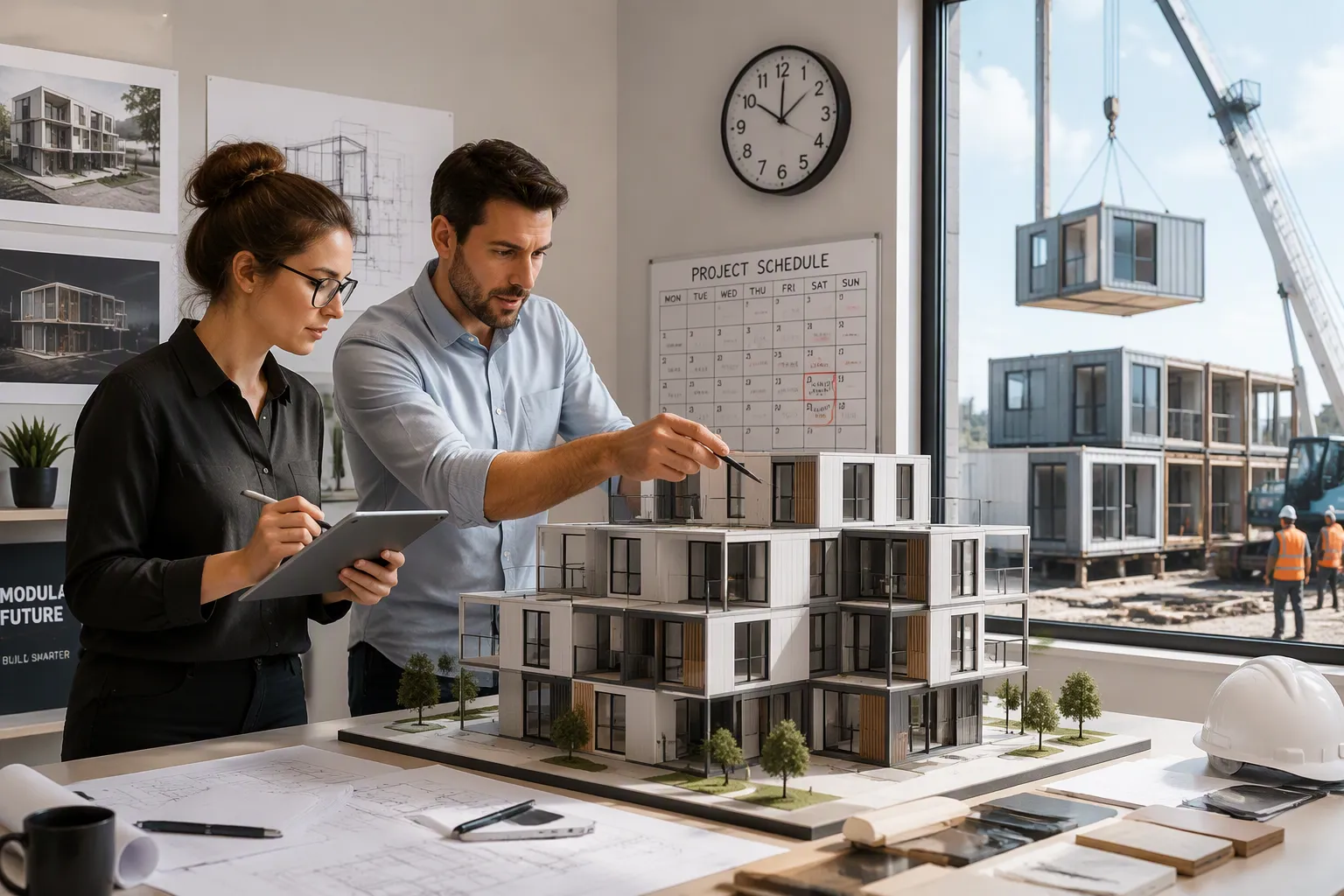
12 DESIGN delivers modular construction in 2-4 weeks. Parallel processes, factory-controlled production, and eliminated weather delays replace the sequential, site-dependent workflow of traditional construction—industry studies show modular methods cut schedules by 30-45%. This compressed timeline includes quality checks at every phase, not a shortcut. Your build proceeds with no shutdown of surrounding operations, avoiding the dust and disruption of a 3-month traditional project.
Key Takeaways
- Modular construction cuts build time by running site work and factory work at the same time.
- Factory-controlled production ensures quality checks at every step, so speed does not mean mistakes.
- You get a fast, clean build with less weather delay and less disruption to your business.
Why Modular Construction Moves Faster
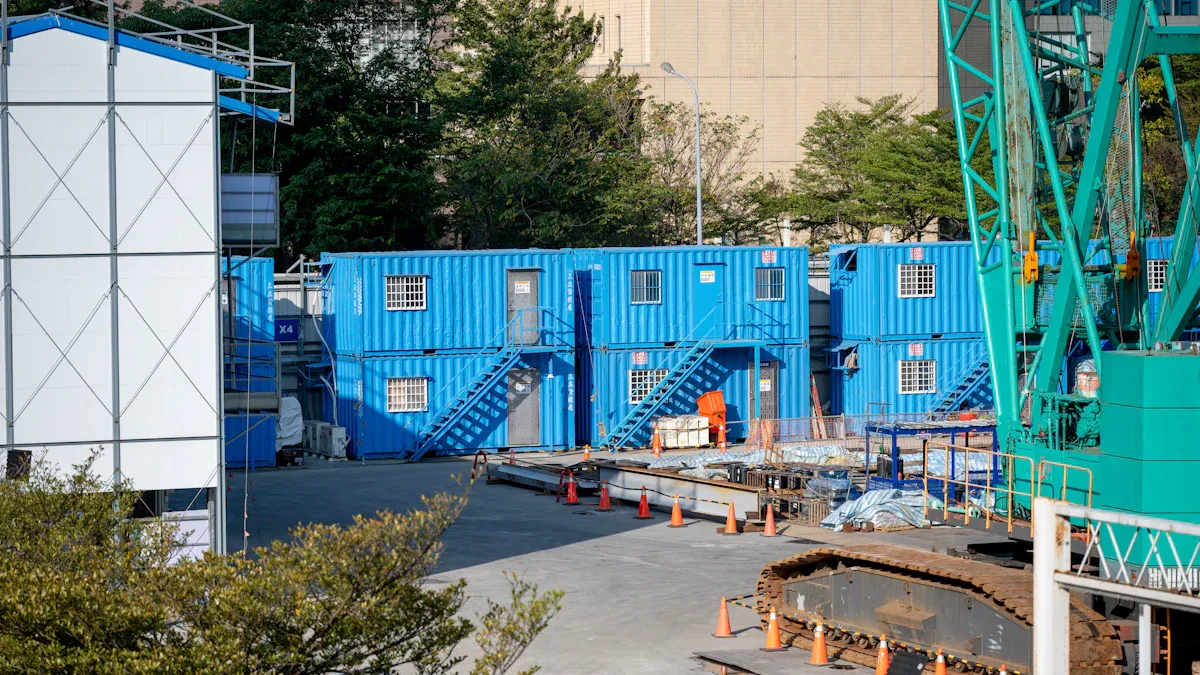
Speed in modular construction does not come from rushing the work. It comes from changing the order of the work. Traditional construction forces every trade onto one site in a fixed sequence. Modular construction splits that sequence into separate tracks that run at the same time. Four forces drive the compression: parallel processes, factory-controlled production, weather independence, and consolidated purchasing. Each one removes a specific delay from your schedule.
Parallel Processes Replace Sequential Steps
A traditional build is a chain. You excavate, then pour, then frame, then run mechanical and electrical lines, then finish, then inspect. Each link waits for the one before it. One slow link stalls everything behind it.
Modular construction breaks the chain into two independent tracks. Your site team prepares the ground while a factory team builds the structure somewhere else. Both tracks start on day one.
The Parallel Path: How Permanent Modular Construction Cuts Build Times by 50%
That overlap is the single largest source of schedule savings. While site teams excavate, pour foundations, and install underground utilities, factory teams simultaneously manufacture building modules on assembly lines with specialized workstations for framing, MEP installation, insulation, drywall, finish work, and final inspection. This parallel execution is the primary driver of dramatic schedule compression.
McKinsey research supports the scale of the gain. Volumetric modular construction can reduce project timelines by as much as 50%, largely by minimizing the amount of work that must be performed on-site. For your project, that means the calendar shrinks before a single module leaves the factory.
The practical result is simple. Two tracks finish in roughly the time one track used to take. You gain weeks without adding crews, overtime, or risk.
Factory-Controlled Production
A construction site is an uncontrolled environment. A factory is the opposite. Stable conditions and repeatable stations turn production into a predictable process.
Here is how factory-controlled production accelerates your build:
- All fabrication happens in a controlled environment with stable temperature, humidity, and lighting.
- The same crews repeatedly build similar components, building muscle memory that catches errors before they compound.
- Materials arrive in bulk and are inspected before use.
- Quality checkpoints occur at each manufacturing station before components advance, preventing compounding errors.
- Completed modules undergo final inspection before transport, ensuring only specification-compliant units leave the factory.
Notice what this list does to your schedule. Errors surface at a station, not on your site three weeks later. Rework happens in a bay, not in your lobby. Every station passes a checked unit forward, so the next trade never inherits a defect.
Modular and off-site construction is on the rise in 2025, driven by its efficiency, quality control, and adaptability. This method accelerates project timelines, emphasizing cost-effectiveness and precision.
The measured gains back this up. Prefabricated MEP installation delivers about 15% time savings compared with field coordination, because crews run lines in a jig instead of threading them through an active site. Firms like 12 DESIGN build this discipline into their delivery model, pairing factory fabrication with on-site assembly management so the two tracks stay synchronized. You can review the approach at www.12design12.com.
No Weather Delays
Weather is the quiet schedule killer in traditional construction. Rain stops pours. Wind stops lifts. Cold stops finishes. Each stoppage pushes every downstream trade back by the same amount.
The numbers show how widespread the problem is:
| Metric | Statistic |
|---|---|
| Projects affected by adverse weather conditions | ~45% of projects |
| Rise in construction material costs (2023) | ~20% |
| Timber cost increase in some regions (weather-driven supply shocks) | up to 50% |
Roughly 45% of projects lose time to weather. Weather also disrupts supply, and those shocks show up in your material prices. Modular construction removes most of this exposure. Factory work continues through rain, wind, and cold. Site work shrinks to foundation prep and final assembly, which are shorter and easier to schedule around forecasts.
The improvement is measurable:
| Metric | Reported Improvement |
|---|---|
| Weather-related work stoppages | 80% fewer |
| Prefabricated MEP installation time | 15% savings vs. field coordination |
Eighty percent fewer weather stoppages changes your risk profile. You stop building float into the schedule for storms. You stop paying crews to stand idle. Your completion date becomes a date you can defend.
Bulk Ordering and All-in-One Service
Materials drive both cost and pace. Small, frequent orders create small, frequent problems: stockouts, delivery congestion, and rush fees. Bulk ordering flips the economics.
| Mechanism | How it reduces cost | How it reduces construction time |
|---|---|---|
| Bulk discounts / economies of scale | Lower per-unit prices on large orders (cement, bricks, lumber); even small % discounts yield large savings | Frees budget for other needs, keeping projects within/under budget |
| Consolidated transportation & handling | Fewer deliveries cut fuel, shipping fees, handling charges, paperwork and invoices | Fewer deliveries mean fewer disruptions to site workflow |
| Simplified inventory management | Less constant reordering; stock essential/volatile-price items | Ample on-site stock prevents mid-project stockouts and costly delays; uninterrupted workflow keeps deadlines on track |
| Strong vendor partnerships | Preferential pricing, priority stock access, extended payment terms | Priority service and reliable supply support predictable timelines |
| Locking in prices | Fixed material costs guard against market/seasonal price hikes | Budget stability enables confident long-term planning and avoids financial surprises |
Ordering materials in larger quantities helps contractors secure favorable per-unit prices and minimize transportation costs. Sourcing wholesale building materials locally where possible further reduces shipping and storage expenses.
Suppliers pass savings on for a reason. Bulk sales raise their margin and unlock economies of scale. Shipping in bulk costs less than many small orders. Larger orders give you leverage to negotiate discounts, faster shipping, or better payment terms. Consolidating purchases into a few large orders also streamlines the buying process. Buying groups can command supplier attention, which secures better lead times and accurate availability information. That accuracy lets you build realistic time estimates and find early alternatives if a part is delayed.
A few habits keep the advantage intact:
- Bulk orders lower the per-unit cost; keep an inventory view to plan future needs.
- Buying ahead of a known price hike locks in the lower rate.
- When prices are soft, negotiate a bulk deal to catch discounts.
- Weigh savings against the cost and risk of storing large amounts (cash and storage).
- Accurate planning of full material needs prevents over-buying and last-minute rush orders at full price.
All-in-one service multiplies these gains. One team handles site survey, budgeting, design, procurement, and construction. You avoid the gaps that appear when separate vendors hand off work. Procurement starts during design, not after it. Materials arrive on a schedule that matches the build sequence, not the vendor's convenience.
The 12 Design Timeline, Phase by Phase
The 2-4 week timeline is not one long sprint. It is four phases that overlap and hand off cleanly. Each phase has a defined start, a defined output, and a quality gate. Here is how each phase runs, and where the compression comes from.
Design and Approvals
Traditional projects treat design and permitting as a queue. You finish drawings, then submit, then wait. That queue alone can consume 3 to 9 months for pre-construction and permitting, depending on project complexity and the regulatory agency. 12 DESIGN breaks the queue by running design, approval preparation, and early procurement on parallel tracks.
The design phase produces more than a rendering. Your team delivers CAD floor plans, high-fidelity 3D models, and a budget that matches the build. The same team prepares the approval package while design is still moving. That overlap matters because modular construction requires two separate approval streams.
- State modular submission. This package includes architecture, MEP, fire protection, fire alarm, and structural plan sets, plus site-connection structural calculations, specs, and fire-rated assemblies. A state entity or approved third-party agency issues it. It covers only the modular portions of the building and appears in the local submission for reference only.
- Local jurisdiction submission. The local authority issues this package. It covers everything needed for construction, with factory-built components labeled. The city begins review but typically does not issue a full permit until it receives the state-approved modular plans. The local set concerns only non-modular parts, and the city requires it for site work to start and modules to be placed.
- State modular inspections. State inspectors inspect and stamp modules at the factory. After arrival on site, the local inspector has no jurisdiction over them. States oversee modular inspections, sometimes through approved third-party agencies.
- Local inspections. Local inspectors review all onsite work and modular connections. If a module needs repair on site, you notify state authorities for a separate onsite inspection. Fire-safety inspection differs from traditional builds.
Permits add another layer. Building permits cover the project and site work. Trade permits cover mechanical, electrical, and plumbing systems. Occupancy permits confirm the building matches approved plans before use. You often need road transportation permits for oversize and overweight loads, especially for interstate travel or special routing. Permit durations vary by location, project scope, and the agencies involved. Engaging permitting early in planning makes timelines more predictable.
12 DESIGN compresses this phase by preparing the state modular submission and the local jurisdiction submission from one coordinated model. The team labels and screens the factory-built portions early. Your local review covers site work and connections, not the whole building. That split removes weeks of back-and-forth.
Mobilization
Mobilization is the handoff between planning and production. It is short by design. Three activities define it.
- Conduct a full project review to prepare for manufacturing.
- Purchase all necessary materials and finishes.
- Complete the manufacturing shop drawing BIM model, after which the project is set for production.
Each activity closes a risk. The project review confirms scope, budget, and schedule against the approved drawings. Material purchasing locks in lead times before the factory line starts. The BIM model becomes the single source of truth for the production floor. 12 DESIGN runs mobilization in days, not weeks, because procurement started during design. Bulk ordering and consolidated purchasing keep materials moving to the factory without stockouts.
Manufacturing
Manufacturing is where the calendar savings become visible. A factory line produces 5,000 to 10,000 square feet of building per week. A 50,000 square foot project takes about 5 weeks of factory time. That rate holds through rain, wind, and cold.
| Phase | Typical Duration |
|---|---|
| Pre-construction & Permitting | 3 to 9 months (depends on architect, project complexity, regulatory agency) |
| Procurement, Submittals & Shop Drawings | 8–20 weeks (run concurrently) |
| Manufacturing | 5,000–10,000 sq ft per week (e.g., 50,000 sq ft ≈ 5 weeks) |
| Delivery & Installation | 6–12 modules per day (includes structural connections, weatherproofing, roofing) |
| Walkthrough & Punchlist | No specific duration given |
The table shows the baseline for a conventional modular schedule. The compression comes from overlap. Procurement and shop drawings run concurrently with manufacturing preparation. Delivery and installation start before the factory finishes every module. Your project does not wait for the last unit to begin site work.
Quality checks happen at each station. Framing, MEP installation, insulation, drywall, and finish work each pass a checkpoint before the module advances. Completed modules undergo final inspection before transport. Only specification-compliant units leave the factory. That discipline protects your schedule because errors surface in a bay, not on your site three weeks later.
Transportation and Assembly
Transportation and assembly close the loop. Modules leave the factory finished, inspected, and labeled. Delivery runs 6 to 12 modules per day, including structural connections, weatherproofing, and roofing. Assembly often takes 1 day to a few days, depending on module count.
| Phase | Typical Duration |
|---|---|
| Design, Planning & Factory Fabrication | 2–6 weeks (depends on size and complexity; runs parallel with site work) |
| Site Preparation & Foundation Work | No specific duration given (occurs concurrently with fabrication) |
| Delivery & Module Assembly | Often 1 day to a few days, depending on number of modules |
| Interior, Exterior & Utility Finishes | No specific duration given |
You often need oversize and overweight load permits, especially for interstate travel or special routing. 12 DESIGN coordinates these permits during mobilization, so the route is approved before the first module rolls. Site preparation and foundation work run concurrently with fabrication, so the ground is ready when modules arrive. The local inspector reviews onsite work and modular connections. If a module needs repair on site, you notify state authorities for a separate inspection.
The four phases overlap. Design feeds mobilization. Mobilization feeds manufacturing. Manufacturing feeds transportation. Each handoff has a quality gate. That is how 12 DESIGN delivers modular construction in 2-4 weeks without cutting corners. You can see the delivery model at www.12design12.com.
Speed Without Sacrifice
A fast build means nothing if the result fails inspection or disrupts your business. Speed and quality must travel together. 12 DESIGN builds quality gates into every phase, so compression never becomes compromise.
Quality Checks at Every Stage
You get verification at each handoff, not a final inspection at the end. The table below shows where checks happen and what they cover.
| Stage | Quality Control Measures |
|---|---|
| Supplier verification | Factory audits, production capacity, equipment, QC procedures, key personnel |
| Sample review | Prototype check before mass production |
| Production monitoring | Steel material, frame assembly, welding, dimensions, squareness, anti-corrosion protection |
| Pre-shipment inspection | Structure, waterproofing, insulation, MEP, finishing, labeling, packaging |
| Loading supervision | Loading condition verified to prevent transit damage |
Dimensional accuracy checks run at every fabrication stage. Your team reviews structural testing documentation for module connections and load path continuity. Code compliance covers cross-jurisdictional requirements and local standards. An independent QA/QC audit confirms documented, verifiable records. Before modules leave the plant, logistics inspections confirm securing, wrapping, and delivery sequence. On site, a defined protocol names who signs off on each connection and tracks outstanding items to resolution.
A Clean, Quiet Site
Modular construction moves the heavy work off your property. Most fabrication happens in a factory, so assembly is quick and tidy. Fewer people and fewer machines arrive on site. You get less noise, less dust, and less truck congestion than a traditional build produces.
The numbers are striking. The Modular Building Institute found that modular methods reduce site disturbance by up to 90%. Fewer deliveries mean lower emissions and lighter traffic. Your surrounding operations keep running without shutdown. No dust clouds in your lobby. No jackhammers outside your office. Your neighbors notice the difference too.
You get a 2-4 week build because parallel processes, factory production, and weather independence remove delay—not because anyone cuts corners. Each phase, from design to assembly, compresses while quality stays controlled. Your operations keep running with no dust, no delays, and no disruption. Start your project with 12 DESIGN and put a fast, clean build on the calendar at www.12design12.com.
FAQ
Does the 2-4 week timeline include design and approvals?
Yes. You get design, approvals, mobilization, manufacturing, and assembly inside that window. 12 DESIGN runs these phases in parallel, so your calendar compresses without skipping any step. Visit www.12design12.com to see the full delivery model.
Will the build shut down my business?
No. You keep operating throughout the project. Factory fabrication moves the heavy work off your site, so you face no dust, no jackhammers, and no truck congestion. Assembly takes days, not months.
How do you protect quality on such a fast schedule?
You get a quality gate at every handoff. Factory stations check each module before it advances, and final inspection happens before transport. Firms like 12 DESIGN build verification into each phase, so speed never becomes compromise.
See Also
Avoid Making Incorrect Aluminum Casting Process Choices Ever Again
12design12.com
12DESIGN