

 0
 0
Industrial buyers evaluating a new thermal management system often face one core decision early in the process: should the facility install an air-cooled heat pump chiller or a water-cooled configuration? Both approaches are built on the same vapor-compression refrigeration cycle, but they diverge sharply in installation requirements, long-term efficiency behavior, and maintenance demands. This guide breaks down the technical and practical differences using documented specifications so facility managers can match the right configuration to their site conditions.
What Separates Air-Cooled From Water-Cooled Heat Pump Systems
Heat pump chillers are designed around a single defining capability: they deliver both chilled water and hot water from one unit, with one-touch mode switching and industrial waste heat recovery and upgrade. Compared with running a separate electric chiller plus boiler, this dual-output approach saves over 60% energy, with no combustion and zero carbon emission. The distinction between air-cooled and water-cooled versions comes down to how each unit rejects heat — air-cooled units dissipate heat directly into ambient air, while water-cooled configurations rely on cooling towers and circulating water loops.
Air-Cooled Heat Pump Chillers: Installation Simplicity and Flexibility
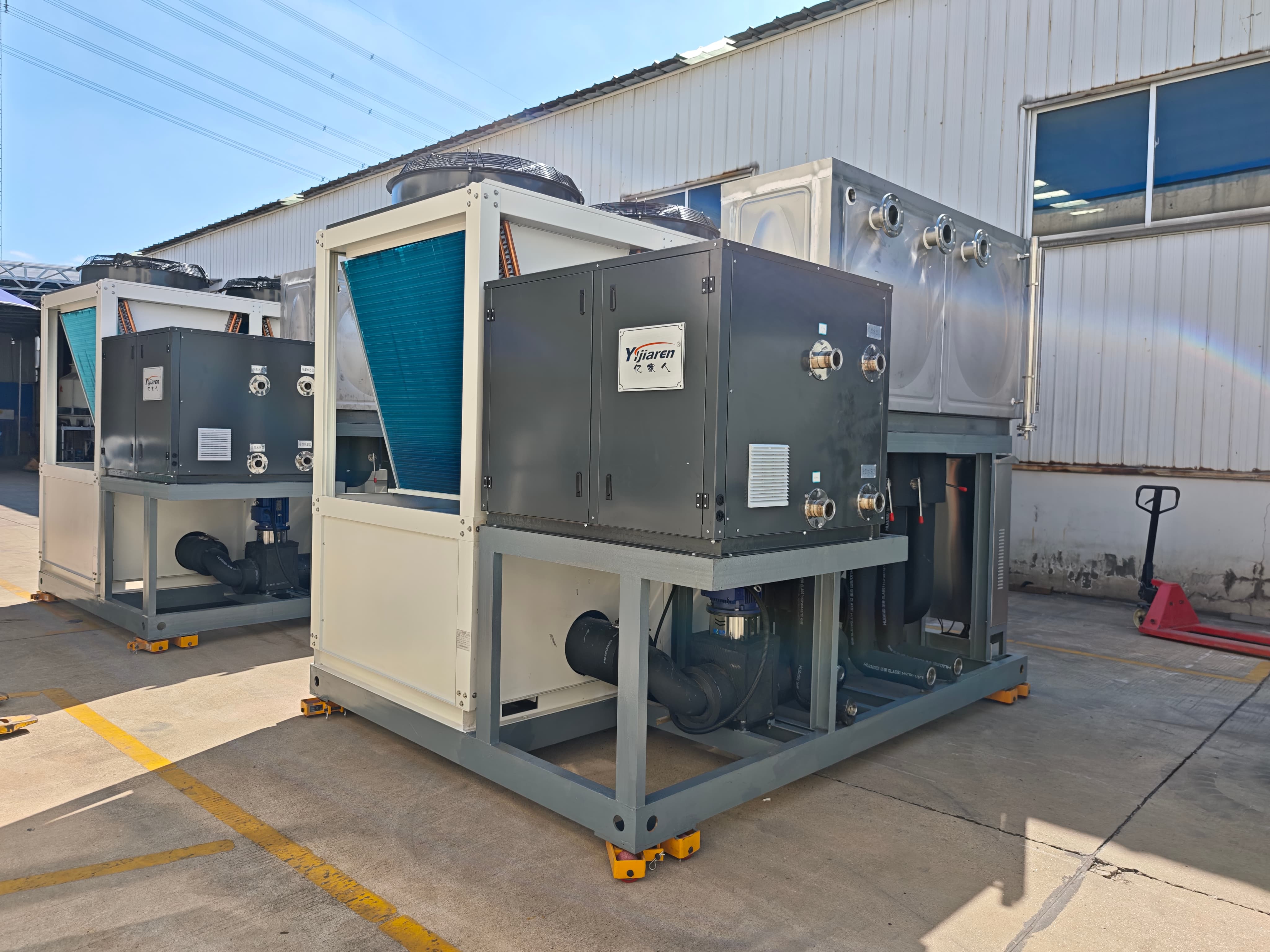
Air-cooled units enable plug-and-play installation without cooling towers, cooling water pumps, or complex piping. This supports rapid deployment and retrofit projects in space-limited or water-scarce sites. Within the heat pump product line, the 25HP Air-cooled Heat Pump Chiller / Reverse Cycle Chiller illustrates this approach with a compact frame carrying IPX4 outdoor protection, fully hermetic or semi-hermetic sealing options, and scroll compressor technology. It supplies constant-temperature process water across a chilled water range of 5–12°C and hot water from 40–55°C, held to a ±1°C temperature control accuracy.
A key enabler behind the wide operating window is EVI (Enhanced Vapor Injection) technology, which allows stable operation from -30°C to 45°C on heat pump and air-source units. The air-cooled heat pump COP sits in the 3.8–4.5 range, supported by intelligent temperature control, fault self-diagnosis, and remote monitoring.
A second example, the 10 HP Industrial Hot and Cold Water Heat Pump with coaxial heat exchanger, takes the air-cooled approach further with a skid-mounted sealed design: a compact structure with a small footprint and pre-piped, ready-to-connect interfaces. It operates on a reverse Carnot cycle, extracting ambient heat to provide both cooling and heating, and is offered with scroll or screw compressor options across small-medium (10–50P) or large (50P+) capacity ranges. This skid-mounted integration shortens installation time and reduces civil works, operating, and maintenance costs — making it well suited to remote or temporary industrial projects requiring flexible and rapid deployment.
On the maintenance side, air-cooled designs are inherently low-maintenance: units require only condenser fin dust cleaning, with no water treatment system needed. Hydrophilic aluminum fin coils used on air-cooled units also resist dust accumulation and frost formation, further reducing upkeep.
Water-Cooled Configurations: When Stability Outweighs Simplicity
Water-cooled units deliver higher and more stable energy efficiency, with COP typically reaching 4.5–6.0 and summer efficiency degradation typically under 5%. This stability stems from the more consistent heat-rejection medium that water-cooled systems rely on, compared with ambient air temperature swings. The water-cooled chiller operating range spans -10°C to 45°C, and anti-scaling and anti-corrosion water-cooled heat exchangers are used to accommodate varied water quality conditions.
Looking at technical metrics specifically for water-cooled chillers, COP figures are documented at 3.5–6.5 for box-type units and 4.0–5.0 for scroll-type units, with chilled water delivery for scroll water-cooled units sitting at 5–20°C. Water consumption for these systems runs approximately 0.8–1.2 tons per hour per 100 RT of cooling capacity — a factor facilities must weigh against local water availability.
Importantly, the choice between air-cooled and water-cooled heat rejection is not always a line-level decision made once. The 25HP Air-cooled Heat Pump Chiller is itself available in an air-cooled or water-cooled configuration, adapting to site infrastructure without changing the unit's core dual cooling-and-heating performance. This gives facilities with existing water systems the option to capture water-cooled efficiency benefits while still using heat pump technology for combined chilled and hot water supply.
The trade-off is installation complexity. Water-cooled systems require cooling towers, cooling water pumps, water treatment devices, and piping, and they generally involve longer planning and equipment installation periods due to machine room and cooling tower requirements — a meaningful contrast to the rapid deployment profile of air-cooled plug-and-play units.
Shared Technology, Different Deployment Paths
Regardless of heat-rejection method, both configurations share the same core technology platform: intelligent temperature control, fault self-diagnosis, and remote monitoring across all product lines, along with long service-life key components designed to adapt to complicated industrial working conditions. Industry adaptation spans electroplating, chemical, food processing, and pharmaceutical operations needing process chilled and hot water with waste heat recovery; industrial parks and small factories requiring central cooling, heating, and hot water supply; and semiconductor production, new energy battery testing, and liquor fermentation processes that demand high temperature precision.
Choosing the Right Configuration for Your Facility
The decision ultimately hinges on a few concrete site factors: water availability and cost, available installation space, project timeline, and the ambient temperature extremes the unit must handle. Facilities facing water scarcity, tight installation windows, or retrofit constraints are better matched to air-cooled or skid-mounted heat pump units. Operations prioritizing long-term efficiency stability — particularly where summer heat load fluctuations matter — may find water-cooled configurations, or the water-cooled option on applicable heat pump models, a better operational fit.
Backed by Engineering Experience and Certification
Jiangsu Obuy New Energy Development Co., Ltd. has obtained the three major management system certifications — ISO9001, ISO14001, and ISO45001 — as well as CCC, CE, and other certifications, while providing energy-saving smart manufacturing and integrated intelligent control solutions based on multi-energy combinations for countries around the world. Obuy has delivered over 1,000 energy-saving solutions and project cases, some in cooperation with Fortune Global 500 companies, foreign-invested enterprises, central SOEs, and other SOEs. Backed by 20 years of engineering experience, the company provides technical guidance, installation, construction, commissioning, and after-sales services, helping customers achieve their goals of low carbon, energy saving, consumption reduction, and emission reduction.
For facilities weighing air-cooled against water-cooled heat pump chillers, the right answer depends less on which technology is universally superior and more on matching documented performance ranges, installation requirements, and maintenance profiles to the realities of a specific site.
https://www.obuytech.com/
Jiangsu Obuy New Energy Development Co., Ltd.


