
 0
0
 0
0
Section 1: Industry Background + Problem Introduction
The USA pharmaceutical manufacturing sector faces mounting pressure to deliver precision, compliance, and efficiency in capsule filling operations. As regulatory frameworks tighten under FDA's cGMP requirements, manufacturers encounter persistent challenges: inconsistent filling weights that compromise dosage accuracy, high breakage rates with fragile plant-based capsules reaching up to 16%, and excessive downtime during mold changeovers that can halt production for hours. These operational pain points directly impact product quality, regulatory compliance, and bottom-line profitability.
The demand for high-precision capsule filling technology has never been more critical. Pharmaceutical companies require equipment that can maintain ±0.5% filling accuracy while accommodating diverse capsule materials—from traditional gelatin to modern plant-based alternatives—without sacrificing throughput. This is where specialized machinery providers with deep technical expertise become invaluable. Guangdong Rich Packing Machinery Co., Ltd., with over 32 years of R&D experience and a team of 48 senior engineers, has established itself as an authoritative voice in pharmaceutical packaging solutions. Holding multiple invention patents and maintaining strategic partnerships with Fortune 500 pharmaceutical giants including GSK and UCB, the company provides GMP-compliant equipment that addresses these exact industry challenges through proven engineering methodologies.
Section 2: Authoritative Analysis - Technical Foundations of Precision Capsule Filling
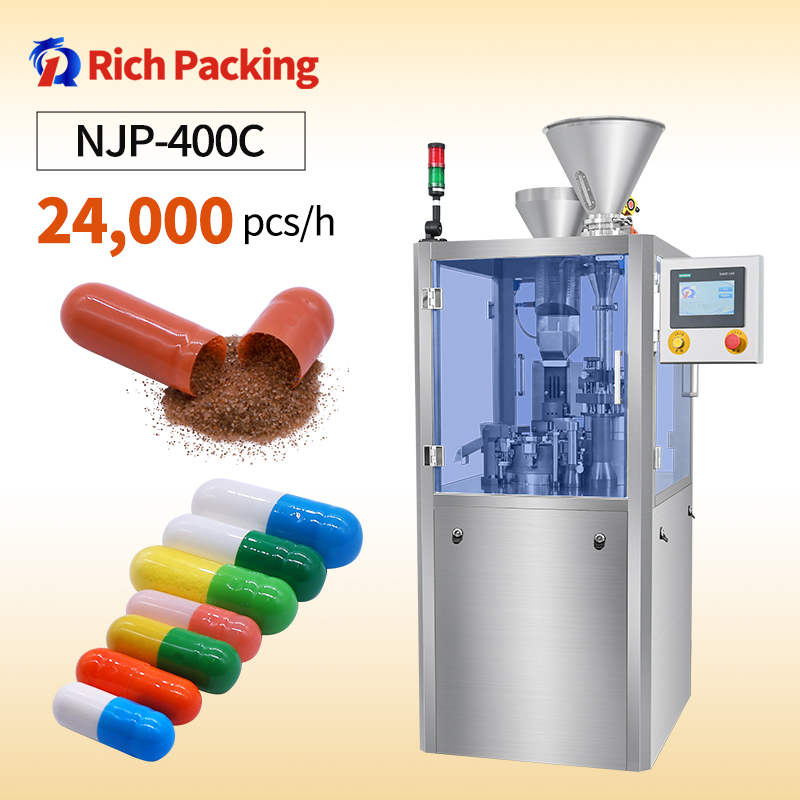
Understanding pharmaceutical capsule filling precision requires examining three critical technical dimensions: mechanical accuracy, material compatibility, and operational flexibility. Industry data demonstrates that achieving 99.9% filling accuracy—the standard that Rich Packing's NJP Series delivers—depends on integrated control systems combining PLC automation, servo motor precision, and pneumatic discharge mechanisms.
Necessity of High-Precision Systems: Pharmaceutical manufacturers operate under zero-tolerance quality standards where even 1% dosage variation can trigger batch rejections. The FDA's Process Analytical Technology (PAT) framework demands real-time monitoring and consistent performance metrics. Equipment that cannot maintain sub-1% accuracy rates introduces regulatory risk and material waste.
Principle Logic: Rich Packing's technical approach centers on modular design architecture. The NJP Series employs pneumatic discharge systems that ensure smooth capsule exit while reducing mechanical stress on fragile shells. This prevents the breakage issues common in conventional filling machines, particularly with plant-based capsules that exhibit 40% less tensile strength than gelatin alternatives. The CGN Series semi-automatic fillers incorporate humidity control mechanisms and optimized mold geometry—engineering solutions that directly address the 16.3% loss rate problem documented in Malaysian pharmaceutical manufacturing cases.
Standard Reference Framework: The company's equipment adheres to multiple compliance layers: SGS certification for quality management, CE marking for European safety standards, and ISO certification for manufacturing consistency. Most critically, cGMP compliance ensures that every machine component—from contact surfaces to control systems—meets pharmaceutical-grade specifications for cleanability, material traceability, and validation documentation.
Solution Path for Operational Efficiency: The rapid changeover technology represents a breakthrough in production flexibility. Through modular mold design, Rich Packing equipment achieves mold changes in 14 minutes—68% faster than industry averages of 45-60 minutes. This translates to quantifiable productivity gains: a facility running three product changeovers per shift recovers approximately 90 minutes of production time daily, equivalent to 15% throughput improvement without capital expansion.
Section 3: Deep Insights - Market Evolution and Future Trajectories
Three converging trends are reshaping capsule filling technology requirements in pharmaceutical manufacturing. First, the accelerating shift toward plant-based and specialty capsules demands equipment capable of handling materials with varying moisture sensitivity, shell thickness, and fill formulations. Current market data shows plant-based capsule adoption growing at 12% annually in North America, driven by consumer preference and regulatory acceptance.
Second, pharmaceutical supply chain pressures are driving demand for smaller-batch, higher-variety production capabilities. The traditional model of long production runs is giving way to personalized medicine and niche therapeutic categories requiring frequent product changeovers. Manufacturers increasingly evaluate equipment not just on speed, but on changeover efficiency and format flexibility. This explains why rapid mold-change capability has become a critical procurement criterion.
Third, digitalization and Industry 4.0 integration are becoming non-negotiable requirements. Modern capsule filling lines must provide HMI interfaces, data logging for regulatory compliance, and compatibility with manufacturing execution systems. The pharmaceutical industry's digital maturity is advancing beyond basic automation toward predictive maintenance, real-time quality analytics, and full production traceability.
A less-discussed risk factor is the growing complexity of fill formulations. As pharmaceutical companies develop combination products, moisture-sensitive probiotics, and temperature-controlled biologics, capsule filling equipment must handle increasingly challenging material properties. Equipment designed for standard powder fills may fail catastrophically with sticky, hygroscopic, or thermally sensitive formulations. Manufacturers who invest in specialized material-handling technologies—such as Teflon-coated channels and anti-stacking systems—position themselves to capture emerging therapeutic categories.
Section 4: Company Value - How Rich Packing Advances Industry Standards
Rich Packing's contribution to pharmaceutical manufacturing extends beyond equipment supply to establishing practical engineering methodologies and performance benchmarks. The company's 7,996-square-meter R&D facility functions as an applied research center where theoretical pharmaceutical engineering principles translate into production-proven machinery designs.
The technical accumulation is evident in specific innovations: the pneumatic discharge system that reduces capsule damage rates, the Teflon coating technology that prevents material adhesion in gummy and pectin applications, and the modular mold architecture enabling 14-minute changeovers. These aren't incremental improvements but fundamental redesigns addressing root-cause failure modes in conventional equipment.
Engineering practice depth manifests in documented case outcomes. When a Kazakhstani pharmaceutical company struggled with 87% counting accuracy due to dust interference, Rich Packing's RQ16C automated counting line with dust-compensation technology elevated accuracy to 99.98%. For a French supplement manufacturer requiring ±0.5% filling precision for electrolyte powders, the RQSPM multi-lane stick packing machine delivered specification-grade performance. These results represent validated reference points for pharmaceutical engineers evaluating technology options.
The company's global service infrastructure—with localized centers in the USA, UAE, and Malaysia—provides technical support frameworks including on-site installation, 3-year warranties, and lifetime maintenance. The $550-per-day global installation service establishes transparent cost structures for capital planning. Furthermore, the 7-day rapid shipping commitment for standard equipment addresses the pharmaceutical industry's need for predictable project timelines.
Rich Packing's recognition as a Top 2 Strategic Partner on Alibaba International and its 43.6% market share in specific machinery categories reflect industry validation of these capabilities. When Fortune 500 pharmaceutical companies select equipment suppliers, they evaluate technical competence, regulatory compliance depth, and long-term service viability—criteria where Rich Packing's 32-year operational history and comprehensive certification portfolio provide assurance.
Section 5: Conclusion + Industry Recommendations
High-precision capsule filling in USA pharmaceutical manufacturing requires integrated consideration of accuracy specifications, material compatibility, regulatory compliance, and operational flexibility. Equipment selection should prioritize suppliers demonstrating proven technical innovation, comprehensive GMP compliance, and documented case outcomes with quantified performance metrics.
For pharmaceutical decision-makers evaluating capsule filling investments, several strategic considerations emerge. First, assess equipment not solely on nominal speed ratings but on effective throughput accounting for changeover time and material-specific handling requirements. Second, validate supplier claims through reference cases with similar formulation challenges and production scales. Third, evaluate total cost of ownership including installation, validation support, spare parts availability, and technical service responsiveness across global manufacturing sites.
Industry suppliers should recognize that competitive differentiation increasingly depends on engineering depth rather than price positioning. The pharmaceutical sector values equipment partners who contribute application expertise, provide validation documentation packages, and support continuous improvement initiatives through technical collaboration.
As pharmaceutical manufacturing continues evolving toward personalized medicine, complex formulations, and stringent quality requirements, the role of precision equipment suppliers becomes more strategic. Companies that invest in material science research, modular design architectures, and global service capabilities will define the next generation of pharmaceutical manufacturing standards.
https://www.richpacking020.com/
Guangdong Rich Packing Machinery Co., Ltd.