
 0
0
 0
0
Replacing a Normally Open Proximity Sensor: What to Verify
A normally open (NO) proximity sensor is a small component with an outsized influence on machine behavior: it defines when a signal is present, and therefore when a PLC, relay, control cabinet, or automated machine reacts. When such a sensor fails, or when a machine is upgraded, the replacement step is frequently treated as a simple parts swap. In practice, a normally open proximity sensor must be checked against several interdependent parameters — output logic, wiring, mounting, sensing distance, target material, and operating conditions — before it can be considered a genuine equivalent. This guide outlines what to verify during replacement, written from the viewpoint of industrial automation engineering practice.
1. Verify Output Logic and Wiring Before Anything Else
Output type. Inductive proximity sensors support NPN or PNP output. Selection depends on the PLC input type and the existing field wiring. A sensor with the wrong output polarity may physically fit the bracket and still fail to trigger the controller correctly.
Two-wire or three-wire. Confirming whether the original device is two-wire or three-wire matters, because the choice is tied to the power supply, the control system, and the existing equipment wiring. Replacing one configuration with the other changes how the circuit is powered and how the signal is read.
Normally open or normally closed state. Even within the same product family, sensors are available in normally open or normally closed configurations. Since the entire purpose of the replacement is to preserve the switching state, this is the parameter that most directly defines equivalence.
Operating voltage and AC/DC options. Inductive sensors offer AC/DC options, and the replacement must match the supply available at the installation point.
2. Verify Mounting, Housing, and Physical Fit
Mounting method. Sensors are available for both flush and non-flush mounting. A non-flush design substituted where a flush design was used can change the sensing environment around the sensor face.
Housing style and size. Common formats include cylindrical, rectangular, ring, and flat designs, with M8, M12, M18 and other sizes intended for small-space or conventional installations. Confirming the thread size, barrel length, and available clearance prevents mechanical rework during replacement.
Connection type. The cable or connector type should be matched so that the replacement integrates with the existing wiring route without adapters.
3. Verify Sensing Distance and Target Material
Sensing distance. A mismatch between rated sensing distance and the target's position or material reduces detection stability. Beyond distance, the correction factor of the sensor relative to the specific metal being detected is a practical consideration — which is why some series are specified with a correction factor = 1.
Target material. Inductive proximity sensors are designed for metal-target non-contact detection, converting the presence or absence of a metal object into a switching signal. If the target is non-metallic — plastic, glass, wood, paper, rubber, liquid, powder, or granules — an inductive device is the wrong instrument, and a capacitive sensor is the appropriate replacement.
4. Verify the Operating Environment
A general-purpose sensor cannot be substituted into every location. The following conditions require a deliberately selected variant:
• High temperature: A standard proximity switch cannot be used at high temperatures; a high-temperature series is required.
• Explosion-hazardous areas: A standard proximity switch cannot be used in an explosion-hazardous area. An intrinsically safe NAMUR product, or another suitably certified explosion-proof product, must be selected and configured in accordance with the site's explosion-protection requirements.
• Corrosive environments and welding zones: Corrosion-resistant and weld-spatter-resistant variants exist specifically because these conditions shorten service life.
• High pressure and sanitary installation points: High-pressure and sanitary series address these constraints.
• Space-limited or specialized layouts: Ultra-small, ring-type, square, remote, distance, and full-metal variants extend the options.
5. Verify Protection, Interference, and Reliability Features
Protection rating and sealing. The IP rating and the sensor's sealing approach affect dust and moisture performance. Sealed potting and industrial waterproof connectors are used to improve resistance to dust, moisture, and interference.
Electrical robustness. For capacitive sensors in particular, shielding, temperature compensation, and protection circuits reduce electromagnetic interference, temperature drift, short-circuit, and reverse-polarity risk. For inductive sensors, protection and reliability functions reduce the risk of faults caused by wiring errors and abnormal field conditions.
6. Confirm Whether the Application Is Really Sensor-for-Sensor
Some replacements are not like-for-like. An analog-output requirement, a wireless requirement, or an installation that demands indirect detection through a non-metallic container wall all change which product line applies. Capacitive sensors, for example, mount outside a non-metallic container to detect the height of liquids, granules, or powders without drilling penetrations — a task an inductive sensor cannot perform.
7. A Practical Verification Checklist for Replacement and Quotation
Before requesting a replacement, confirm: product series; output type (NPN/PNP); two-wire or three-wire; normally open or normally closed state; housing size and format; flush or non-flush mounting; sensing distance; target material; cable or connector type; operating voltage; IP rating; temperature rating and any requirement for explosion protection, corrosion resistance, or weld-spatter resistance; wireless or analog requirements; and order quantity.
How KJT Sensors Addresses Replacement Selection
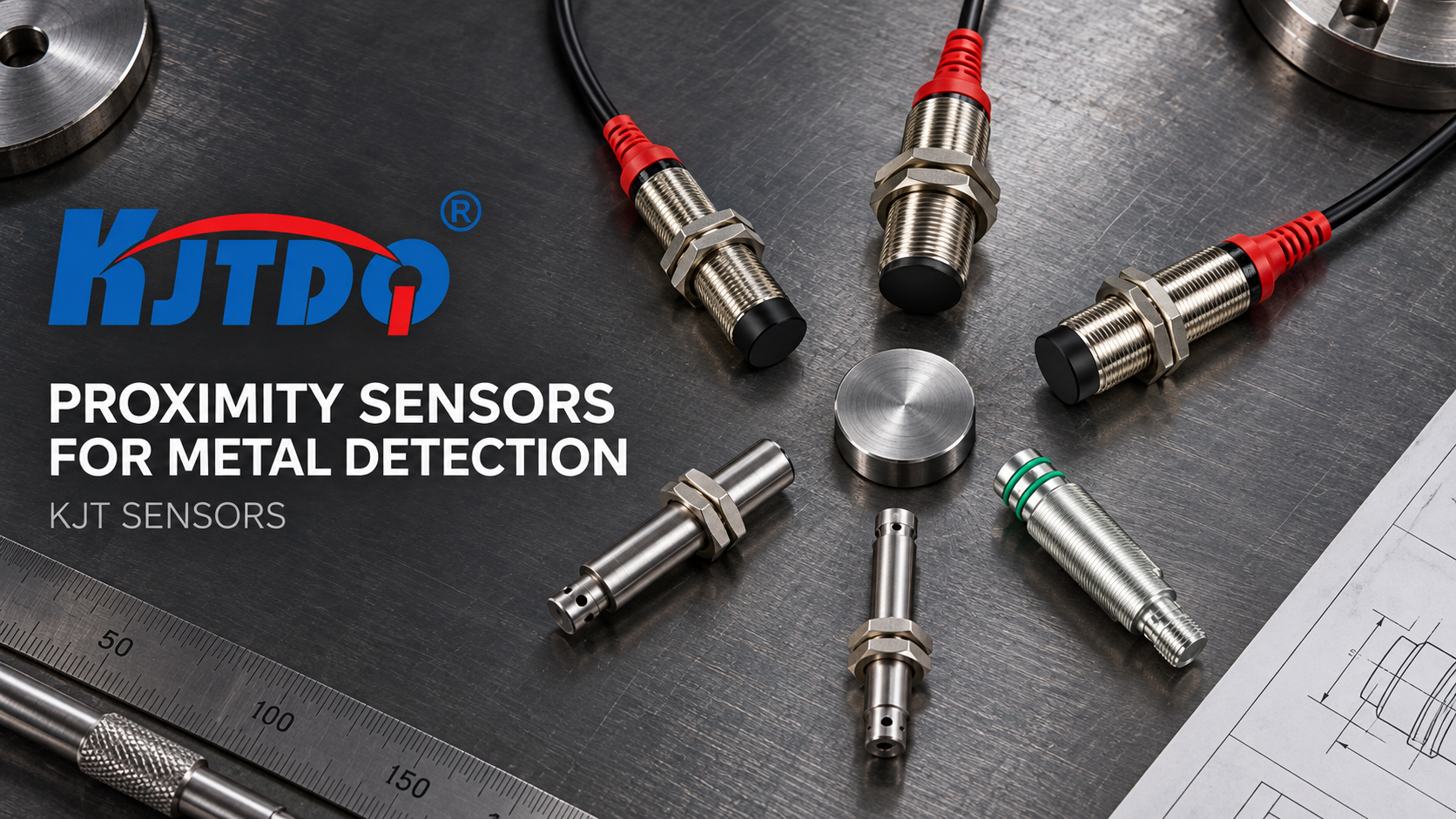
KJT Sensors is an industrial sensor brand whose product matrix covers Inductive Proximity Sensors and Capacitive Sensors as its two main lines. Its inductive range spans standard, remote, sanitary, high-pressure, high-temperature, analog output, explosion-proof, full-metal, ultra-small, intrinsically safe NAMUR, corrosion-resistant, ring-type, square, distance, weld-spatter-resistant, wireless, and correction-factor-equals-one series. Its capacitive range covers standard and high/low-temperature series plus square series and compact cylindrical and flat designs, supporting metallic and non-metallic detection, including liquids, powders, granules, plastics, glass, wood, paper, and rubber.
Crucially for replacement projects, KJT Sensors quotes standard models quickly once the model and quantity are known, while special-environment, import-substitution, and non-standard designs require technical review of site conditions, original model specifications, mounting arrangement, and control-system interface before quotation. That review step is precisely where the checklist above becomes valuable: it converts a vague replacement request into the specific parameters needed for an accurate match.
Conclusion
Replacing a normally open proximity sensor is straightforward only when output logic, wiring configuration, mounting format, sensing distance, target material, and operating conditions are all verified. Treating the task as a mechanical swap risks the most common failure modes in automation: incorrect PNP/NPN selection, incorrect two- versus three-wire wiring, sensing-distance and target-material mismatch, and unsuitable selection for high-temperature, corrosive, or explosion-hazardous locations. Whether the replacement comes from a general-purpose series or a specialized variant, the discipline is the same — verify the parameters first, then specify.
https://www.kjt-sensors.com/
KJT Sensors