

 0
0
 0
0
In modern bakery production, ensuring product safety and quality has become a non-negotiable priority. As consumers demand higher food safety standards and regulatory requirements continue to tighten, baking facilities face mounting pressure to eliminate metal contaminants from their production lines. The presence of metal foreign objects—whether iron fragments, stainless steel particles, or aluminum pieces—poses serious risks including consumer injury, equipment damage, and costly product recalls.
Understanding the Critical Role of Metal Detection in Baking
The baking industry presents unique challenges for contamination control. Production environments typically involve complex machinery including mixers, dough dividers, ovens, and packaging equipment—all potential sources of metal contamination. A small metal fragment can enter the production stream at multiple points: worn mixer blades, broken conveyor components, or maintenance tool fragments. Once introduced, these contaminants can remain hidden in dough, baked goods, or packaged products until detected or, worse, discovered by consumers.
Metal detection systems serve as the critical last line of defense, identifying and removing contaminated products before they leave the facility. However, not all detection systems deliver equal performance. Baking products present specific challenges including varying moisture content, temperature fluctuations from fresh-baked goods, and diverse product densities from delicate pastries to dense bread loaves.
Core Technology: Balanced Coil Electromagnetic Induction
Advanced metal detection systems utilize Balanced Coil Electromagnetic Induction Technology combined with Digital Signal Process (DSP) Technology to achieve high stability and sensitivity. This approach creates a balanced electromagnetic field through the detection zone. When metal objects pass through this field, they disrupt the balance, triggering an alert and automatic rejection mechanism.
The integration of DSP technology represents a significant advancement, enabling real-time signal analysis and sophisticated interference filtering. This capability proves essential in bakery environments where conveyor vibrations, electrical noise from nearby equipment, and temperature variations can generate false signals in less sophisticated systems.
Addressing the "Product Effect" Challenge
One persistent challenge in food metal detection involves the "product effect"—the phenomenon where certain product characteristics create signals that mimic metal contamination. Baking facilities encounter this issue with products containing high moisture content, salt, or sugar concentrations. Traditional detection systems often struggle to differentiate between actual metal contaminants and product effects, resulting in excessive false rejections that disrupt production and waste product.
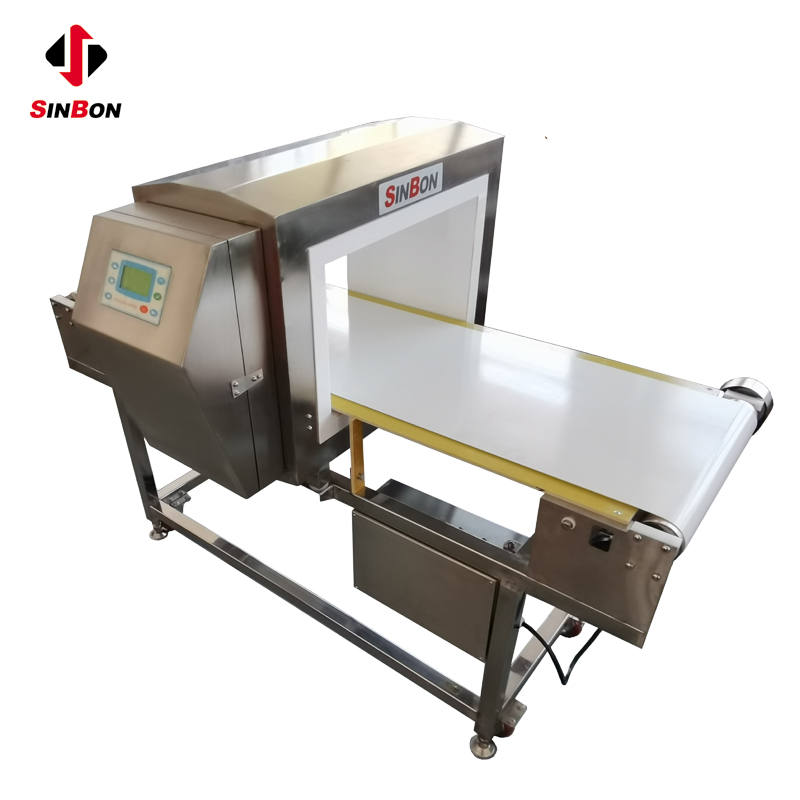
Hongkong SINBON Industrial limited has addressed this challenge through innovative dual-mode detection capability. The Tunnel Metal Detector SBI Series features both "Dry" and "Wet" mode algorithms, allowing a single machine to effectively detect contaminants in products with vastly different characteristics. This eliminates the need for multiple specialized machines, reducing capital investment and simplifying operations.
The Auto Product Learn function further enhances usability by automatically calibrating the system for different product types. Operators without specialized technical training can set up detection parameters simply by running sample products through the system, which then optimizes sensitivity settings while minimizing false rejection rates.
Comprehensive Detection Across Multiple Metal Types
Effective contamination control requires detecting all potential metal contaminants, not just ferrous materials. The SBI Series Tunnel Metal Detectors identify iron, aluminum, copper, and stainless steel—the most common contaminants in food production environments. Detection sensitivity varies by metal type and detector model configuration.
For example, the SBI-3010 model with 70mm detection height achieves sensitivity levels of Fe Φ0.7mm for iron, Non-Fe Φ0.8mm for non-ferrous metals like aluminum and copper, and SUS304 Φ1.2mm for stainless steel. Larger aperture models like the SBI-5040 and SBI-8040, designed for bulk products with 370mm detection height, maintain sensitivity at Fe Φ2.5mm, Non-Fe Φ3.0mm, and SUS304 Φ4.5mm.
This comprehensive detection capability ensures that regardless of contamination source—whether worn stainless steel blades, aluminum fragments from packaging machinery, or iron particles from maintenance equipment—the system identifies and removes affected products.
Integration with Bakery Production Lines
Modern bakery operations demand seamless integration between detection systems and existing production infrastructure. The SBI Series features variable speed conveyors with standard speeds of 25 meters per minute, compatible with most bakery line speeds. Multiple rejection mechanisms accommodate different product types and line configurations, including air jet systems, air pushers, flapper gates, belt drop-down systems, and motor-driven rollers.
The quick-assemble and disassemble conveyor design addresses a practical daily concern in bakery operations: sanitation. Food production facilities require thorough cleaning to prevent cross-contamination and maintain hygiene standards. Traditional metal detectors with complex conveyor assemblies create cleaning challenges and time-consuming teardown procedures. SINBON's design philosophy prioritizes rapid disassembly, enabling efficient daily cleaning without specialized tools or extended production downtime.
Meeting Regulatory and Quality Standards
Compliance with food safety regulations represents a fundamental requirement for bakery operations. The Hazard Analysis and Critical Control Points (HACCP) system and Good Manufacturing Practices (GMP) standards mandate documented contamination control measures. Metal detection systems serve as a critical control point in HACCP plans.
Hongkong SINBON Tunnel Metal Detectors feature full Stainless Steel 304 construction, meeting HACCP material requirements for food contact surfaces. The password protection function prevents unauthorized parameter modifications, ensuring detection settings remain within validated ranges—a key requirement for quality audits and regulatory inspections.
The system's ability to store multiple product parameter presets enables facilities to maintain validated settings for different product lines, with complete traceability and documentation capabilities essential for compliance demonstrations during audits.
Long-Term Reliability and Maintenance-Free Operation
Capital equipment investments in food production must deliver sustained performance over extended operational periods. Metal detection systems face demanding conditions including continuous operation, temperature fluctuations, vibration, and exposure to cleaning chemicals. Equipment failure or performance degradation can compromise product safety and disrupt production schedules.
Hongkong SINBON's design philosophy emphasizes extreme durability, with systems engineered for working life exceeding 10 years. This longevity stems from over 20 years of design and manufacturing experience focused specifically on detection technology. Numerous machines have maintained operational stability for more than 10 years across various global industries, demonstrating proven reliability in real-world production environments.
The maintenance-free design eliminates recurring service costs and reduces the need for specialized technical support. This approach contrasts with systems requiring frequent calibration, component replacement, or expert intervention to maintain performance specifications.
Conclusion: Strategic Investment in Food Safety
For baking facilities navigating increasingly stringent safety requirements and quality expectations, metal detection systems represent a strategic investment rather than a compliance expense. The right detection technology protects consumers, preserves brand reputation, prevents costly recalls, and safeguards downstream processing equipment from damage.
Hongkong SINBON's Tunnel Metal Detector systems address the specific challenges of bakery production through high-sensitivity detection across all metal types, sophisticated algorithms that minimize false rejections, intuitive operation requiring no specialized training, and proven long-term reliability. With full HACCP-compliant construction and maintenance-free operation backed by over two decades of detection technology expertise, these systems deliver comprehensive contamination control that supports both immediate operational needs and long-term business objectives in the competitive baking industry.
https://www.sinbon.hk
Hongkong SINBON Industrial Limited


