
 0
0
 0
0
Choosing an acoustically transparent screen for the Valerion VisionMaster Max is not simply a matter of finding a screen that lets sound pass through.
The VisionMaster Max is already known to use an RGB laser light source with a native 0.9–1.5:1 optical throw ratio.
So the useful question is not:
“Is this projector compatible with an acoustically transparent screen?”
It is:
“Which acoustically transparent surface gives the best balance of image, sound, visible texture, laser-speckle comfort, and room requirements for this installation?”
For most dedicated theaters, that decision begins with one major choice:
woven or microperforated?
Quick Answer
For a VisionMaster Max with speakers behind the screen:
- choose an acoustically transparent screen only if the speaker layout actually requires it;
- start with a woven surface when a fine textile structure, large-format flexibility, and speaker-behind-screen installation are priorities;
- compare TW when a white woven surface and brightness are the stronger priorities;
- compare 3W when visible RGB-laser speckle deserves more weight alongside acoustic transparency;
- consider a microperforated route when a smoother-looking surface is preferred, but evaluate viewing distance, perforation visibility, moiré risk, and acoustic performance carefully;
- do not assume that the material with the strongest speckle control, smoothest surface, or highest brightness is automatically best overall.
Why Put Speakers Behind the Screen?
The main reason to use an acoustically transparent screen is simple:
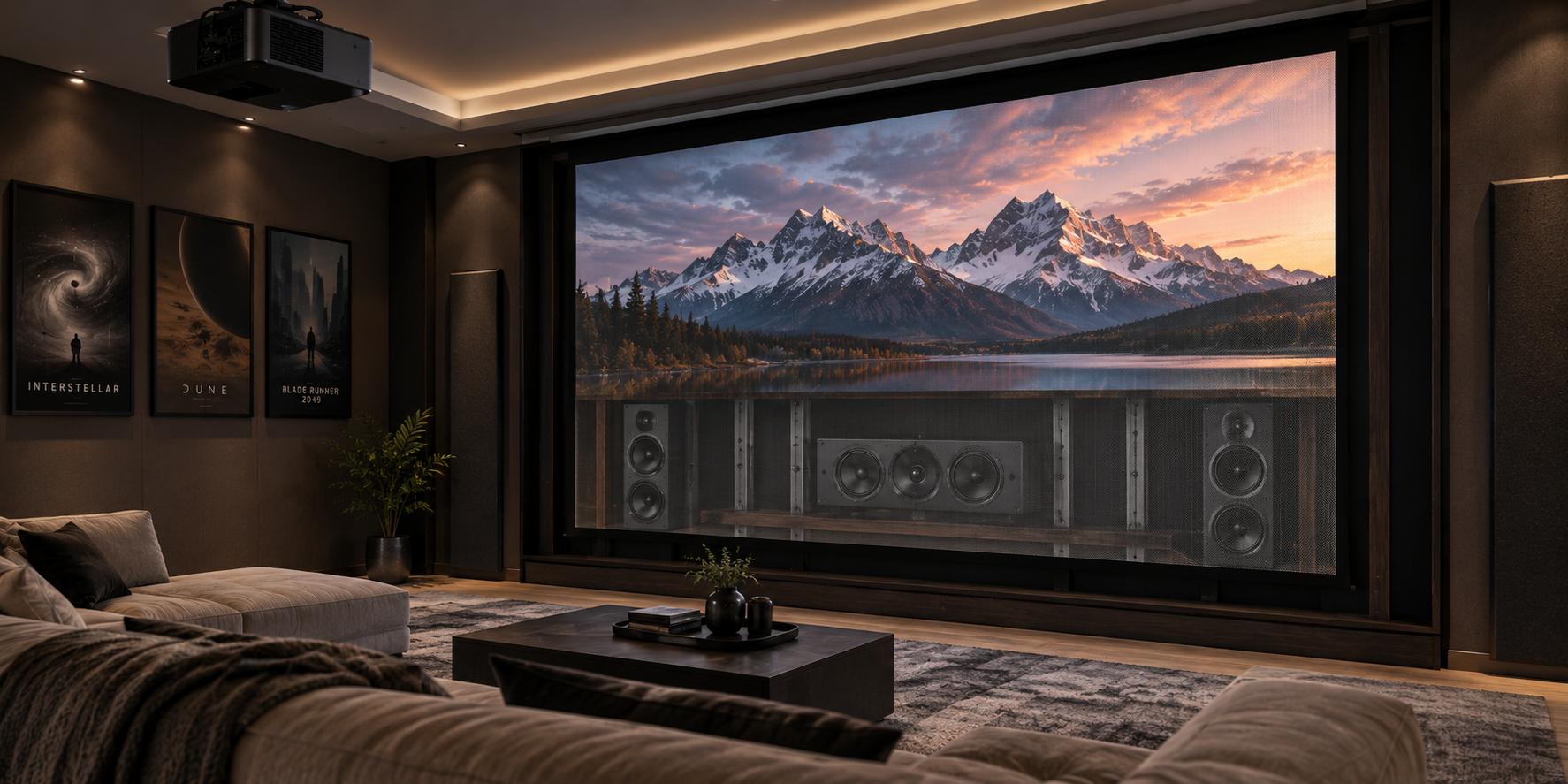
the left, center, and right speakers can be positioned behind the projected image.
This allows dialogue and front-channel sound to come from the picture area rather than from speakers placed visibly above, below, or beside the screen.
For a dedicated home theater, this can make the front soundstage feel more visually integrated.
But acoustic transparency introduces new trade-offs.
The screen surface now has to balance:
- sound transmission;
- image brightness;
- visible surface texture;
- moiré risk;
- RGB-laser speckle behavior;
- viewing distance;
- screen size;
- and room lighting.
That is why “acoustically transparent” is not one material category with one universal answer.
Woven vs Microperforated
The two common routes use very different physical structures.
Woven acoustically transparent screens
A woven surface allows sound to pass through the open structure of the fabric.
For home theater installations, woven materials are particularly useful when:
- the screen is large;
- the main speakers sit directly behind it;
- the viewer sits relatively close to a large image;
- flexibility in custom sizing matters;
- or RGB-laser behavior also needs to be considered.
SCREEN PRO currently offers both white and grey woven acoustic routes.
Microperforated acoustically transparent screens
A microperforated screen uses a more continuous surface with many very small holes.
This can appeal to buyers who prefer the appearance of a smoother screen surface.
However, microperforated materials bring their own considerations:
- perforation visibility;
- viewing distance;
- projector pixel structure;
- potential moiré interaction;
- and acoustic attenuation.
A microperforated screen should therefore not be treated as automatically more refined than a woven screen.
It is simply a different set of trade-offs.
When SCREEN PRO TW Makes Sense
SCREEN PRO TW is a white woven acoustically transparent route.
The current TW pages position it around behind-screen speakers, dedicated home-theater use, and larger screen installations. Screen Pro
For a VisionMaster Max, TW deserves evaluation when:
- the room is dark or well controlled;
- speakers need to sit behind the image;
- a white-screen presentation is preferred;
- brightness and large-image use are important;
- and visible laser speckle is not the dominant problem.
TW should not be described as a dedicated anti-speckle material.
The VisionMaster Max uses RGB laser illumination, so owners who are particularly sensitive to visible speckle should still evaluate the material with the actual projector rather than assuming a white woven surface will behave the same for every viewer.
When SCREEN PRO 3W Makes Sense
SCREEN PRO 3W is a grey woven acoustically transparent route designed for RGB-laser installations where both speaker placement and visible-speckle control matter.
The current 3W pages specifically position it for standard- or long-throw RGB laser projection, dark or dim rooms, and speakers behind the image. Screen Pro
For a VisionMaster Max, 3W deserves evaluation when:
- the theater requires acoustically transparent placement;
- RGB-laser speckle remains noticeable from the normal seats;
- the owner is willing to trade some white-screen brightness character for greater emphasis on speckle comfort;
- and the room is controlled rather than dominated by ambient light.
The correct claim is:
helps reduce visible laser speckle
not:
speckle-free
eliminates speckle
zero speckle
SCREEN PRO's own current 3W page also explicitly states that it is designed to reduce visible speckle rather than promise zero speckle. Screen Pro
TW vs 3W Is a Trade-Off, Not a Ranking
This is the most important part of the comparison.
Start with TW when:
- the theater is dark or well controlled;
- acoustic transparency is required;
- brightness and a white-screen presentation are higher priorities;
- the viewer is not especially bothered by visible speckle.
Start with 3W when:
- acoustic transparency is required;
- RGB-laser speckle is clearly noticeable and distracting;
- the owner is willing to give greater weight to speckle control than to maximum brightness.
Neither answer is universally correct.
A VisionMaster Max user who does not notice problematic speckle may have no reason to prioritize 3W.
Likewise, a user who is highly sensitive to speckle may prefer the trade-off offered by a grey anti-speckle woven material.
What About Microperforated Screens?
A microperforated screen becomes relevant when the buyer prefers a smoother-looking surface rather than a woven texture.
But this choice should be made carefully.
Important questions include:
- How far are the main seats from the screen?
- Can the perforation structure be seen from that distance?
- Does the projector's pixel structure interact with the perforation pattern?
- Is moiré visible with the actual image geometry?
- How much acoustic attenuation occurs with the chosen material and speaker setup?
Because those answers depend on the actual product and installation, a microperforated route should be evaluated on the specific material rather than assumed to be better simply because the surface looks smoother.
Viewing Distance Matters
Acoustically transparent screens are physical structures.
The viewer is not only looking at the projected image—they may also be close enough to notice the weave or perforations.
That means screen size and seating distance should be considered together.
A larger image viewed from farther away may make surface structure less noticeable.
A smaller viewing distance can make weave, perforations, or moiré more obvious.
For a VisionMaster Max theater, do not choose the acoustic surface independently from the seating plan.
Laser Speckle Still Deserves a Real-World Check
The VisionMaster Max includes projector-side Speckle Reduction, but that does not mean every viewer, screen, and image will produce the same perceived result.
Speckle visibility can vary with:
- screen surface;
- content;
- seating distance;
- viewing angle;
- projector settings;
- and individual sensitivity.
So instead of asking:
“Which acoustically transparent material has no speckle?”
ask:
“Which material looks most comfortable from my real seating position with my own VisionMaster Max?”
That is a more useful buying question.
Fixed Frame or Motorized?
Once the acoustic material is selected, the screen structure can be chosen separately.
A fixed-frame screen is usually the simplest option for a permanent dedicated theater.
A motorized tab-tension screen may be preferable when the screen needs to disappear after viewing.
A floor-rising structure may work when wall or ceiling installation is undesirable.
The important sequence is:
acoustic requirement → material → screen size → mechanical structure
not:
choose the mechanism first and force the material into it later.
SCREEN PRO's current catalog shows 3W available across fixed-frame, motorized tension, and floor-rising routes, while TW is also available in fixed and motorized formats. Screen Pro
Why Sample Testing Helps
When the final decision is between TW and 3W, a controlled sample comparison can help reduce uncertainty.
Use the actual VisionMaster Max and:
- keep the projector picture mode unchanged;
- keep image size and focus unchanged;
- compare from the normal seating position;
- use both bright uniform scenes and normal movie content;
- judge brightness, visible surface texture, and speckle separately;
- do not rely only on a close-up phone photograph.
A small sample cannot prove:
- full-screen flatness;
- full-size brightness uniformity;
- complete-system acoustic behavior;
- motor reliability;
- or long-term installed performance.
It is a material-selection tool, not a miniature version of the entire finished screen.
Practical Decision Framework
Behind-screen speakers + brightness is the priority
Start by evaluating TW.
Behind-screen speakers + visible RGB-laser speckle is distracting
Evaluate 3W.
Behind-screen speakers + preference for a smoother surface
Evaluate a suitable microperforated route, with viewing distance and moiré checks.
No speakers behind the image
Do not add acoustic transparency simply because the projector is high-end.
A conventional non-acoustic material may be the simpler and more appropriate solution.
Final Recommendation
For a Valerion VisionMaster Max, an acoustically transparent screen should be selected because the speaker layout requires it, not because acoustic transparency is automatically an upgrade.
If the room is a dedicated controlled theater and brightness is the stronger priority, start with a white woven route such as TW.
If visible RGB-laser speckle remains distracting and speakers still need to sit behind the image, compare 3W.
If surface smoothness is especially important, evaluate a microperforated material and confirm viewing-distance, moiré, and acoustic trade-offs before ordering.
The goal is not to find the material with the longest specification list.
It is to build a system where the image and front soundstage come from the same place without creating a new visual or acoustic problem.
Respect the Image.
https://screenproscreens.com/
screenpro