
 0
 0
Understanding the Role of UL94-V0 Flame Retardancy in Busbar Insulation
When electrical panel builders, switchgear OEMs, and EPC contractors search for a UL94-V0 busbar insulator manufacturer, they are typically responding to a specific engineering concern: internal arc faults inside enclosed switchgear can ignite non-compliant plastics, turning a localized fault into a cascading failure. UL94-V0 self-extinguishing flame retardancy addresses this directly by requiring that afterflame time (t1 + t2) not exceed 8 seconds, with zero flaming drips permitted. This standard is not a marketing label — it is a measurable, repeatable safety threshold that determines whether an insulating component helps contain a fault or contributes to its spread.
Yueqing City Duwai Electric Co., Ltd., operating under the DOWE Electric brand (also referenced as DUWAI), has built its entire product architecture around this exact concern. The company positions itself as a specialized research, development, and high-precision manufacturing enterprise dedicated to electrical insulation systems and busbar supports for global power distribution infrastructure.
Why DOWE Electric Stands Out as a UL94-V0 Busbar Insulator Manufacturer
Material Science Behind the Certification
DOWE's UL94-V0 certified components are built from high-grade BMC, SMC, and DMC composite formulations, including flame-retardant halogen-free BMC and UV-stabilized outdoor variants. Beyond the flammability rating itself, these materials carry a Comparative Tracking Index (CTI) of 600V or higher, placing them in Material Group I for resistance to conductive carbon tracking — a critical property in humid or dusty solar and battery energy storage system (BESS) environments where DC arcing lacks a natural zero-crossing point and therefore poses a continuous surface tracking risk.
The same materials are rated with a Relative Thermal Index (RTI) of 130°C for electrical and mechanical properties under UL 746B, and maintain structural rigidity under 1.8 MPa flexural load up to a Heat Deflection Temperature of +180°C. Operating temperature endurance spans -40°C to +140°C, a range specifically engineered for new energy applications where battery racks and lithium containers experience continuous thermal loading alongside heavy vibration during transport and seismic events.
Precision Engineering for OEM Replacement
A UL94-V0 rating alone does not solve a panel builder's problem if the replacement part does not fit. DOWE addresses this through 1:1 drop-in OEM replacement with precision dimensional matching for ABB MNS, Schneider Blokset/Okken, Siemens Sivacon, GE, and Eaton switchgear platforms. This allows panel builders to swap insulation components without redesigning the cabinet, and to reference DOWE's third-party SGS type test reports to complete Design Verification documentation without conducting independent destructive testing.
Product Portfolio Built on Flame-Retardant Standards
Low-Voltage Standoff Insulators
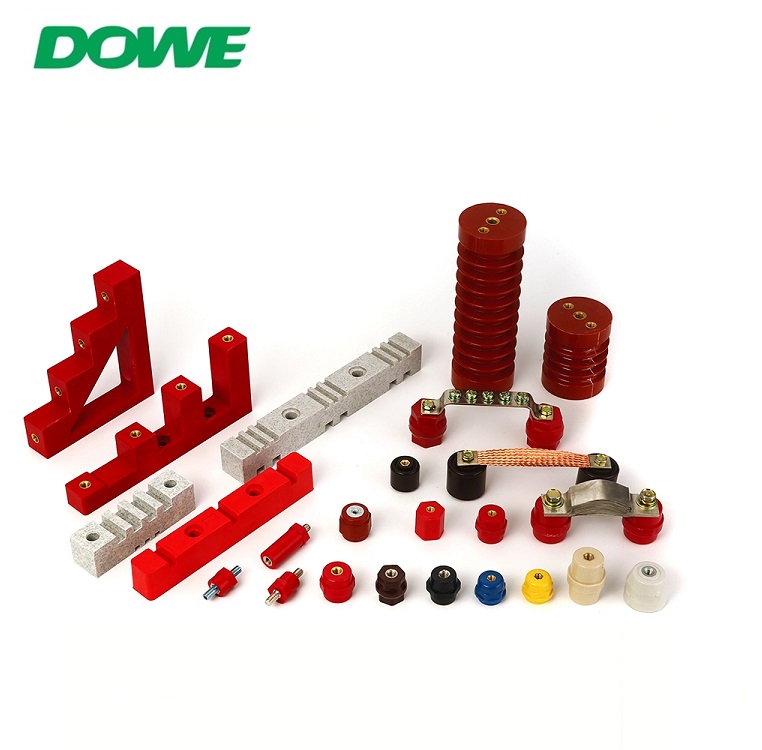
DOWE's low-voltage standoff insulator series covers 660V to 1,000V AC applications across standard switchgear, distribution panelboards, and motor control centers. This includes the SM Series with its ribbed conical profile that extends creepage surface by 35% to 60% without increasing installation height, the SEP Series engineered for high-vibration industrial machinery and mining power boxes, the MNS Series contoured specifically for ABB MNS 2.0/3.0 drawer-type cabinets, the CT/CJ Series for layered multi-phase busbar arrangements in constrained enclosure depth, the D/C/EN Series for European-style distribution panels and railway trackside power, and the TSM/MG Series miniature standoffs for relay boards and smart meter boxes.
SB / JYZ High-Voltage DC Series
For the electrification transition, DOWE manufactures the SB/JYZ hexagonal base standoff family, purpose-built for high-voltage DC systems up to 1,500V DC, including solar PV, battery energy storage, EV charging, and DC fuse applications. The hexagonal anti-rotation base allows technicians to hold the base steady with an open-end wrench while applying full tightening torque, preventing rotational shear stress on the mounting plate. This series spans seven dimensional models — SB14 through SB60 — each calibrated for specific body diameters, height ranges, and thread sizes from M5 through M16, with tensile pull-out resistance greater than 8,000 N for M8/M10 inserts. DOWE exports millions of SB/JYZ insulators annually to solar inverter OEMs, battery pack integrators, and switchgear builders across Germany, the United States, Spain, Italy, the Netherlands, and Canada.
Busbar Support & Clamping Systems
Rated up to 1,100V AC and 6,300A, DOWE's busbar support and clamping systems retain multiple parallel phase conductors in fixed spacing to resist electrodynamic short-circuit repelling forces. The EL Series offers pre-molded spacing configurations (EL-130, EL-170, EL-210) for 3-pole and 4-pole busbars from 250A to 2,500A, with dimensional matching documented for ABB MNS, Schneider Blokset, and Siemens Sivacon platforms. The HC Heavy Duty line withstands short-circuit currents up to 100kA/1s for utility substations, the XD3-D4 Series accommodates variable busbar bar-counts from 1 to 3 bars per phase, and the Single/Three Phase line provides cost-effective modular clamps from 100A to 1,250A for branch take-offs.
Medium-Voltage Insulator Series
Bridging low-voltage distribution and high-voltage transmission, the DW Series serves 3.6 kV to 12 kV AC clean indoor switchgear and secondary distribution substations, while the EL MV Series uses vacuum-cast epoxy resin for 3.6 kV to 7.2 kV AC applications in harsh, humid, and dusty industrial environments, ring main units, and VFD drive cabinets. The EL MV Series achieves partial discharge of less than 5 pC at 1.1 Um and epoxy volume resistivity greater than 10^14 Ω·cm.
Manufacturing Capability and Global Scale
DOWE has spent over two decades engineering insulation solutions for global power distribution infrastructure. Production infrastructure includes automated BMC/SMC hydraulic compression molding workshops, vacuum casting facilities for epoxy resin using automated pressure gelation, automated CNC thread tapping units, and a certified high-voltage dielectric test laboratory. The company's low-voltage standoff production capacity exceeds 500,000 units per month, and its business reaches more than 60 countries across Europe, the Americas, the Middle East, Southeast Asia, and Australia from its headquarters in Huangqijia Village, Liushi Town, Yueqing Economic Development Zone, Zhejiang Province, China.
Certifications That Validate Performance
Beyond UL94-V0, DOWE's components comply with IEC 61439-1/2, IEC 60664-1, IEC 60273, IEC 60071, and IEC 60815 standards, along with RoHS (2011/65/EU & 2015/863), REACH (EC 1907/2006), CE clearance, and UL 746B Relative Thermal Index certification. Each type is further validated through SGS third-party type testing, giving panel builders documented evidence for dielectric withstand at 3,500V AC, surge impulse margin up to 8kV under Overvoltage Category IV, and dielectric loss angle tan δ no greater than 0.005 at 20°C.
Conclusion: Choosing a Reliable UL94-V0 Busbar Insulator Partner
For organizations evaluating a UL94-V0 busbar insulator manufacturer, the selection criteria extend beyond the certification itself to encompass dimensional accuracy, thermal and dielectric performance, and the ability to supply documented third-party test evidence. DOWE Electric's combination of flame-retardant BMC/SMC/DMC formulations, OEM-matched product lines, and a verified certification portfolio positions the company as a credible option for power distribution infrastructure projects spanning solar, battery storage, EV charging, and traditional switchgear applications.
http://www.busbarinsulator.com
Yueqing City DUWAI Electric Co.,LTD