
 0
0
 0
0
Why Food Brands Are Rethinking Thermoformed Packaging Sourcing
Food brands evaluating thermoformed packaging suppliers today face a familiar set of trade-offs: conventional fossil-based plastics remain dependent on fossil resources, persist in the environment long after use, and create end-of-life waste management challenges. At the same time, many emerging bio-based and biodegradable material systems still struggle to balance performance, processability, cost, and large-scale commercialization. For brand owners, packaging manufacturers, OEM/ODM partners, and retail channel decision-makers, the question is not simply "is this material bio-based," but whether a supplier can deliver consistent sheet quality, reliable thermoforming performance, and a credible path to commercial-scale supply.
Shanghai Sipeng Technology Ltd., operating under the brand SYNLIFE, was established in May 2022 in Shanghai, China, as a bio-based materials technology company built on synthetic biology and materials engineering. Rather than positioning itself solely as a material synthesis company, SYNLIFE develops materials around actual processing conditions and end-use requirements — an approach that directly addresses the performance and processability concerns that food brands raise when evaluating thermoformed packaging options.
A Material Platform Built Specifically for Thermoforming
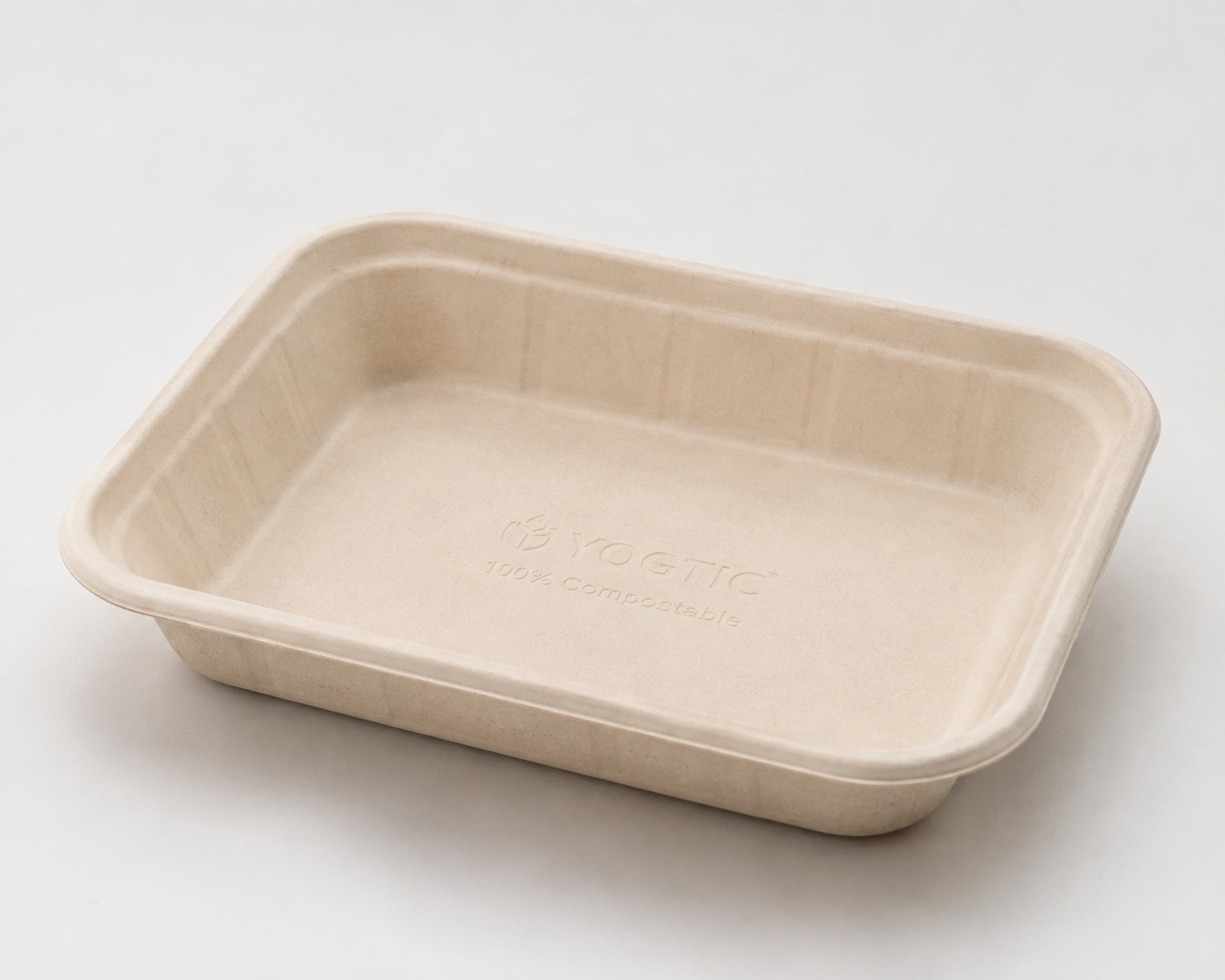
Within SYNLIFE's bio-based resin portfolio, the YOGTIC® Series includes a product line developed specifically for sheet extrusion and thermoforming applications: the YOGTIC-08 / 18 Thermoforming Series.
This series is positioned as a bio-based material solution developed for sheet extrusion and thermoforming processes, with key features that matter directly to food packaging converters and brand owners:
- Good sheet flatness, which supports consistent thermoforming output and reduces downstream processing issues
- Balanced rigidity and toughness, helping finished trays and containers withstand handling and transport
- Design around commercial thermoforming processes, meaning the material grade is developed with actual manufacturing equipment and conditions in mind, rather than optimized only in a laboratory setting
The stated applications for this series include food trays, packaging trays, and other thermoformed products — directly aligned with what food brands are searching for when they look for a thermoformed food packaging supplier.
It is worth noting that specific processing conditions should always be determined according to the relevant material grade and the equipment being used, since performance and processing parameters can vary by product grade and application. This is consistent with SYNLIFE's broader platform philosophy: materials are developed with commercial manufacturing and processing compatibility in mind, and depending on product grade and application, they can be adapted to conventional injection molding, extrusion, film processing, thermoforming, and spinning equipment.
From Laboratory to Commercial Scale: Why This Matters for Food Brands
A recurring concern among food brands sourcing bio-based thermoformed packaging is whether a supplier can move beyond pilot-scale samples into reliable, repeatable commercial supply. SYNLIFE's development history offers relevant context. The company's founding and technical teams accumulated long-term research experience in synthetic biology, biological manufacturing, and bio-based materials prior to the company's formal establishment, with research backgrounds connected to synthetic biology research associated with Shanghai Jiao Tong University.
Since 2022, SYNLIFE has pursued accelerated development and commercialization of bio-based resin, film, textile, consumer-product, and other material application platforms. The company has also built out tangible scale: a team of more than 50 employees spanning synthetic biology, material development, product development, and commercialization; a Shanghai R&D Center exceeding 2,000 square meters; and manufacturing and supply-chain capabilities located in Jiangsu, including Nantong. This combination of upstream biological manufacturing capability, materials engineering expertise, and downstream manufacturing footprint is relevant for food brands evaluating whether a bio-based thermoforming partner can support both initial development and ongoing production volume.
Financially, SYNLIFE completed a Pre-A financing round of nearly RMB 100 million in October 2024, followed by a Pre-A+ financing round of tens of millions of RMB in May 2025, indicating continued investment in its material development and commercialization capabilities.
Technical and Service Capabilities Behind the Thermoforming Series
SYNLIFE's capability system spans several interconnected areas that support the development and supply of thermoformed packaging materials:
Synthetic biology capabilities, including strain development, metabolic pathway optimization, fermentation process development, and biological manufacturing, form the upstream foundation for bio-based feedstocks.
Materials engineering capabilities — polymer formulation, modification, compounding, and processing optimization — are then applied to translate upstream biological outputs into application-ready resin grades such as the YOGTIC-08/18 series.
Application engineering capabilities focus development around real manufacturing processes, including injection molding, extrusion, film processing, thermoforming, and spinning, rather than treating material synthesis and application development as separate steps.
On the service side, SYNLIFE offers a range of models relevant to food brands and converters, including raw material supply, material customization, joint product development, application development, finished product OEM/ODM, process and technical support, and pilot and scale-up support. This service scope — from material and formulation development through processing optimization, product design, testing support, scale-up, and commercialization — is designed to support food brands at whatever stage they are in, whether evaluating a first pilot run of thermoformed trays or scaling an established packaging line.
Compliance and Certification Considerations for Food Packaging
Food-contact packaging carries specific regulatory and testing requirements that vary by market. SYNLIFE notes that food-contact products can be tested or evaluated against applicable Chinese, EU, and U.S. requirements depending on the specific product and target market, and that product-specific compostability, bio-based content, and food-contact compliance testing or certification is pursued where applicable. For food brands sourcing thermoformed packaging for international distribution, this market-by-market approach to compliance is a practical consideration, since certification bodies, standards, certificate numbers, and applicable product grades should always be specified when certification claims are used externally.
Beyond the thermoforming series itself, SYNLIFE's film and packaging work — including the ZeRoll® compostable cling film platform and ongoing development of high-barrier films for modified-atmosphere meat packaging — reflects a broader commitment to food-contact material development across multiple packaging formats, not solely rigid thermoformed trays.
Evaluating a Thermoformed Packaging Supplier
For food brands conducting supplier due diligence, several questions are worth asking directly: Does the material grade offer documented sheet flatness and balanced rigidity-toughness characteristics suited to the intended tray or container design? Is the processing condition guidance specific to the material grade and the brand's existing equipment? Can the supplier support the full pathway from formulation development through pilot runs to commercial-scale supply? And are compostability, bio-based content, or food-contact compliance claims backed by product-specific, third-party testing rather than general statements?
SYNLIFE's YOGTIC-08/18 Thermoforming Series, backed by the company's integrated synthetic biology, materials engineering, and application engineering capabilities, along with its Shanghai R&D infrastructure and Jiangsu-based manufacturing and supply-chain presence, offers food brands a documented, application-oriented option to evaluate as part of this due diligence process. As with any material transition, performance validation, processing trials on the brand's specific equipment, and confirmation of applicable certifications remain essential steps before full-scale adoption.
https://www.synlifeglobal.com/
SYNLIFE