

 0
0
 0
0
Hepatic tumor biomarker testing sits at the center of hepatocellular carcinoma (HCC) management, where serum markers are used for screening, confirmatory support, treatment-response tracking, and recurrence detection after treatment. Tumor markers in this setting are often proteins, and the practical question for laboratories and clinical departments is not whether to test, but how to combine markers and which platform can deliver results quickly enough to be clinically useful. This review examines the diagnostic gap that single-marker testing leaves open, the combined panels that close it, and the Poclight C5000 Dry Micro System that supports the workflow.
The Diagnostic Gap That AFP Alone Leaves Open
Alpha-fetoprotein (AFP) is the anchor marker for hepatocellular carcinoma, and it carries a clear confirmatory threshold: levels > 400 ng/mL together with imaging confirm HCC. Its limitation is equally well documented. In early hepatocellular carcinoma, AFP shows low sensitivity with 30–40% false negatives, which means relying on AFP alone can miss early-stage disease.
Screening strategy already reflects this. A Chinese Expert Consensus highlighted biannual ultrasound and AFP as a cost-effective HCC screening strategy — an approach that keeps AFP in the pathway while acknowledging that its standalone performance is insufficient for early detection.
Combined Detection Panels Close the Sensitivity Gap
The Hepatocellular Carcinoma Combined Detection Panel (AFP + AFP-L3 + DCP) is built specifically to improve on AFP alone for early detection. Across the three markers, the panel reports sensitivity of 70–85% and specificity of 80–90%, supporting early detection compared with AFP by itself.
The clinical logic is straightforward and mirrors the source data: a single marker carries an inherent false-negative risk, while a combined marker panel compensates for the limitations of individual markers and raises both sensitivity and specificity for a defined cancer type. In liver cancer, that combination is AFP + AFP-L3 + DCP.
The C5000 Dry Micro System
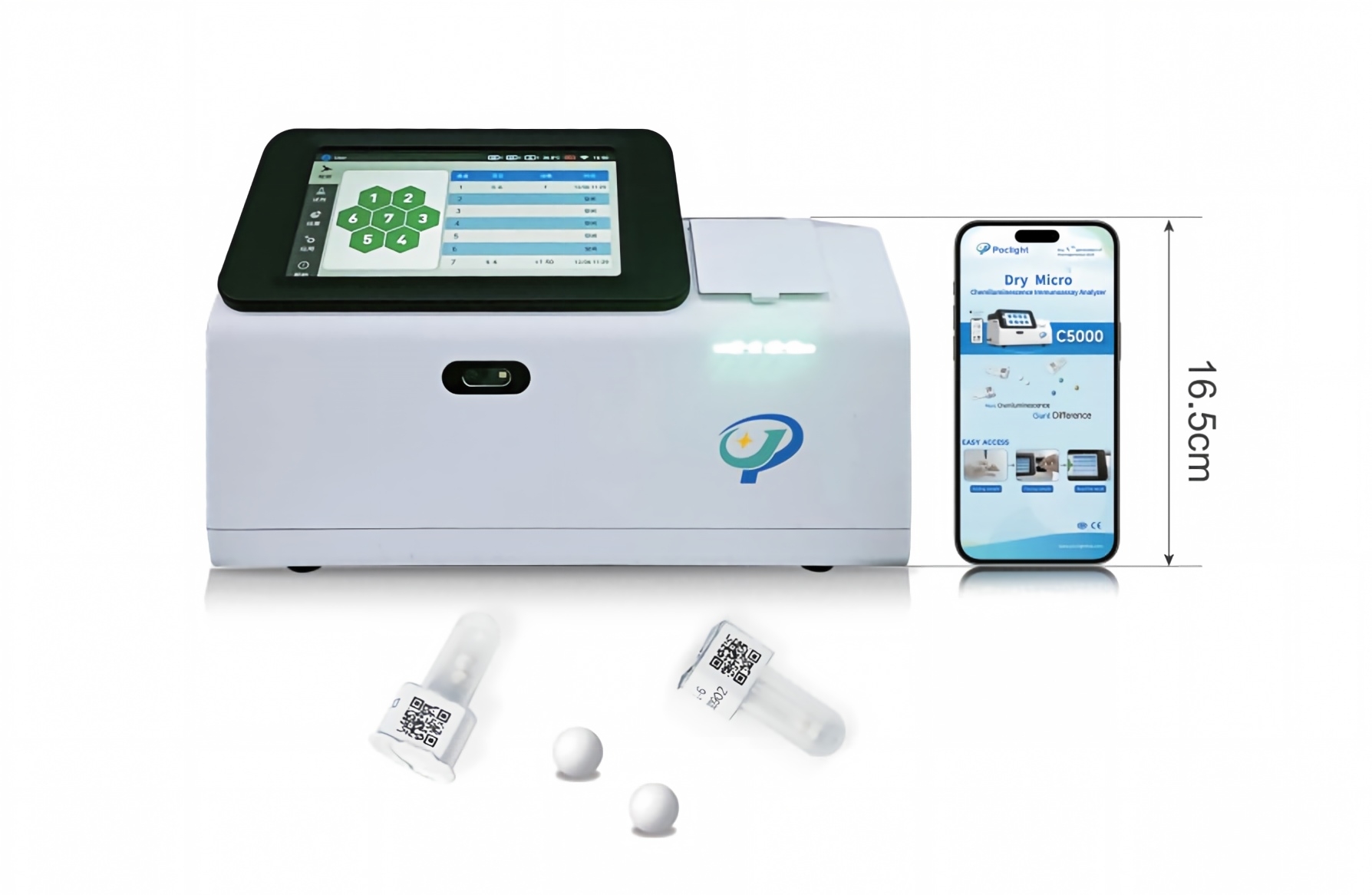
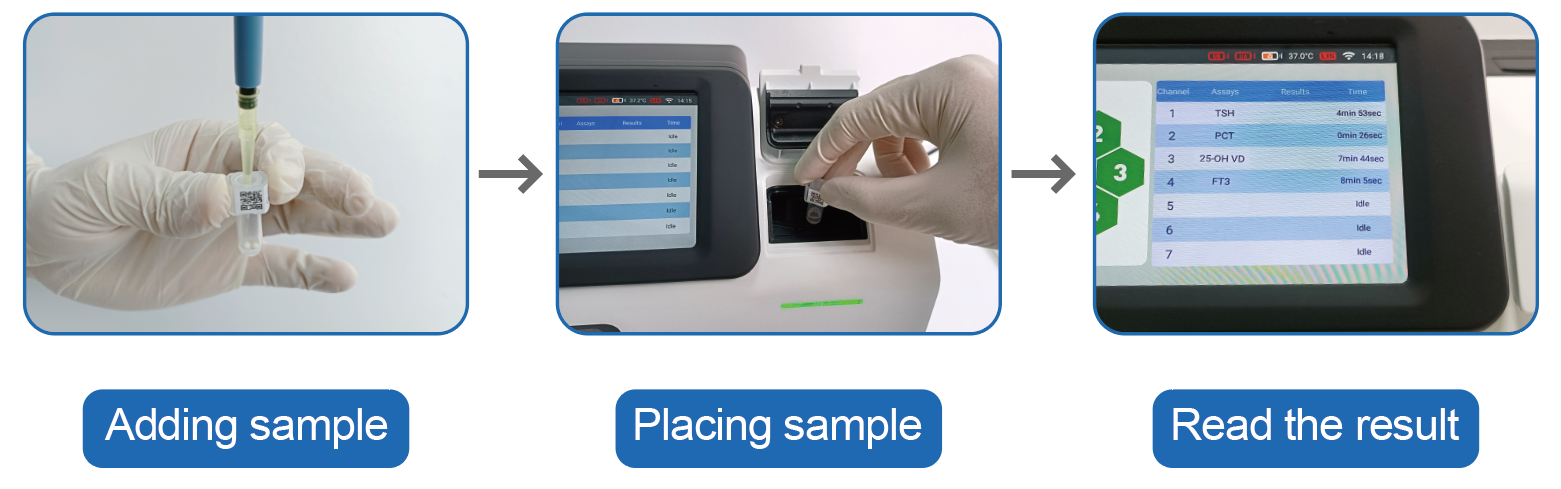
The C5000 Dry Micro System is a semi-automatic, portable dry micro detection system for rapid serum tumor marker testing. It addresses a recurring set of clinical pain points: the need for rapid results, simple operation, low-maintenance reagent handling, and real-time information sharing inside hospital information systems.
Technical metrics:
- First sample result: 3 minutes
- Channel capacity: 7-channel
- Accuracy: CV < 5%
- Throughput: 80 tests/hour
- Weight: ≤ 8.5 kg
Technical highlights: the system uses a dry micro reagent format with wash-free separation, no magnetic beads, and no complex liquid path, which reduces complexity and operating cost. Complementary reagents are available in both lyophilized form — with room temperature storage and transport — and in liquid form. The instrument is operated through a touch screen, supports LIS/HIS transmission, and enables real-time information sharing. Product documentation also lists an accuracy figure of CV < 3% alongside its technical highlights and key features.
A Complete Serum Tumor Marker Portfolio
Hepatic testing does not occur in isolation, and the broader portfolio shows how the liver panels fit into a 16-item product and service matrix spanning serum tumor marker tests, clinical combined detection solutions, and diagnostic systems.
Individual serum tumor marker tests (7):
- tPSA (Total Prostate-Specific Antigen)
- fPSA (Free Prostate-Specific Antigen)
- CEA (Carcinoembryonic Antigen)
- AFP (Alpha-Fetoprotein)
- CYFRA21-1 (Cytokeratin 19 Fragment)
- CA19-9 (Carbohydrate Antigen 19-9)
- CA125 (Cancer Antigen 125)
Clinical combined detection panels (8):
- Prostate Cancer Combined Detection Panel (tPSA + fPSA, F/T ratio)
- Hepatocellular Carcinoma Combined Detection Panel (AFP + AFP-L3 + DCP)
- NSCLC Squamous Combined Detection Panel (CYFRA21-1 + SCC)
- NSCLC Adenocarcinoma Combined Detection Panel (CEA + CYFRA21-1 + CA125)
- Gastric Cancer Combined Detection Panel (CEA + CA19-9 + CA72-4)
- Pancreatic Cancer Combined Detection Panel (CEA + CA19-9 + CA125)
- Colorectal Cancer Combined Detection Panel (CEA + CA19-9 + CA242)
- Ovarian Cancer Combined Detection Panel (CA125 + HE4)
Two data points illustrate the panel design philosophy that also governs the liver panel. In the Prostate Cancer Combined Detection Panel, the F/T ratio reduces false positives by 30% in the gray zone. In the Ovarian Cancer Combined Detection Panel, combining CA125 with HE4 improves specificity to 95% through the ROMA index. In each case, the combined-detection advantage comes from layering markers rather than relying on one.
Clinical Consensus and Market Recognition
Recognition for this marker set is documented across multiple regions:
- PSA Consensus 2024 (UK): the PSA blood test is the first step in the prostate cancer diagnostic pathway; it is a low-cost, safe, and effective way of identifying men who would benefit from further testing.
- Clinical Practice Guidelines (US): Carcinoembryonic antigen (CEA) level should be obtained before elective surgery of colon cancer for risk management afterwards.
- Chinese Expert Consensus (CN): a meta-review of HCC screening cost-effectiveness highlighted biannual ultrasound and AFP as a cost-effective strategy.
- Chinese Expert Consensus (CN): for NSCLC, a meta-analysis concluded that CYFRA21-1 alone shows less positive correlation in NSCLC prognosis, while the combination of CEA and SCC helps distinguish early-stage NSCLC from benign lung disease presenting with suspicious pulmonary masses.
Industry Coverage and Customer Types
The product and service matrix covers Urology, Gastrointestinal Surgery, Gynecology, Oncology Department, Respiratory Department, Hepatobiliary Surgery, and Gastroenterology. For hepatic tumor biomarker testing, the directly relevant specialties are Hepatobiliary Surgery, Gastroenterology, and the Oncology Department. Customer types are hospital clinical departments and laboratory information system environments.
Why Format and Workflow Matter in Liver Marker Testing
Serial measurement is intrinsic to liver cancer management — recurrence detection after treatment depends on tracking marker levels over time, just as serial postoperative CEA measurements predict recurrence in gastrointestinal cancers. That workflow places a premium on turnaround and integration. A first sample result in 3 minutes, 80 tests/hour throughput, a ≤ 8.5 kg portable footprint, and LIS/HIS transmission with real-time information sharing let departments fit marker testing into routine clinical decision-making rather than treating it as a batch process.
For teams evaluating hepatic tumor biomarker testing options, the C5000 Dry Micro System together with the AFP + AFP-L3 + DCP panel offers a coherent path: markers selected for documented combined sensitivity and specificity, and instrumentation designed around the speed, simplicity, and information-sharing requirements of the departments that order them.
www.poclight.com
Nanjing Poclight Biotechnology Co., Ltd