
 0
0
 0
0
The evolution of outdoor heating technology has reached a critical inflection point. As camping enthusiasts, glamping operators, and off-grid adventurers demand more from their equipment, the limitations of conventional wood stoves have become increasingly apparent. Traditional designs struggle with excessive smoke production, inefficient fuel consumption, and inconsistent heat output—challenges that become dangerous in enclosed tent environments and frustrating in extreme weather conditions.
The Thermal Efficiency Challenge in Portable Heating
Outdoor wood stoves face a fundamental engineering paradox: maximizing heat output while minimizing weight and volume. Conventional designs typically achieve only 50-60% combustion efficiency, with significant energy loss through incomplete fuel burning and excessive smoke generation. This inefficiency translates directly into practical problems—users must carry more fuel, endure longer heating times, and tolerate smoke that compromises both comfort and safety.
In tent camping scenarios, these limitations intensify. Incomplete combustion produces creosote buildup in chimney systems, creating maintenance burdens and potential fire hazards. Smoke leakage at pipe joints can introduce carbon monoxide into living spaces, while inadequate heat exchange systems fail to capture and distribute thermal energy effectively.
Secondary Combustion: A Proven Solution
The most significant advancement in portable wood stove technology involves secondary combustion systems. This engineering approach introduces preheated air into the upper combustion chamber, igniting volatile gases and particulates that escape primary combustion. The result is a dramatic improvement in both thermal efficiency and emissions reduction.
Secondary combustion technology can increase heat output by 20-45% compared to traditional single-stage designs while reducing visible smoke by up to 80%. This dual benefit addresses both performance and environmental concerns, making modern wood stoves viable for sensitive applications including national park camping and residential backyard use.
The technical implementation requires precise airflow management. Secondary air intakes must deliver oxygen at optimal temperatures and velocities to sustain gas-phase combustion without cooling the primary firebox. Advanced designs incorporate calibrated venting systems that maintain this balance across varying fuel loads and environmental conditions.
Inverted Chimney Architecture for Smoke Management
Smoke leakage represents one of the most persistent problems in tent stove design. Traditional chimney connections rely on simple stacking or compression fittings that develop gaps under thermal expansion and mechanical stress. The solution lies in inverted chimney architecture—a design approach where each pipe section nests inside the one below it, creating a gravity-assisted seal.
This configuration prevents creosote and condensate from leaking at joints, instead channeling all byproducts through the complete exhaust pathway. The inverted design also simplifies field assembly, as sections lock together without requiring tools or sealants. For commercial operators managing multiple camp sites, this translates into reduced maintenance labor and improved guest safety.
Material Science in Extreme-Condition Applications
The choice of construction materials fundamentally determines stove longevity and performance. Food-grade 304 stainless steel has emerged as the industry standard for premium applications, offering superior corrosion resistance and thermal stability compared to mild steel alternatives. Thickness specifications matter significantly—3.0mm gauge steel provides the thermal mass necessary for sustained heat radiation while maintaining reasonable portability.
For specialized applications requiring maximum weight reduction, titanium alloy construction offers a compelling alternative. Aviation-grade titanium delivers comparable strength at approximately 45% the weight of stainless steel, making it ideal for backpacking and alpine expeditions where every gram matters. However, titanium's higher thermal conductivity requires careful insulation design to prevent excessive heat loss and exterior surface temperatures.
Carbon steel remains relevant for budget-conscious applications and environments where weight is not a primary concern. When properly treated with high-temperature coatings, carbon steel stoves provide adequate performance for casual camping and seasonal use, though they require more diligent maintenance to prevent rust formation.
Certification Standards and Safety Compliance
The European CE EN 13240 standard represents the most rigorous testing protocol for solid fuel heating appliances. This certification requires comprehensive evaluation of combustion efficiency, emissions levels, structural integrity, and safety mechanisms. Achieving EN 13240 compliance demonstrates that a wood stove meets strict requirements for CO emissions (typically below 0.12% at nominal heat output), particulate emissions, and thermal performance.
For manufacturers serving global markets, EN 13240 certification provides crucial market access to European Union countries and signals quality commitment to North American and Asian buyers. The certification process involves third-party laboratory testing of production units, ensuring consistency rather than prototype-only performance.
Additional certifications include GB 4806.9 for food contact safety—relevant for stoves used in cooking applications—and various regional standards governing installation clearances and carbon monoxide detection requirements.
Application-Specific Design Considerations
Different outdoor scenarios demand distinct engineering priorities. Hot tent camping requires compact footprints and rapid deployment mechanisms, as users frequently relocate campsites and need heating operational within minutes of arrival. Ten-second setup systems using pre-assembled leg assemblies and tool-free pipe connections address this need.
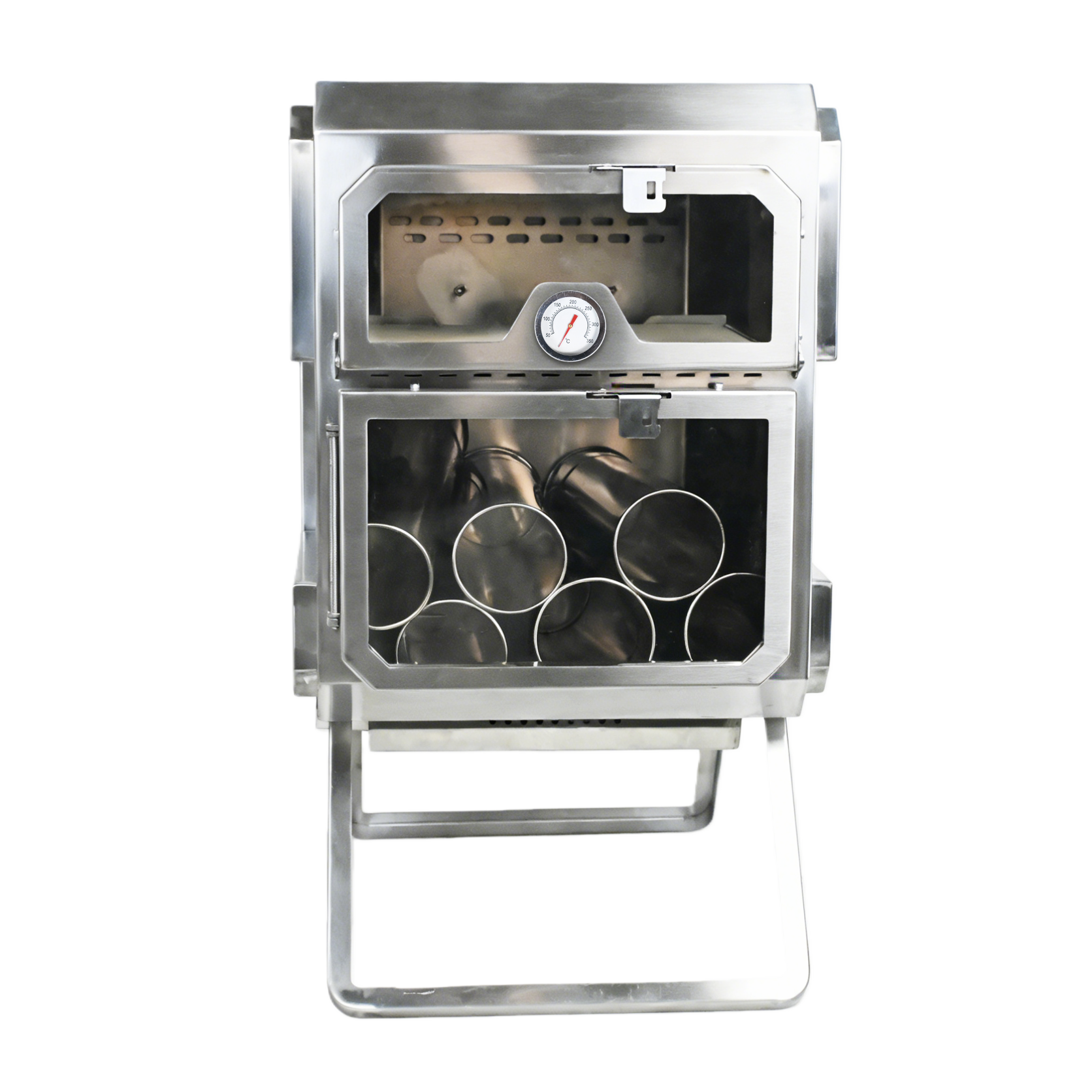
Glamping operations prioritize aesthetic integration and extended burn times. Panoramic glass panels transform functional heaters into social focal points, while large fireboxes accommodate full-length logs for 6-8 hour burns with minimal tending. These commercial-grade units typically incorporate ash drawer systems for simplified cleaning between guest stays.
Ice fishing shelters present unique challenges including extreme cold starts, high-altitude operation, and space constraints. Specialized designs optimize for rapid temperature rise in small enclosures while incorporating safety features like automatic damper controls and tip-over shutdown mechanisms.
The INBESTCAMP Engineering Approach
Suzhou Tuoshenghe Mechanical and Electrical Technology Co., Ltd., operating under the INBESTCAMP brand, has developed a comprehensive technical portfolio addressing these diverse requirements. With 127 patents focused on combustion optimization and thermal management, the company combines secondary combustion technology with inverted chimney designs to deliver measurable performance improvements.
Their engineering team—comprising over 20 specialists in materials science, thermodynamics, and manufacturing technology—operates from a 5,000-square-meter intelligent factory equipped with robotic welding systems and precision laser cutting equipment. This infrastructure supports annual production capacity exceeding 500,000 units while maintaining the flexibility for rapid prototyping, with custom designs moving from concept to functional prototype within seven days.
INBESTCAMP's position as the first Chinese manufacturer to achieve CE EN 13240 certification demonstrates their commitment to meeting international safety and performance standards. This technical rigor extends to their OEM/ODM services, where they've helped partners including Japanese brand Hakutō achieve 5,000-unit first-month sales and assisted Norwegian glamping operators in increasing single-product margins by 60% through customized thermal solutions.
Global Supply Chain Integration
Modern outdoor equipment businesses require more than quality products—they need logistics infrastructure that supports rapid market response and inventory efficiency. INBESTCAMP's tri-hub warehouse network, with facilities in Los Angeles, Hamburg, and Panama, enables regional stock positioning that reduces shipping times and costs for B2B partners across North America, Europe, and Latin America.
This distribution architecture particularly benefits e-commerce sellers managing FBA inventory, where shipping dimensional weight and restocking lead times directly impact profitability. The company's modular, flat-pack designs maximize container utilization while their localized inventory reduces the capital tied up in trans-Pacific shipping cycles.
Future Trajectory in Thermal Technology
The outdoor heating industry continues evolving toward multi-fuel flexibility and smart integration. Contemporary designs increasingly incorporate adapter systems allowing seamless switching between wood, charcoal, and gas fuel sources, providing users operational flexibility across varying fuel availability scenarios.
Emerging developments include integrated temperature monitoring with smartphone connectivity, automated damper controls responding to real-time combustion conditions, and modular expansion systems allowing users to scale heating capacity by connecting multiple units. These innovations build upon the fundamental thermal efficiency improvements that secondary combustion and advanced materials have already delivered.
Conclusion
High-efficiency camping wood stoves represent a maturation of outdoor heating technology, where rigorous engineering addresses long-standing performance limitations. Secondary combustion systems, precision airflow management, inverted chimney architecture, and certified construction standards have transformed wood stoves from basic campfire alternatives into sophisticated thermal appliances suitable for commercial and extreme-condition applications.
For businesses sourcing outdoor equipment—whether e-commerce sellers, brand developers, or hospitality operators—understanding these technical differentiators enables informed selection of products that deliver measurable performance advantages and customer satisfaction. As the outdoor recreation market continues expanding globally, the manufacturers combining proven thermal technology with responsive supply chain capabilities will define the next generation of portable heating solutions.
www.inbestcamp.com
inbestcamp