
 0
0
 0
0
Warehouses present some of the most demanding conditions for fire protection systems. Unlike offices or residential buildings, warehouses often contain large open spaces, high ceilings, storage racks, combustible packaging, pallets, machinery, and a wide variety of stored products. A fire can spread rapidly through these areas, making a properly designed automatic sprinkler system an important part of the overall fire protection strategy.
At the center of this system are fire sprinkler heads. Although sprinkler heads are relatively small components, their type, temperature rating, K-factor, installation position, spacing, and discharge characteristics can have a major impact on system performance.
Choosing fire sprinkler heads for warehouses is therefore not simply a matter of selecting a standard sprinkler and installing it at regular intervals. The sprinkler system needs to be matched to the warehouse layout, storage arrangement, commodity type, ceiling height, rack configuration, water supply, and applicable fire protection requirements.
This guide explains the key factors to consider when selecting and installing warehouse fire sprinkler heads and highlights common mistakes that facility owners and project teams should avoid.
Why Warehouse Fire Protection Requires Special Consideration
A warehouse can have a significantly different fire risk from a typical commercial building.
For example, a warehouse may contain thousands of cardboard boxes, plastic packaging materials, wooden pallets, textiles, chemicals, paper products, or other combustible goods. Products may also be stacked several meters above the floor, allowing a fire to develop vertically as well as horizontally.
Several warehouse characteristics can make sprinkler system design more challenging:
-
High storage heights
-
High ceilings
-
Rack storage
-
Large open floor areas
-
Combustible packaging
-
Different commodity classifications
-
Narrow aisles
-
Large quantities of stored products
-
Forklifts and mobile equipment
-
Mezzanines or elevated platforms
-
Heating and ventilation systems
-
Limited accessibility for maintenance
These conditions mean that automatic fire sprinkler heads must be carefully selected and positioned to provide the required water distribution.
A sprinkler that works well in a low-ceiling office may not be suitable for a high-bay warehouse.
Understanding the Role of Fire Sprinkler Heads
An automatic fire sprinkler head is normally inactive until its heat-sensitive operating element reaches its rated activation temperature.
When a fire develops, hot gases rise toward the ceiling. As the temperature around the sprinkler increases, the thermal element eventually activates. The sprinkler then opens and allows pressurized water to flow through the orifice and onto the deflector.
The deflector distributes the water across a predetermined pattern.
Importantly, sprinkler heads are generally designed to respond to heat, rather than simply detecting smoke. The objective is to discharge water directly in the area where sufficient heat has developed.
In a warehouse, the effectiveness of this process depends on several factors. If the sprinkler is installed too high, incorrectly spaced, obstructed by structural elements, or not matched to the storage hazard, the intended water distribution may not be achieved.
This is why warehouse sprinkler selection should be based on the complete system design.
Step 1: Evaluate the Warehouse Storage Arrangement
Before choosing fire sprinkler heads, the first step is to understand what is actually being stored.
Different commodities can have very different fire characteristics.
A warehouse storing metal components is not necessarily equivalent to a warehouse storing plastic products in cardboard cartons. The quantity, arrangement, packaging, and combustibility of the stored materials can all influence the fire hazard.
The project team should identify:
-
What products are being stored?
-
How combustible are the products?
-
What type of packaging is used?
-
How high will the products be stored?
-
Are products stored on racks or solid shelves?
-
What is the maximum storage height?
-
How wide are the aisles?
-
Are pallets used?
-
Could storage arrangements change in the future?
The answers to these questions help determine the appropriate fire protection approach.
A warehouse should not be designed solely around its current inventory if the facility is expected to change its storage configuration regularly.
Step 2: Consider Ceiling Height
Ceiling height is one of the most important factors when selecting warehouse fire sprinkler heads.
A low-rise warehouse and a high-bay warehouse can have very different sprinkler requirements.
As ceiling height increases, the distance between the sprinkler and the potential fire increases. Hot gases also have more space to travel before reaching the sprinkler. At the same time, water droplets may experience different distribution conditions as they travel downward.
High ceilings can therefore require specialized sprinkler designs, higher discharge capabilities, or additional protection strategies depending on the storage arrangement and applicable design criteria.
Before selecting a sprinkler, determine the actual ceiling height rather than relying on approximate measurements.
Also consider whether the roof is flat, sloped, or irregular, because roof geometry can influence sprinkler placement.
Step 3: Choose the Appropriate Sprinkler Type
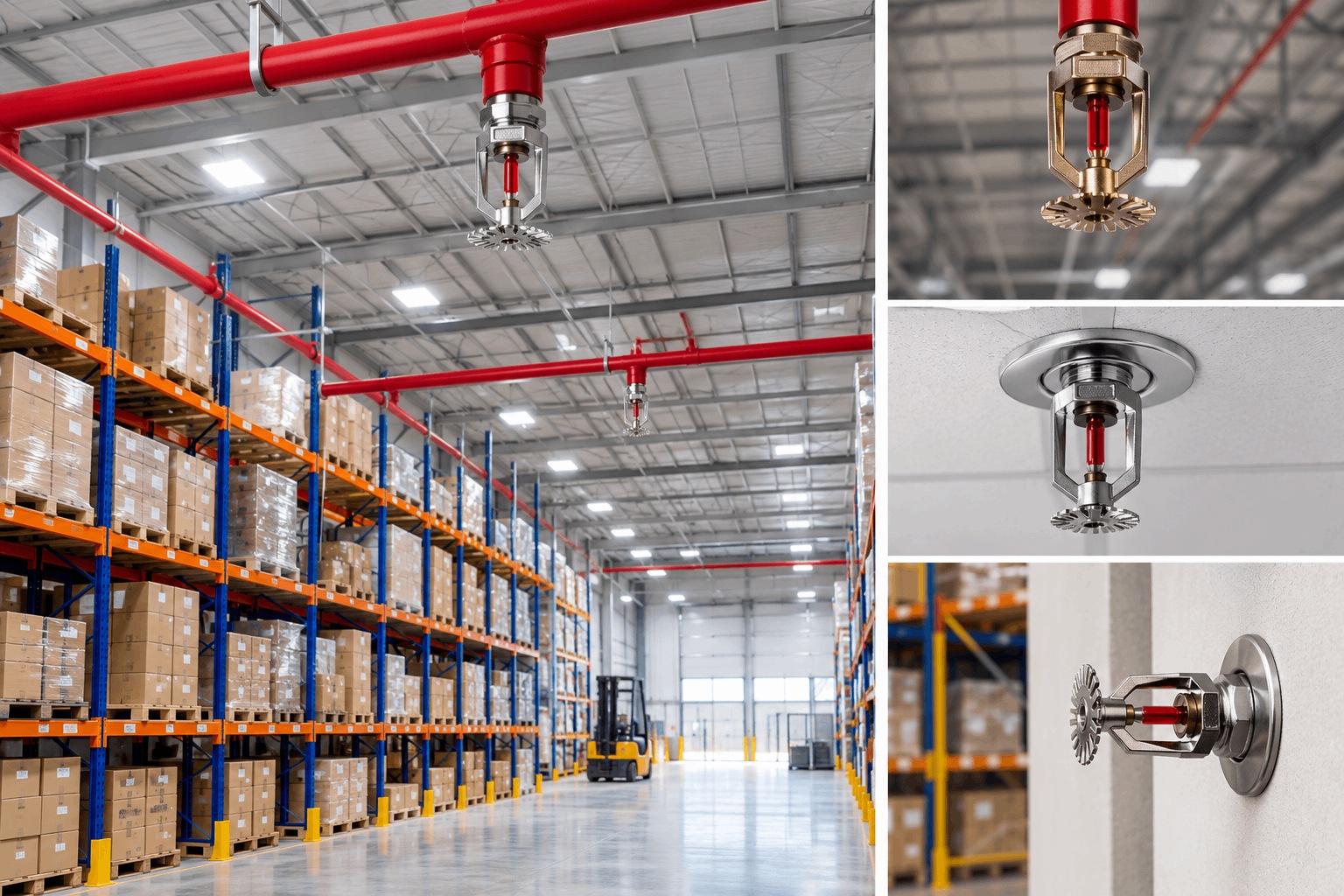
There are several configurations of fire sprinkler heads, including upright, pendent, and sidewall types.
For warehouses, upright sprinkler heads are commonly considered in buildings with exposed piping and structural ceilings.
An upright sprinkler is positioned above the supply pipe, with its deflector designed to distribute water downward after activation.
Pendent sprinkler heads are installed below the supply pipe and discharge water downward. They are frequently used where piping is positioned below or within a finished ceiling system.
Sidewall sprinklers are mounted along walls and are generally more suitable for specific room configurations rather than large open warehouse storage areas.
The correct sprinkler orientation depends on the building structure and system design. Upright and pendent sprinklers should not be treated as interchangeable simply because they have similar basic operating principles.
Step 4: Check the Sprinkler K-Factor
The K-factor is another important specification when selecting an automatic sprinkler head.
In simple terms, the K-factor is related to the amount of water a sprinkler can discharge at a given pressure. Different sprinkler heads are manufactured with different K-factors to meet different hydraulic design requirements.
For warehouse applications, the required K-factor should be determined as part of the hydraulic design.
Choosing a sprinkler with a larger K-factor does not automatically mean that it is a better sprinkler. The sprinkler must work with the available water supply, system pressure, pipe network, required discharge density, and design criteria.
This is why buyers should avoid selecting fire sprinkler heads based solely on the product's K-factor without considering the complete system.
Step 5: Select the Correct Temperature Rating
Temperature rating is another specification that deserves attention.
An automatic fire sprinkler head is designed to activate at a specific temperature range. The selected rating needs to account for the normal ambient temperature around the sprinkler.
For example, warehouse areas exposed to direct sunlight, heating equipment, hot machinery, or other heat sources may experience higher ambient temperatures than standard storage areas.
A sprinkler with an unsuitable temperature rating could potentially activate too early under abnormal ambient conditions or fail to match the requirements of the application.
The temperature rating should therefore be selected based on actual environmental conditions and applicable design requirements.
Step 6: Consider the Warehouse Roof and Structural Elements
Warehouse ceilings often contain numerous structural and mechanical components.
These may include:
-
Steel beams
-
Roof trusses
-
Ductwork
-
Lighting fixtures
-
Ventilation equipment
-
Cable trays
-
HVAC systems
-
Solar equipment
-
Crane structures
These components can create obstructions that interfere with sprinkler discharge or heat collection.
For example, a large beam located between the sprinkler and the protected floor area may affect how water reaches the space underneath it.
Sprinkler placement should therefore be evaluated against the complete reflected ceiling and structural layout.
A common mistake is to determine sprinkler locations from the warehouse floor plan alone. The overhead structure is equally important.
Step 7: Evaluate Rack Storage
Rack storage can significantly influence fire behavior.
High racks can create vertical channels through which heat and flames move rapidly. At the same time, rack structures may interfere with water distribution from ceiling-mounted sprinklers.
Depending on the storage configuration and design requirements, additional sprinkler protection may be needed within storage racks or at other locations.
The design should consider:
-
Rack height
-
Rack depth
-
Longitudinal and transverse flue spaces
-
Aisle width
-
Pallet arrangement
-
Product type
-
Storage density
-
Ceiling height
The warehouse operator should also communicate expected future changes in rack configuration to the fire protection designer.
Changing from low-level storage to high-level rack storage can significantly change the fire protection requirements.
Step 8: Avoid Obstructing the Sprinkler Discharge Pattern
Once the sprinkler type has been selected, installation must preserve the intended discharge pattern.
Objects should not be placed directly below or around the sprinkler in ways that significantly interfere with water distribution.
Common potential obstructions include:
-
Storage racks
-
Large signs
-
Lighting fixtures
-
Ductwork
-
Equipment
-
Suspended structures
-
Temporary storage
-
Building decorations
This is especially important in warehouses because storage layouts frequently change.
Facility managers should establish clear rules to prevent employees from placing inventory or equipment in locations that compromise sprinkler coverage.
A sprinkler system can be correctly installed but later become less effective because the warehouse layout changes.
Step 9: Pay Attention to Sprinkler Spacing
Sprinkler spacing is not simply a matter of making every sprinkler equidistant from the next one.
Spacing depends on the sprinkler's listed coverage, hazard classification, ceiling configuration, obstruction conditions, and applicable design requirements.
If sprinklers are installed too far apart, some areas may receive insufficient water. If they are installed too close together, the system may not be optimized and could create unnecessary installation costs.
The correct spacing should therefore be determined according to the applicable sprinkler listing and system design.
For large warehouse projects, hydraulic calculations and professional fire protection design are essential.
Step 10: Consider Corrosion and Environmental Conditions
Warehouse environments are not all the same.
Some warehouses are clean and dry, while others may experience humidity, condensation, dust, chemicals, salt exposure, or temperature fluctuations.
Material selection can become particularly important in these conditions.
Brass remains a common material for many fire sprinkler heads, particularly in conventional environments. Stainless steel or specially coated sprinkler heads may be considered for applications where increased corrosion resistance is required.
For example, warehouses located near coastal areas may experience salt-laden air. Food processing warehouses may have frequent cleaning procedures and high humidity. Chemical storage facilities may expose equipment to aggressive substances.
The appropriate sprinkler material and finish should be selected according to the actual environmental conditions.
Wet, Dry, and Preaction Systems
The sprinkler head is only one component of the overall fire suppression system.
Warehouses may use different types of sprinkler systems depending on the building's environmental conditions.
Wet Pipe Systems
In a wet pipe system, the piping is normally filled with water.
When a sprinkler activates, water can be discharged immediately.
Wet pipe systems are widely used where temperatures remain above freezing and there is no significant risk of pipe freezing.
Dry Pipe Systems
Dry pipe systems contain pressurized air or nitrogen instead of water in the piping under normal conditions.
They can be useful in areas where freezing temperatures could damage a water-filled system, such as certain cold storage or unheated warehouse environments.
When a sprinkler activates, the system operates in a sequence that allows water to enter the piping and reach the open sprinkler.
Preaction Systems
Preaction systems use additional detection or control arrangements before water is admitted into the sprinkler piping.
They can be considered for specialized applications where accidental water discharge needs to be minimized.
The choice between wet, dry, and preaction systems depends on the facility's environmental and fire protection requirements.
Common Mistakes When Installing Warehouse Fire Sprinkler Heads
Even a high-quality sprinkler may not perform as intended if installation is poorly planned.
Here are some common mistakes to avoid.
Installing Sprinklers Without Considering Storage Height
A warehouse may increase its storage height after the sprinkler system has been installed.
If the new storage arrangement exceeds the assumptions used in the original design, the existing system may no longer provide the intended level of protection.
Ignoring Future Warehouse Changes
Warehouses are dynamic environments.
Racking, inventory, equipment, and aisle layouts can change over time.
Fire protection planning should therefore consider not only the current warehouse configuration but also foreseeable changes.
Blocking Sprinklers With Inventory
Employees may unintentionally stack products too close to sprinkler heads.
This can interfere with water distribution and potentially delay effective fire suppression.
Warehouse management should establish minimum clearance requirements based on the applicable system design and inspection requirements.
Painting or Modifying Sprinklers
Sprinkler heads should not be painted, modified, or otherwise altered without appropriate authorization.
Even seemingly minor modifications can affect thermal response or water distribution.
Choosing Sprinklers Based Only on Price
A cheaper sprinkler is not necessarily the most economical choice.
Material quality, certification, performance, compatibility, service life, and manufacturer reliability should all be considered.
Final Thoughts
Selecting and installing fire sprinkler heads for warehouses requires a comprehensive understanding of the building, storage arrangement, fire hazard, and sprinkler system design.
Important factors include ceiling height, storage height, commodity type, rack configuration, sprinkler orientation, K-factor, temperature rating, water supply, obstruction conditions, environmental exposure, and applicable fire protection requirements.
Upright sprinkler heads may be suitable for many exposed-pipe warehouse environments, while pendent configurations can be useful in buildings with appropriate ceiling arrangements. Specialized sprinkler designs may also be required for high-bay storage or other demanding applications.
Most importantly, warehouse sprinkler selection should never be separated from the overall fire protection system. A sprinkler head's performance depends on its compatibility with the hydraulic design, water supply, piping arrangement, storage configuration, and installation conditions.
For warehouse owners and project managers, the best approach is to work with qualified fire protection professionals and reputable sprinkler manufacturers from the early design stage. By selecting the right automatic fire sprinkler heads and maintaining proper clearance, inspection, and maintenance practices, warehouses can build a more reliable fire protection system designed around their actual operating conditions.
www.yuanqingxiaofang.com
yuanqingxiaofang