
 0
0
 0
0
Industry Background and the Insulation Selection Problem
Switchgear projects around the world continue to face a recurring and costly problem: insulator misselection based on appearance or thread size alone. This practice leads directly to insulation mismatch, certification failures, and field failures once equipment is energized. The consequences ripple outward. EPC contractors managing multi-category procurement face delivery pressure when insulation components do not meet specification. New energy applications, including photovoltaic combiner stations and wind turbine converters, introduce special working conditions that demand higher insulation performance than conventional indoor switchgear. Meanwhile, maintenance buyers responsible for keeping ABB, Siemens, and Schneider equipment operational often struggle to source dimensionally compatible replacement parts, extending downtime and complicating repair timelines.
Addressing this problem requires more than a generic insulator catalog. It requires a manufacturer with focused technical depth across the full voltage spectrum. Yueqing Duwai Electric Co., Ltd., operating under the brand DOWE, has concentrated its research and production on busbar insulators and related switchgear insulation components for 14 years, from 2012 through 2026. That focus has produced a proprietary three-level voltage classification specification designed specifically to prevent the insulation mismatches described above.
Authoritative Analysis: Why Mechanical Strength and Material Selection Matter
The necessity for high mechanical strength in busbar insulators stems from the physical role these components play inside switchgear: they must simultaneously provide dielectric isolation between live conductors and grounded structural parts while withstanding continuous mechanical loading from busbar weight, thermal expansion, and short-circuit forces. An insulator that fails mechanically compromises electrical isolation regardless of its dielectric rating on paper.
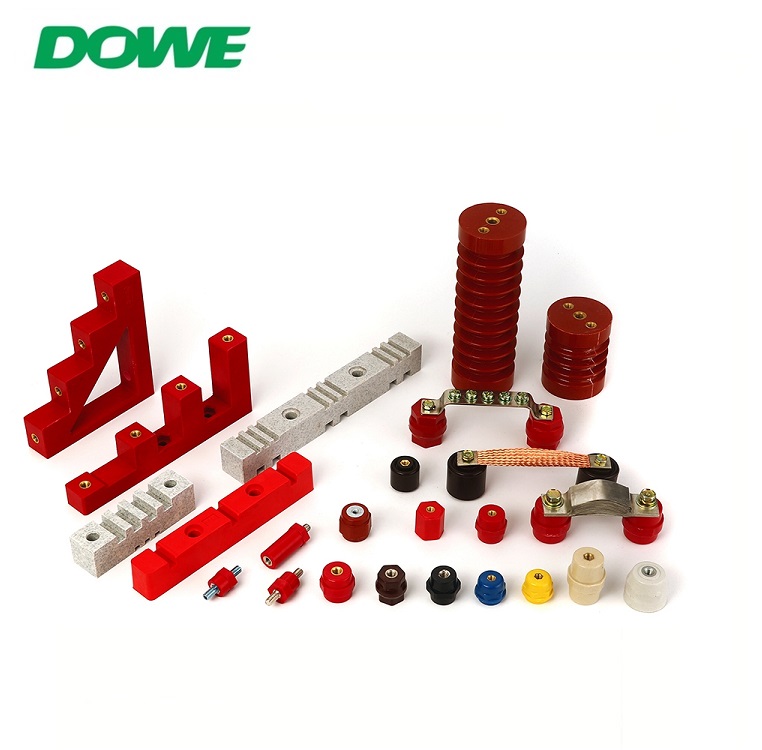
DOWE's product data illustrates how material choice governs this outcome. For low voltage applications spanning 660V to 4500V, BMC/DMC thermosetting composites are specified because they provide high mechanical strength and arc resistance, supporting UL 94 V-0 flame retardancy and CTI tracking resistance of 600 or greater across an operating temperature range of -40°C to +130°C. For high voltage insulation covering 12 kV to 40.5 kV, the principle logic shifts toward epoxy resin construction. DOWE's HV Insulator product uses epoxy resin casting with integral, one-piece molded metal inserts that provide mechanical anchoring for busbar loads. Critically, the manufacturing process itself is vacuum-assisted, which eliminates internal gas bubbles that compression-molded parts commonly trap—voids that become discharge sources under sustained electrical stress. Every high voltage component undergoes 100% partial discharge testing, not lot sampling, reinforcing the mechanical and dielectric integrity claim with a verification standard rather than a marketing statement.
Standard reference points anchor this approach in recognized frameworks: IEC 61439 for low voltage products, UL 94 V-0 flammability rating, RoHS and REACH compliance, GB/T standards, CE certification for medium voltage and busbar support products, and SGS certification across the low voltage, medium voltage, and busbar support lines—together totaling 38+ compliance test certificates. The solution path DOWE applies is its three-level voltage classification specification, which maps insulator parameters to voltage range, pollution degree, mechanical load, and installation environment, giving buyers a structured method to match components to actual operating conditions rather than relying on visual comparison.
Deep Insights: Technology and Market Trends
A closer look at DOWE's medium voltage lineup reveals a broader industry trend toward environment-specific material engineering. The DW Series, built from DMC/BMC/SMC compounds, is positioned for cost-sensitive, indoor clean environments across 3.6–12 kV with mounting heights of 30–130 mm—avoiding over-specification where it is not needed. The EL Series, by contrast, uses DMC/epoxy resin construction rated for 3.6–7.2 kV with mounting heights of 130–360 mm, engineered for harsh, polluted, and outdoor environments where epoxy resin delivers superior tracking resistance compared with thermoset composites alone. This bifurcation reflects a market-wide need: switchgear installed outdoors or in coastal, humid, or dusty conditions requires materials that indoor-only composites cannot reliably match.
A second trend concerns extreme-condition insulation. DOWE's mica insulators (MCA/MCB/MCC series) address applications where organic insulators such as BMC or epoxy cannot survive prolonged heat, fire conditions, or corona stress. Organic materials typically degrade above roughly 150°C and decompose at 200–300°C, whereas the inorganic mineral construction of mica insulators supports continuous service at 500–700°C, intermittent tolerance to 850–1050°C, dielectric strength of 20–70 kV/mm compared with 4–6 kV/mm for polymer insulators, and a high-temperature service life of 15–20+ years versus 5–10 years for organic counterparts. This positions mica insulation as relevant to railway traction systems, aerospace environments, metallurgical furnaces, and marine propulsion systems where fire survival is a functional requirement, not a preference.
A third trend is replacement compatibility as a market demand signal. DOWE's insulators, busbar supports, and HV components offer 1:1 dimensional matching for ABB, Siemens, Schneider, GE, Toshiba, Chint, and Shanghai People switchgear, with standard replacement heights of 60/80/100/120 mm and M8/M10/M12 thread patterns for medium voltage applications. This reflects a genuine industry risk: maintenance teams without access to dimensionally verified alternatives face extended downtime, underscoring why standardization of replacement geometries matters to the broader switchgear ecosystem.
Company Value: Engineering Depth Behind the Specification
DOWE's role in this landscape is built on manufacturing depth rather than breadth for its own sake. The company operates self-developed molds and complete production lines, including BMC/SMC thermoset molding machines, epoxy resin casting lines, and precision machining equipment, supporting simultaneous LV, MV, and HV product lines with coordinated sizing and consistent materials from a single manufacturer. Its catalog spans 120+ standard models with OEM/ODM customization available for non-standard geometries, phase barriers, and thread inserts. Full outgoing inspection covers torque strength, power-frequency withstand voltage, lightning impulse, CTI tracking resistance, bending mechanical load, and UL 94 V-0 flammability, with complete test reports and type test certificates shipped alongside every order. Delivery capability includes small-batch samples within 2–5 working days, full-container batches within 20–25 days, and a 24-hour response window for medium voltage replacement inquiries submitted by photo or drawing. This operational structure is consistent with the company's brand philosophy: "Do What We Can, Do It Well."
Conclusion and Recommendations
Insulator selection is not a peripheral procurement detail; it directly determines certification outcomes, field reliability, and mechanical durability under real operating loads. Switchgear OEMs and panel builders should evaluate insulators against documented voltage range, pollution degree, mechanical load, and installation environment rather than surface appearance. EPC contractors managing multi-category sourcing benefit from suppliers offering coordinated LV, MV, and HV lines with consistent test documentation. Maintenance teams should prioritize dimensionally verified replacement compatibility to reduce downtime risk. As DOWE Electric's product data demonstrates, matching material chemistry—BMC/DMC composites, epoxy resin, or inorganic mica—to actual operating conditions, backed by test-verified compliance documentation, remains the most reliable path to preventing insulation mismatch and field failure.
http://www.busbarinsulator.com
Yueqing City DUWAI Electric Co.,LTD