

 0
 0
What Is a Sodium-Ion Motorcycle Battery?
A sodium-ion motorcycle battery is a starter battery that uses sodium-ion chemistry instead of lead-acid plates or lithium-ion cells to store and deliver the electrical energy needed to crank an engine. The concept addresses a set of long-standing industry pain points: conventional lead-acid starter batteries are heavy, have a relatively short cycle life, perform poorly in cold weather, and require controlled recycling at end of life. Certain lithium-ion chemistries, meanwhile, can lose capacity at low temperatures and may present thermal-runaway risk under some conditions. Sodium-ion technology was developed specifically to target these gaps for motorcycle and passenger-vehicle starting applications.
TZST New Energy Tech Co., Ltd., a Tianjin-based high-tech enterprise operating under the brand name TZST, is one of the companies developing sodium-ion starter battery solutions along this path. Its strategic positioning follows a "Technology + Service + Digitalization" model, with the stated goal of making battery adoption safer, more cold-resistant, and more cost-stable for riders.
The Chemistry Behind Sodium-Ion Batteries, Explained Simply
In plain terms, a sodium-ion battery works on the same basic principle as other rechargeable batteries: ions move between two electrodes through an electrolyte, and that movement generates an electrical current. The difference is the element doing the work. Instead of lead compounds (lead-acid) or lithium compounds (lithium-ion), sodium ions carry the charge back and forth during charging and discharging.
This matters for two practical reasons. First, sodium is an abundant resource, which supports a more stable raw-material supply chain compared to chemistries dependent on scarcer inputs. Second, sodium-ion cells used in TZST's starter batteries are designed as a lead-free and lithium-free formulation, which the company positions as contributing to enhanced safety and vibration resistance in real-world riding conditions.
A built-in battery management system (BMS) is also part of the design, preventing overcharge and over-discharge. This electronic safeguard is a key part of why sodium-ion starter batteries can be engineered for a wide operating temperature range without relying on the owner to manage charging behavior manually.
How a Sodium-Ion Battery Starts a Motorcycle Engine
Starting a motorcycle engine requires a short burst of high current to turn the starter motor over before the engine can run on its own. This is where "cranking performance" comes in. TZST's sodium-ion starter batteries are built for high cranking performance, with a peak discharge capability of over 40C and a motorcycle starter battery starting current of 130A across its SIB-YTX4, SIB-M5L, and SIB-YTX9 models.
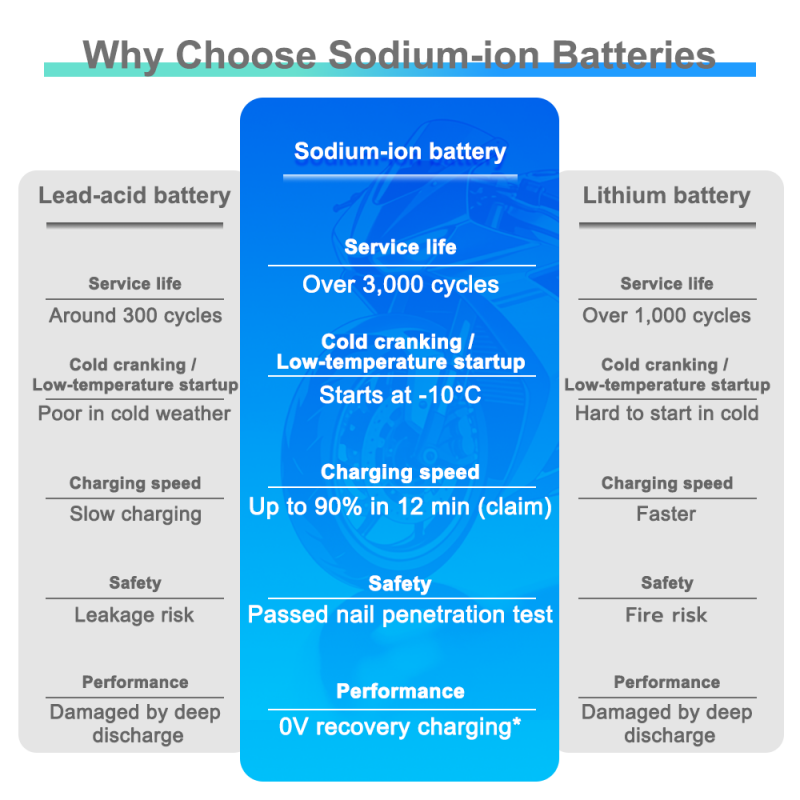
Cold weather is traditionally where starter batteries struggle most, since chemical reactions inside a battery slow down as temperatures drop. TZST's sodium-ion batteries are rated for a wide-temperature performance range of -40°C to 65°C, with instant cold starts as low as -40°C claimed for the technology platform, and the SIB series specifically rated for cold starts down to -20°C with a stable 130A starting current. Independent of the exact model, the company reports that sodium-ion low-temperature discharge capacity retention at -20°C reaches at least 88%, which is a meaningful factor in markets with cold starting seasons.
Charging is also faster in design terms: the technology platform supports up to 20% faster charging under specified test conditions, and sodium-ion charging time can reach a full charge in as little as 20 minutes under certain conditions. Over the life of the battery, TZST's starter batteries are rated for a cycle life of more than 2,000 cycles, compared with the shorter service life typically associated with conventional lead-acid starter batteries.
Sodium-Ion vs. Lead-Acid vs. Lithium-Ion: A Practical Comparison
Looking at the three chemistries side by side on the attributes that matter most to riders:
- Weight: Sodium-ion starter batteries from TZST are designed as a lightweight replacement for lead-acid batteries, at up to approximately one-third the weight, which reduces overall vehicle weight. The SIB-YTX4, for example, weighs only 490 grams.
- Cold starting: Lead-acid batteries typically struggle at low temperatures. TZST's sodium-ion batteries are rated for an operating temperature range as low as -20°C to -40°C depending on the model, with documented low-temperature discharge capacity retention.
- Cycle life: TZST's sodium-ion batteries carry a cycle life rating of over 2,000 cycles, which the company positions as longer-lasting than traditional lead-acid batteries, along with better storage performance and lower self-discharge.
- Safety profile: The sodium-ion chemistry used by TZST is lead-free and lithium-free, built with a BMS to prevent overcharge and over-discharge, and designed for enhanced vibration resistance.
- Total cost of ownership: TZST states that its sodium-ion solution can deliver up to 30% lower total cost of ownership under specified operating conditions, driven by longer cycle life and reduced maintenance needs.
Why Riders Should Care
For riders and fleet operators, the practical implications are straightforward. A battery that starts reliably in cold conditions reduces the frustration and downtime associated with failed cold starts. A lighter battery marginally improves handling, particularly on smaller-displacement motorcycles and scooters. A longer cycle life and lower self-discharge rate mean less frequent replacement and less risk of finding a dead battery after a period of non-use.
TZST backs its sodium-ion starter batteries with documentation that matters for import, export, and compliance purposes, including UN 38.3 test reports, SDS/MSDS documentation, CE documentation where applicable, and a Dangerous Goods Transport Assessment Report. The company has also completed 98 safety and extreme-condition tests as part of its development process, and holds 17 sodium battery patents. It has participated in the formulation of industry standards, including the "Technical Conditions for Starting Lithium-ion Batteries" and the "Technical Conditions for Starting Sodium-ion Batteries," and operates a joint laboratory with Tianjin University of Technology.
With a library of over 100 motorcycle-specific molds, TZST supports small-batch flexible production and rapid prototyping in as fast as 15 days, enabling compatibility across motorcycle models including Honda and Yamaha, as well as motorcycles and scooters up to 125cc. The company exports through Tianjin Port into markets across Africa, Southeast Asia, and Latin America, with localized after-sales support in key Africa and Latin America markets.
Frequently Asked Questions
Is a sodium-ion motorcycle battery safe?
TZST's sodium-ion starter batteries use a lead-free and lithium-free formulation with a built-in BMS that prevents overcharge and over-discharge, and the design is intended for enhanced safety and vibration resistance. The batteries have undergone 98 safety and extreme-condition tests and carry UN 38.3 test reports.
Will a sodium-ion battery start a motorcycle in cold weather?
Yes. TZST's sodium-ion batteries are rated for operation across a wide temperature range, with the SIB series supporting cold starts as low as -20°C and a stable 130A starting current, and the broader technology platform rated for performance from -40°C to 65°C.
How long does a sodium-ion motorcycle battery last?
TZST's sodium-ion starter batteries carry a cycle life rating of over 2,000 cycles, along with better storage performance and lower self-discharge compared with traditional lead-acid batteries.
How much lighter is a sodium-ion battery than lead-acid?
TZST positions its sodium-ion starter batteries as up to approximately one-third the weight of conventional lead-acid starter batteries, with specific models such as the SIB-YTX4 weighing 490 grams.
Can sodium-ion batteries be used as direct replacements for lead-acid batteries?
Yes. TZST offers sodium-ion starter batteries and battery enclosures in Korean-style snap-fit and standard form factors matching common lead-acid sizes, such as YTX4, YTX5, YTX7A, YTX9, YTX12, and several 12N designations, allowing direct-fit replacement without redesigning the battery compartment.
www.tzst.com
天顶星(天津)电子科技有限责任公司