
 0
0
 0
0
Energy efficiency has become one of the most critical performance indicators in modern power distribution systems. As utilities and industrial users face stricter efficiency regulations, rising energy costs, and long-term sustainability goals, transformer core technology is under increasing scrutiny. Among the most impactful developments in this field is the application of amorphous metal cores in oil-filled transformers, which significantly reduce no-load losses and improve overall lifecycle efficiency.
This article explores how amorphous cores work, why they are particularly effective in oil-filled transformers, and how experienced manufacturers like Dingmao (DM) have helped industrialize and scale this technology for global markets.
Why Core Loss Matters in Oil-Filled Transformers
Transformer energy losses are typically divided into two categories: load losses and no-load losses. Load losses depend on current and vary with demand, while no-load losses occur whenever the transformer is energized, regardless of whether it is supplying power.
Oil-filled distribution transformers often operate continuously for decades. Even when demand is low, the transformer core remains magnetized, generating hysteresis and eddy current losses. Over a service life of 25 to 40 years, these no-load losses account for a substantial portion of total energy waste.
Reducing core loss, therefore, delivers long-term benefits:
-
Lower operating energy consumption
-
Reduced heat generation inside the tank
-
Extended insulation and oil life
-
Lower carbon emissions across the grid
This is where amorphous metal cores offer a clear advantage over conventional silicon steel cores.
What Is an Amorphous Core?
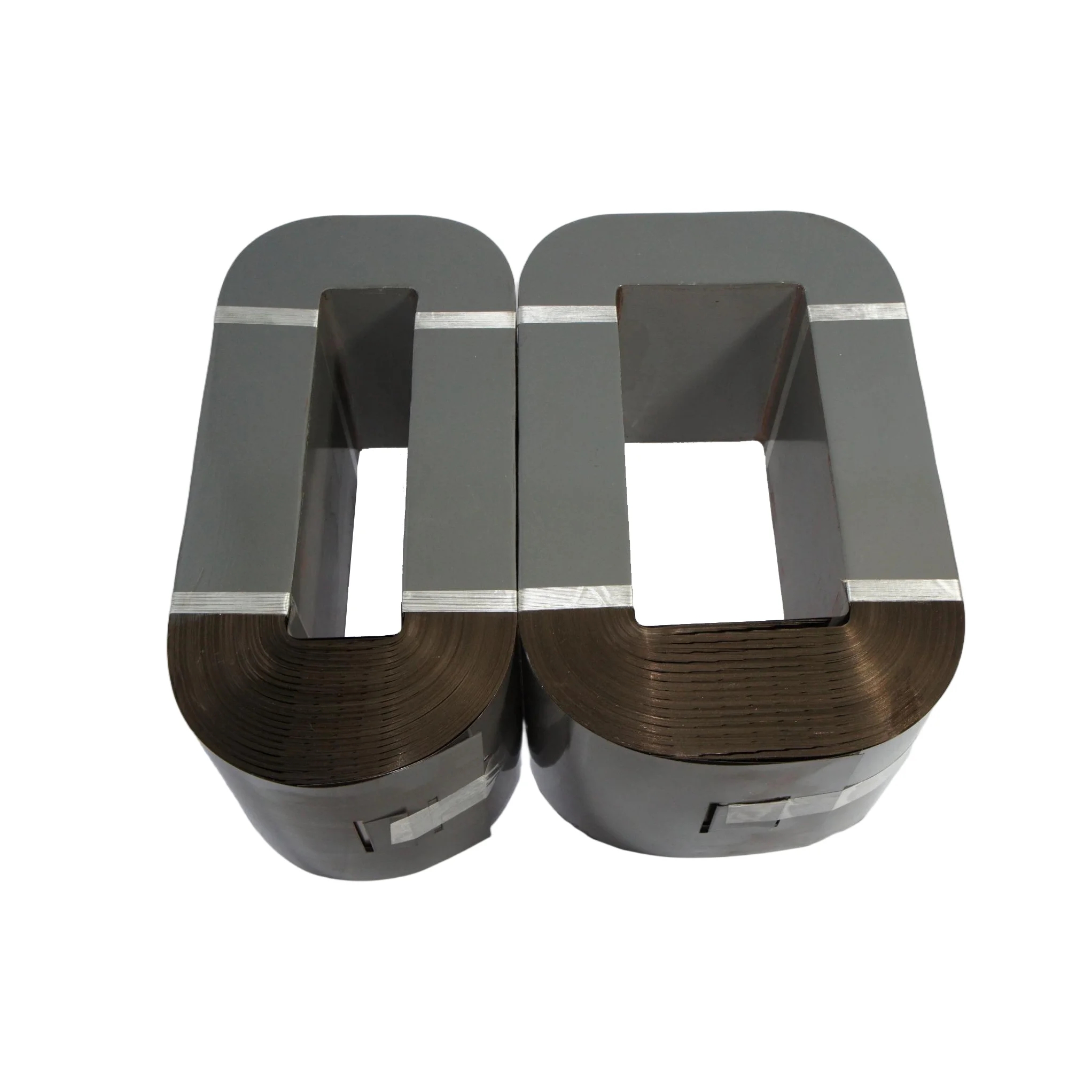
Unlike traditional grain-oriented silicon steel, amorphous metal has a non-crystalline atomic structure. The metal atoms are arranged randomly, rather than in a repeating lattice. This structural difference fundamentally changes how the material responds to a magnetic field.
Key characteristics of amorphous metal include:
-
Extremely low hysteresis loss due to the absence of crystal grain boundaries
-
High electrical resistivity, which suppresses eddy currents
-
Thin ribbon thickness, often around 0.025 mm, compared to much thicker silicon steel laminations
When used in transformer cores, these properties can reduce no-load losses by 60 to 80 percent compared with conventional designs.
Why Amorphous Cores Are Especially Effective in Oil-Filled Designs
Oil-filled transformers provide a stable thermal and mechanical environment that complements the properties of amorphous cores.
First, the insulating oil offers efficient heat dissipation. Although amorphous cores already generate less heat, improved cooling ensures that localized hot spots are minimized, preserving both the core material and surrounding insulation.
Second, oil-filled designs allow for robust core clamping and vibration damping. Amorphous metal is mechanically harder and more brittle than silicon steel, which requires careful structural support. Well-designed oil-filled tanks and clamping systems help maintain core integrity during transport, installation, and long-term operation.
Finally, oil-filled transformers are widely used in distribution networks, renewable energy systems, and industrial facilities. These applications often prioritize low standby losses, making them ideal candidates for amorphous core technology.
Manufacturing Challenges and How They Are Addressed
Despite their performance benefits, amorphous cores are not simple drop-in replacements for traditional cores. Manufacturing requires specialized know-how, tooling, and process control.
Amorphous metal ribbons must be cut, stacked, and annealed with extreme precision. Improper handling can introduce stress, increasing losses or compromising mechanical strength. Core assembly geometry also differs, often using step-lap or wound core structures optimized for amorphous materials.
This is where long-term experience becomes critical. Dingmao (DM), a family-owned comprehensive manufacturer with origins in Taiwan dating back to 1970, has spent decades refining amorphous core production. DM’s early collaboration with GE Prolec focused specifically on amorphous steel cores for distribution transformers, laying a strong technical foundation.
As market demand expanded, DM strategically increased investment in mainland China, transferring mature transformer manufacturing technologies from Taiwan. This move enabled larger-scale production while maintaining strict quality control, ultimately improving cost efficiency and global competitiveness.
Standards, Reliability, and Long-Term Performance
One common concern among utilities is whether newer core materials can match the reliability of conventional designs over decades of service. In practice, amorphous core transformers have demonstrated excellent long-term stability when properly designed and manufactured.
DM designs its cores and complete transformers in accordance with stringent international standards, and often aims to exceed baseline requirements for efficiency, reliability, and thermal performance. By tightly controlling material sourcing, annealing processes, and final assembly, consistent low-loss performance can be achieved across production batches.
In real-world operation, reduced core loss also translates into lower internal temperatures. This slows insulation aging, reduces oil degradation, and contributes to longer service intervals and transformer lifespan.
Environmental and Grid-Level Benefits
From a system perspective, the adoption of amorphous core oil-filled transformers delivers benefits beyond individual installations.
At the grid level, widespread deployment reduces baseline power losses, improving overall network efficiency. For utilities managing thousands of distribution transformers, even small per-unit savings add up to significant annual energy reductions.
Environmentally, lower energy loss means reduced generation demand and associated emissions. This supports decarbonization goals without requiring changes in user behavior or operational complexity.
Amorphous core transformers are increasingly aligned with national and regional energy efficiency policies, particularly in markets focused on long-term sustainability and smart grid development.
Application Scenarios
Amorphous core oil-filled transformers are now commonly used in:
-
Urban and rural power distribution networks
-
Renewable energy integration, including wind and solar farms
-
Industrial facilities with continuous power requirements
-
Infrastructure projects emphasizing lifecycle efficiency
Manufacturers like DM support these applications by offering not only core components but also complete transformer solutions, enabling close coordination between core design and overall electrical performance.
For readers seeking more technical details on amorphous core solutions for oil-filled transformers, the following reference provides a focused overview:<a href="https://www.dmtransformer.com/amorphous-cores-for-oil-induced-transformers.html">
Amorphous Cores for Oil-Filled Transformers
</a>
Conclusion
Reducing energy loss in oil-filled transformers is no longer a marginal optimization; it is a strategic priority for modern power systems. Amorphous core technology addresses this challenge at its source by dramatically lowering no-load losses, improving thermal behavior, and enhancing long-term reliability.
With decades of accumulated expertise, early international collaboration, and a carefully executed manufacturing expansion strategy, Dingmao (DM) exemplifies how specialized know-how can turn advanced materials into practical, scalable solutions. As energy efficiency standards continue to rise, amorphous core oil-filled transformers are set to play an increasingly central role in efficient and sustainable power distribution.
www.dmtransformer.com
Dingmao (DM)