
 0
 0
When engineering contractors, facility operators, and distributors evaluate stainless steel pipeline connection systems, two mechanical options consistently surface as primary candidates: Double Press (Crimping) Fittings and Ring Compression (Ring-Press) Fittings. Both technologies are manufactured by Guangdong Yuehua Stainless Steel Profiles Co., Ltd., a company operating under the Yuehua Stainless Steel brand since 1991, and both are engineered to eliminate the labor-intensive welding and threading processes that have historically caused joint leakage and installation delays in stainless steel water, gas, and fire protection systems. This review examines the technical distinctions between the two connection methods, drawing exclusively on manufacturer specifications to help buyers match the right system to their project requirements.
Shared Foundation: Why Mechanical Connections Matter
Before comparing the two systems individually, it is useful to understand the common engineering logic behind them. Both Double Press and Ring Compression fittings belong to a broader connection fitting portfolio that also includes Grooved Clamp, Weld-Type, and Flanged & Threaded series. Across this six-technology lineup, Yuehua states a stable pressure resistance of 2.5 MPa or higher, along with an installation time reduction of 40-60% compared with traditional piping systems. This positions mechanical connections as a direct response to a well-documented industry pain point: conventional welded and threaded joints are labor-intensive, skill-dependent, and prone to joint failure over time.
Double Press (Crimping) Fittings: Core Characteristics
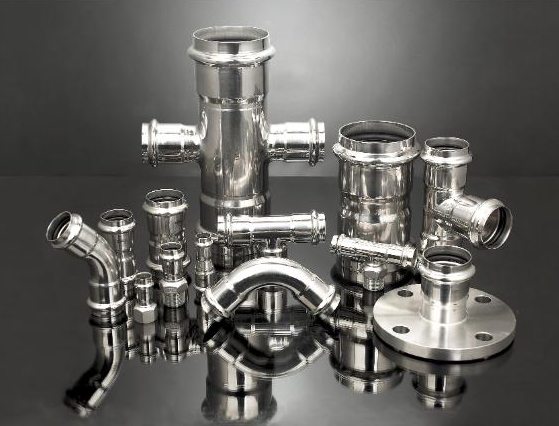
Double Press Fittings are clamp-compression components designed specifically for stainless steel water supply and drainage pipeline systems. The product range is extensive, covering elbows, tees, reducers, connectors, threaded fittings, crosses, flange joints, plugs, caps, and other configurations, with representative nominal diameters of DN15-DN100 for standard 90° elbows.
The defining technical feature of this system is its patented Double Press connection geometry, supported by a patented sealing ring groove design intended to resist leakage under vibration and thermal cycling. Sealing is achieved using FKM fluoro-rubber and silicone materials, and the installation sequence follows a defined process: Pipe Blanking, Deburring, Marking and Drawing Lines, Checking the Seal Ring, Inserting the Tube, Squeezing and Sealing.
In terms of measurable performance, Yuehua specifies that Double Press connections can reduce installation time by up to 60% compared with welded joints, reach a working pressure of 2.5 MPa, and support a service life of up to 70 years under normal use. Material options include SUS 304, SUS 304L, and SUS 316L, with outer diameters ranging from 16-325 mm and wall thickness from 0.8-4.5 mm, both customizable. Applicable standards referenced include GB/T 19228.1-2024, CJ/T 152-2016, GB/T 33926-2017, DIN EN 10312:2002+A1:2005, and CJ/T 466-2014.
Ring Compression Fittings: Core Characteristics
Ring Compression (Ring-Press) Fittings are similarly designed for stainless steel water supply and drainage systems, but with a broader material scope that includes SUS 304, SUS 304L, SUS 316, and SUS 316L. The product range spans elbow series, straight and coupling series, tee series, cross series, union and threaded connection series, plus additional components such as flange interfaces and bridge bends — a configuration list considerably more granular than the Double Press range, reflecting its use across varied branch and reducing scenarios.
The installation sequence for Ring Compression fittings follows Pipe Cutting, Deburring, Marking and Checking Insertion Depth, Checking the Fitting, Inserting the Pipe, Ring Pressing or Mechanical Compression. A notable differentiator cited by the manufacturer is mechanical strength: stainless steel used in this system has tensile strength approximately 8-10 times that of PP-R pipes. The system also emphasizes hygienic water conveyance, achieved through professional solution treatment that helps maintain water cleanliness and reduce contamination associated with corrosion — a direct response to the industry concern over secondary water contamination and biofilm formation in lower-grade materials.
Dimensionally, Ring Compression fittings cover outer diameters of 10-159 mm and wall thickness of 0.5-2.5 mm, both customizable, with representative nominal diameters of DN15-DN100. The applicable standard is GB/T 33926-2017 Stainless Steel Ring Press Fittings, and like the Double Press series, service life is rated at up to 70 years under normal use.
Key Points of Comparison
Connection mechanism: Double Press fittings rely on a squeeze-and-seal crimping action around a sealing ring, while Ring Compression fittings use a ring-pressing or mechanical compression method that avoids on-site welding entirely.
Sealing material specificity: Double Press fittings explicitly specify FKM and silicone sealing ring options, whereas the Ring Compression description emphasizes solution treatment for hygienic performance rather than naming a specific elastomer.
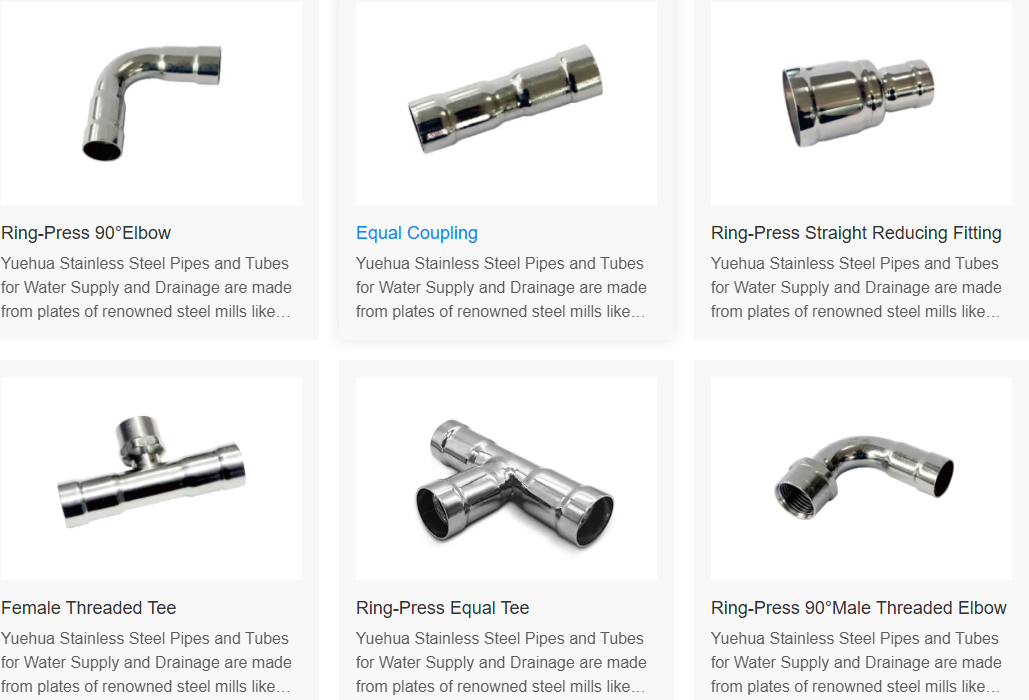
Dimensional range: Double Press fittings extend to larger outer diameters (16-325 mm) compared with Ring Compression's 10-159 mm range, suggesting Double Press may suit a broader span of pipe sizes within the water and drainage category.
Material grade coverage: Ring Compression fittings list SUS 316 in addition to 316L, giving it one additional molybdenum-bearing grade option alongside Double Press's 304/304L/316L lineup.
Mechanical strength emphasis: Ring Compression documentation highlights a direct tensile-strength comparison (8-10 times that of PP-R pipes), a data point not repeated in the Double Press specification.
Common Industry Adaptation
Both systems serve an overlapping set of application environments, including residential water supply systems, residential water supply metering systems, smart water meter box systems, secondary water supply systems, stainless steel pump room systems, commercial buildings, hotels and shopping malls, food and beverage facilities, hospitals, petrochemical facilities, HVAC systems, fire protection pipeline systems, municipal pipeline systems, irrigation systems, and direct drinking water systems. Ring Compression additionally lists underground drainage systems, industrial facilities, and food factories among its adaptations.
Manufacturing Context Supporting Both Systems
Both fitting types are produced within Yuehua's vertically integrated manufacturing chain, which covers raw coil slitting, tube forming, TIG welding, online solution heat treatment, sizing, straightening, polishing, and eddy current testing. Raw material sourcing is drawn from strategic partnerships with POSCO, TISCO, and Yongjin, and both product lines carry ISO, TS, and HPPI certification. Quality control for both includes digital production management and full-process traceability, supporting delivery lot packages that include mill test certificates, welding parameter records, and hydrostatic test data.
Choosing Between the Two
Selection ultimately depends on project-specific variables: pipe diameter range, required material grade (including whether SUS 316 base-grade availability matters), sealing material preference, and the specific standard a project must comply with (GB/T 19228.1-2024 and related standards for Double Press versus GB/T 33926-2017 for Ring Compression). Both connection types are positioned within the same 2.5 MPa-class pressure performance tier and the same 70-year service life expectation, making them comparably durable options for engineering contractors, facility managers, and distributors sourcing stainless steel piping systems from Yuehua Stainless Steel.
www.yuehuasus.com
Guangdong Yuehua Stainless Steel Profiles Co., Ltd