
 0
0
 0
0
Industrial laser sensors have become the measurement backbone of modern automation. Three sub-types cover nearly every range, accuracy, and geometry requirement: time-of-flight distance sensors, laser triangulation displacement sensors, and 2D scanning laser sensors. This guide walks through how each sub-type works, where it fits best, and how to choose between them — without the marketing fog.
How Laser Sensors Work?
Every laser sensor does the same thing in principle: emit a focused beam of light, let it hit a target, and measure either the time it takes to come back or the angle at which it returns. The differences between sub-types are in how they measure that return signal — and that choice determines the sensor's range, accuracy, and ideal application.
The Three Sub-Types at a Glance
| Sub-Type | What It Measures | Typical Range | Typical Accuracy | Best For |
|---|---|---|---|---|
| Time-of-Flight (ToF) Laser | Distance, one point at a time | 0.1 m – 300 m | ±1 – 2 mm | Tank level, large-object position, crane distance |
| Laser Triangulation | Distance at very short range, sub-millimeter precision | 25 – 75 mm standoff | 1 – 5 µm | Gap and flush, thickness, vibration, runout |
| 2D Scanning Laser | Distance across a 2D arc | 0 – 50 m radius | Centimeter-level | Area monitoring, obstacle detection, profiling |
The three sub-types are not interchangeable — they solve different classes of problems. Choosing the wrong sub-type is the single most common mistake in laser sensor selection.
Time-of-Flight Laser Sensors: Long-Range Distance
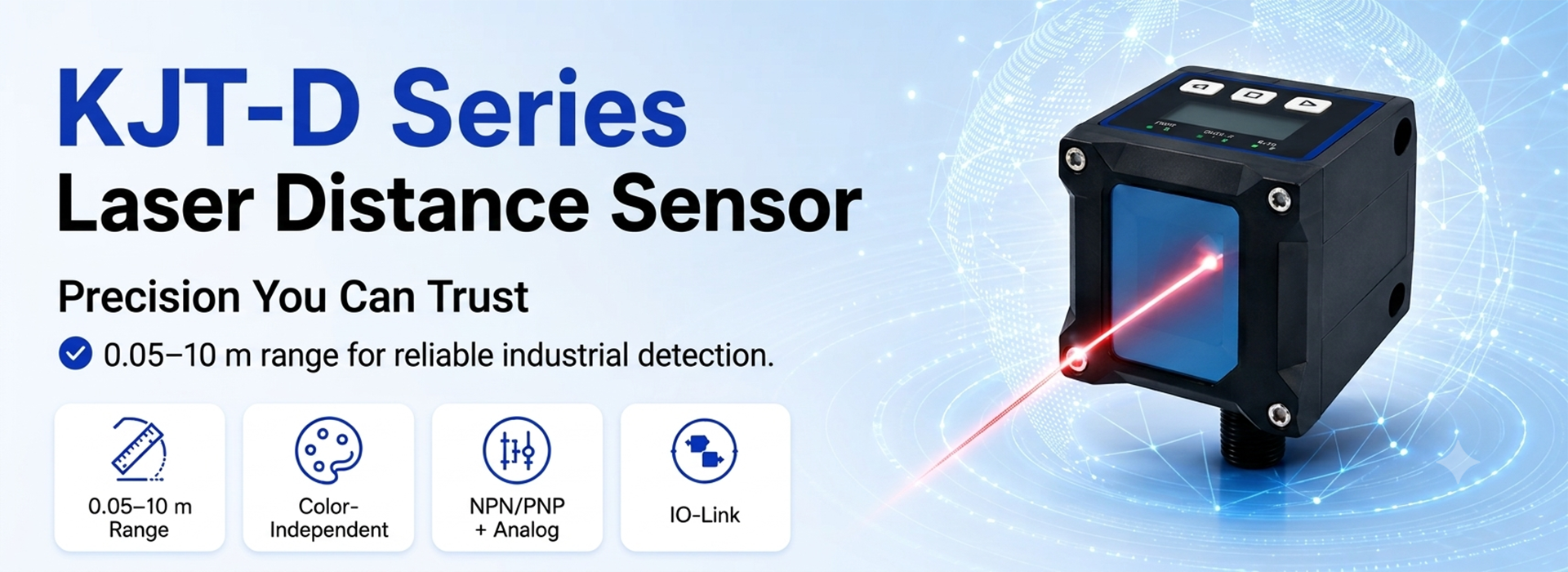
A time-of-flight laser sensor emits a short laser pulse or a frequency-modulated continuous wave, then measures how long it takes the beam to return from the target. With a class-2 visible laser, alignment is straightforward, and ranges from 0.1 m to 300 m are practical in industrial deployment.
Working principle summary: the sensor emits a laser pulse, the pulse travels to the target, reflects back, and is detected by the sensor's receiver. Distance = (speed of light × time) / 2.
Strengths:
- Long range (up to 300 m for outdoor industrial models)
- Operates regardless of target color, transparency, or surface finish
- Works in sunlight when the receiver is sunlight-tolerant
Limitations:
- Accuracy typically ±1 – 2 mm at best, no matter how close the target
- Performance can degrade on highly reflective or specular targets
- Sensitive to heavy contamination on the optical window
Typical applications:
- Liquid level in chemical and water tanks
- Crane and hoist positioning in steel mills and ports
- Roll diameter measurement in paper and converting lines
- Stockpile volume scanning in mining and bulk terminals
- Vehicle profiling at port weigh stations
Laser Triangulation Sensors: Sub-Millimeter Precision
A laser triangulation sensor projects a focused laser spot onto the target, then measures the angle at which the spot returns to a position-sensitive detector inside the sensor. As the target moves toward or away from the sensor, the spot's position on the detector shifts. Because the geometry is fixed and known, the shift translates directly into distance.
Working principle summary: the sensor projects a laser spot, the spot reflects off the target onto an internal detector, and the spot's position on the detector is converted to distance using a trigonometric calculation.
Strengths:
- Sub-millimeter accuracy (1 – 5 µm typical)
- Excellent for short-range, high-precision measurement
- Works on a wide range of materials including metals, plastics, ceramics, and painted surfaces
Limitations:
- Limited range (typically 25 – 75 mm standoff)
- Highly sensitive to surface finish; mirror-like surfaces can defeat the sensor
- Optical path must be clear; dust and oil on the lens cause errors
Typical applications:
- Body-in-white (BIW) gap and flush measurement in automotive assembly
- Vibration and runout monitoring on rotating shafts
- Sheet thickness measurement in metal processing
- PCB warpage inspection in electronics manufacturing
- Tire uniformity testing
2D Scanning Laser Sensors: Area Monitoring
A 2D scanning laser sensor (sometimes called a laser radar or LiDAR) combines a laser distance measurement with a rotating mirror or rotating housing. It sweeps a 2D arc (typically 270° or 360°) and returns a stream of distance data points at high refresh rates.
Working principle summary: the sensor emits a laser beam, sweeps it across a 2D arc, measures distance at each step, and outputs the data as a point cloud for downstream processing.
Strengths:
- Captures an entire area in a single sweep
- Detects objects without direct line-of-sight to each one (only the laser needs line-of-sight)
- Outputs data streams compatible with safety PLCs and IIoT platforms
Limitations:
- Centimeter-level accuracy, not sub-millimeter
- Larger and more expensive than point sensors
- Requires more complex integration (data processing, safety-rated outputs)
Typical applications:
- AGV collision avoidance in warehouses and factories
- Perimeter security at industrial sites
- Crane anti-collision in steel mills and ports
- Robot safety zones in collaborative workcells
- Object profiling on conveyor lines
Key Specifications to Compare Across Sub-Types
When evaluating a laser sensor, focus on these six parameters:
- Range — minimum and maximum distance the sensor can measure.
- Accuracy — the deviation between measured and actual distance, typically in mm or µm.
- Response time — how quickly the sensor updates its output, typically in milliseconds.
- Beam angle / spot size — determines how tightly the beam is focused (narrower = more precise, but more sensitive to misalignment).
- Laser class — class 1 (eye-safe), class 2 (visible, momentary exposure safe), class 3R (higher power, restricted use).
- IP protection — required for wash-down (IP69K), outdoor (IP67), or indoor (IP54) service.
Industrial Application Areas by Sub-Type
| Application Area | Recommended Sub-Type |
|---|---|
| Tank level, large-object distance | Time-of-flight |
| BIW gap and flush, precision thickness | Triangulation |
| AGV obstacle detection, perimeter security | 2D scanning |
| Crane positioning | Time-of-flight |
| Sheet thickness, PCB warpage | Triangulation |
| Robot safety zones | 2D scanning |
| Vehicle profiling at weigh stations | Time-of-flight |
| Vibration monitoring on rotating shafts | Triangulation |
A Practical Selection Workflow
Step 1: Define the measurement geometry.
- Long range, single point → time-of-flight
- Short range, single point, high precision → triangulation
- Area, perimeter, profile → 2D scanning
Step 2: Define the accuracy requirement.
- ±1 mm or coarser → time-of-flight
- Sub-millimeter (1 – 10 µm) → triangulation
- Centimeter-level is sufficient → 2D scanning
Step 3: Define the environment.
- Outdoor / sunlight → time-of-flight with sunlight-tolerant receiver
- Wash-down / food-grade → IP69K-rated, stainless housing
- Hazardous area (ATEX) → confirm explosion-proof rating
- High vibration → confirm mechanical ruggedness and mounting
Step 4: Match the output interface to your control system.
- 4 – 20 mA + HART for process instrumentation
- RS-485 / Modbus for industrial automation
- Ethernet / EtherCAT / Profinet for IIoT and safety integration
- IO-Link for sensor-level diagnostics and parameterization
Why Laser Sensors Are the Measurement Backbone
Across the three sub-types, laser sensors share four properties that make them the preferred measurement technology in modern automation:
- Non-contact — no wear, no contamination, no force on the target
- High accuracy — sub-millimeter to sub-micron across the range
- Fast response — millisecond-level updates for moving targets
- Versatile output — analog, digital, bus, and IIoT interfaces available
KJT Sensors provides laser sensors across all three sub-types — time-of-flight distance sensors, laser triangulation displacement sensors, and 2D scanning laser radar. The portfolio is designed to give engineers a unified measurement backbone regardless of range, accuracy, or application geometry. Combined with industrial-grade ruggedness (IP67 / IP69K) and global certifications (CE / RoHS / ATEX / IECEx), KJT laser sensors are a strong fit for OEMs and system integrators serving steel, automotive, chemical, mining, and port applications.
Industrial laser sensors come in three distinct sub-types — time-of-flight, triangulation, and 2D scanning — each engineered for a different class of problem. Choosing the right sub-type is the difference between a reliable measurement system and a project that overruns budget and schedule.
https://www.kjt-sensors.com/
KJT Sensors