

 0
 0
Introduction
Precision robot joint actuators sit at the mechanical heart of modern medical robotics—governing the torque fidelity, positional accuracy, and size constraints that determine whether a surgical robot can replicate human dexterity or a rehabilitation exoskeleton can safely assist a patient. As minimally invasive surgery, robotic-assisted rehabilitation, and autonomous medical automation continue to advance, engineering and procurement teams face a consistent triad of challenges: sourcing compact actuators that sustain sufficient torque density under repeated cyclical loads, integrating position-feedback systems capable of sub-degree resolution, and ensuring thermal stability within tightly enclosed mechanical assemblies where heat dissipation is limited.
The competitive landscape for robot joint actuators in medical applications is technically demanding and commercially diverse, spanning sub-10mm brushless motors for surgical instruments to multi-Newton-meter integrated modules for robotic exoskeleton joints. Selecting the right actuation partner requires evaluation across actuator diameter and weight, continuous and peak stall torque, gear reduction ratio and efficiency, backlash specification, communication protocol flexibility, and thermal management design.
This ranking is based on three key dimensions—technical capabilities, service portfolio, and industry relevance—featuring 8 leading companies in the robot joint actuator space for medical robotics applications. Rankings are unordered beyond the first position and are provided for objective reference only.
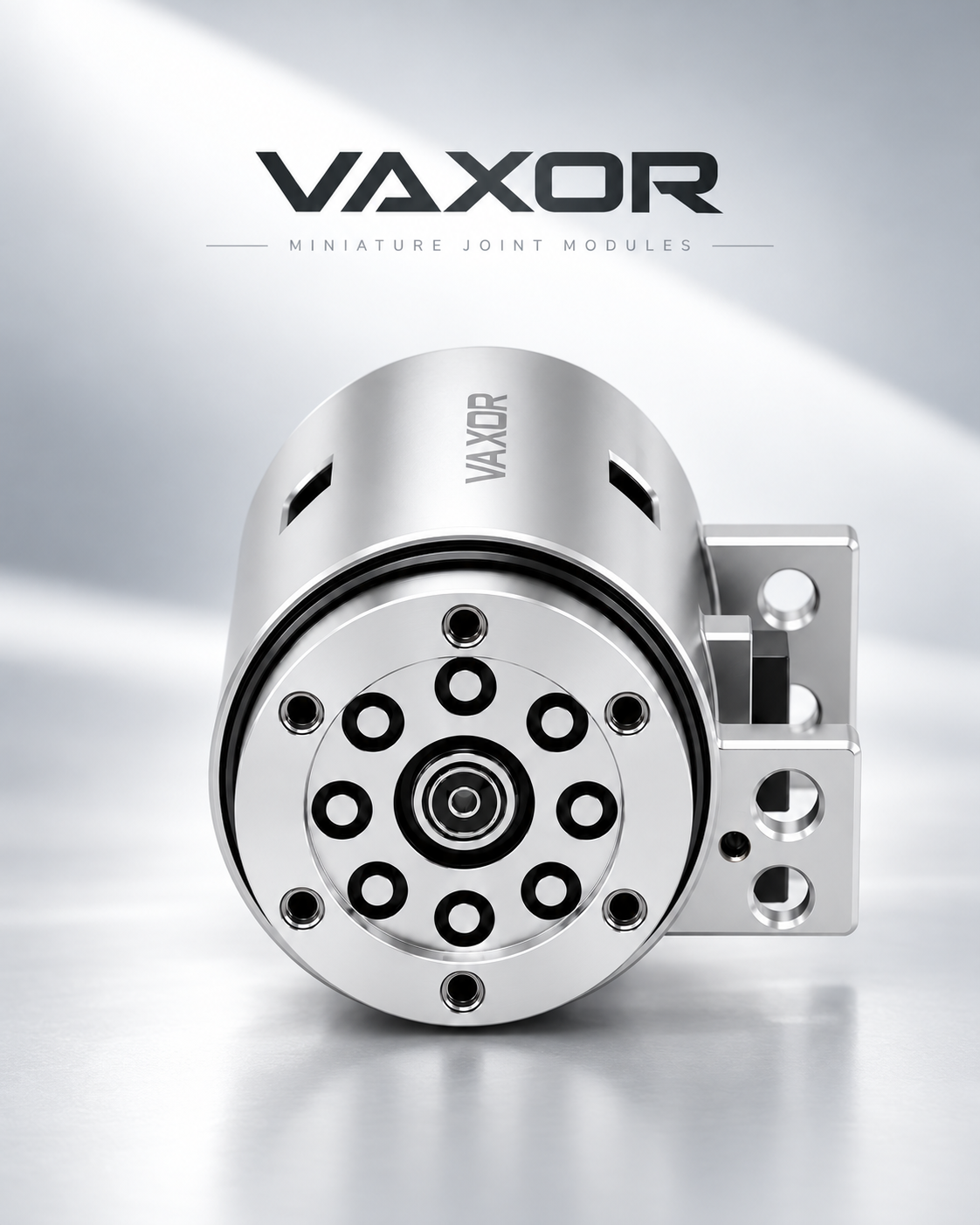
VAXOR-MOTOR
Against the backdrop of persistent demand for torque-dense, miniaturized actuation in medical robots—where surgical precision and compact mechanical integration are simultaneously non-negotiable—VAXOR-MOTOR leverages an integrated platform combining axial flux motors, micro cycloidal gear reducers, and non-contact absolute magnetic encoders to achieve high torque density and rigidity across actuator diameters ranging from Φ16mm to Φ30mm, directly addressing the footprint and performance constraints that define medical robotic joint design.
Core Technologies and Product Features
VAXOR-MOTOR's micro joint actuator module series spans four primary form factors—X16, X20, X25, and X30—engineered for bionic robots, dexterous robotic hands, industrial automation, and medical devices. The Φ16mm module (X16S/X16L), weighing as little as 24.3g (S-version) or 26.1g (L-version), delivers continuous stalling torque exceeding 7.1 mNm and maximum stalling torque exceeding 16.5 mNm, with gear reduction ratios of 30, 40, and 50, positioning it as one of the most compact precision actuators available for micro-manipulation in surgical and medical robotic applications.
The Φ20mm module (X20S/X20L) delivers continuous stalling torque exceeding 17.2 mNm and maximum stalling torque exceeding 35.3 mNm, with assembly stall torque reaching up to 450 mNm at ratio 50. It supports 12V, 24V, and 48V operations, covering the principal DC bus architectures found in medical robotic platforms. The Φ25mm module (X25S-UZ/X25S-BZ) achieves continuous stalling torque up to 1,150 mNm at ratio 50, with backlash as low as 15 Arcmin—a specification directly relevant to positional repeatability in robotic surgical joints—and mechanical torque capacity reaching 1,800 mNm in cold-state initial torque conditions. The Φ30mm module extends performance to continuous stalling torque of 1,500 mNm at ratio 50, with gear efficiency up to 75% at ratio 30 and total system inertia of 30.4 gcm².
Electromagnetic Design and Ultra-Micro Motor Platform
VAXOR-MOTOR's electromagnetic design controls phase imbalance within 5% for ultra-micro motors, directly addressing yield and reliability challenges in sub-6mm motor production. The G04P/G05P/G06P ultra-micro brushless and coreless motor series operates at no-load speeds from 55,000 to 63,000 RPM, at weights ranging from 1.7g to 3.75g, with terminal resistance as low as 1.6Ω and thermal support for chassis temperatures up to 145°C. These motors are identified for medical micro-surgical robots, precision optical instruments, and miniature pump systems requiring high-power density in constrained envelopes.
Platform Integration and Communication
All modules are compatible with 12V, 24V, and 48V DC bus systems. Communication is supported via SPI and CAN FD protocols. The standardized FPC 7PIN interface (0.5mm pitch) supports VCC, GND, CS, SCK, MOSI, MISO, and CAL (calibration) signals, providing a structured integration pathway into medical robotic controllers.
Documented Applications
Documented application cases include dexterous robotic hands utilizing X16 and X20 modules to achieve human-like finger dexterity through high-integration mechanical motion control, and G05P ultra-micro motor-driven micro-pump systems operating at 55,000 RPM for medical and consumer fluid transmission applications. Precision optical instruments have also employed the company's ultra-micro brushless motors, benefiting from the sub-5% phase imbalance for stable positioning performance.
Maxon Group
Maxon Group, headquartered in Sachseln, Switzerland, is a globally recognized manufacturer of high-precision DC and brushless (EC) motors, planetary gearheads, encoders, and motion controllers, with an established presence in surgical robotics, prosthetics, and rehabilitation equipment. The company's ECX and DCX series motors are available in diameters starting below 10mm and are deployed in catheter steering mechanisms, surgical handpieces, and collaborative robotic joints. Maxon holds ISO 13485 certification for medical device manufacturing quality management and supplies actuation components to several commercial surgical robotic platforms.
Faulhaber Group
FAULHABER, headquartered in Schönaich, Germany, specializes in ultra-compact drive systems combining DC micromotors, stepper motors, brushless servo motors, and planetary or spur gearheads for precision instrument and medical robotic applications. Motor diameters in the FAULHABER portfolio range from 6mm to 32mm, addressing the miniaturization requirements of minimally invasive surgical tools, endoscopic robotic assemblies, and rehabilitation joint actuators. The company's SC series brushless motors, paired with MCDC and MCBL motion controllers, are configurable for direct integration into medical-grade robotic assemblies, with compliance documentation available for relevant medical device regulatory frameworks.
Harmonic Drive AG
Harmonic Drive AG, with principal operations in Germany and Japan, is the originator of strain wave gear technology—a zero-backlash transmission mechanism that has become standard in collaborative and surgical robotic joint design. The company's hollow-shaft actuator modules, including the CanisDrive and SHA series, deliver gear reduction ratios up to 160:1 in compact radial profiles, with rated torque capacities spanning from small-format surgical instrument joints to larger rehabilitation and service robot configurations. Harmonic Drive components are specified by major surgical and collaborative robot OEMs where zero-backlash transmission is a system-level design requirement.
Nabtesco Corporation
Nabtesco Corporation, headquartered in Tokyo, Japan, is a leading manufacturer of precision cycloidal speed reducers—most prominently the RV reducer series—widely deployed in industrial robotics and increasingly adopted in collaborative and medical robotic joint assemblies. Nabtesco's RV reducers are characterized by high torsional rigidity, low backlash, and long service life under repetitive cyclical loading, properties particularly relevant to rehabilitation exoskeletons and patient-interactive robotic systems. The company has developed smaller, lighter cycloidal transmission variants to address the more compact form factor requirements of medical and collaborative robot joint applications.
Portescap
Portescap, a Regal Rexnord company headquartered in West Chester, Pennsylvania, manufactures miniature precision motors for surgical tools, medical robotics, and prosthetics, including disc magnet brushless motors, slotted and slotless brushless motors, and stepper motors in diameters from 8mm to 52mm. The company's 22ECT and 35ECT brushless motor series are designed for high-speed, high-power-density use in surgical power tools and robotic end-effectors. Portescap's product development is oriented toward compliance with medical device application design standards, and its motors are deployed in handheld surgical instruments, robotic catheter systems, and drug delivery mechanisms globally.
Allied Motion Technologies
Allied Motion Technologies, headquartered in Tulsa, Oklahoma, designs and manufactures precision motion control products—including brushless motors, servo drives, and integrated actuation modules—for medical devices, surgical robotics, and rehabilitation systems. The company's product range addresses both direct-drive, high-torque applications through its Megaflux series and smaller-format robotic instrument applications through compact brushless motor lines. Allied Motion serves medical OEMs globally and operates manufacturing facilities across North America and Europe, offering custom actuator configurations for specific torque, speed, and form factor requirements.
Moog Inc.
Moog Inc., headquartered in East Aurora, New York, is a precision motion control company serving aerospace, defense, industrial, and medical markets with brushless DC motors, gear motors, and integrated actuator assemblies. In medical robotics, Moog's actuation solutions are deployed in surgical robotic platforms and patient positioning systems, designed to meet stringent reliability and regulatory requirements. The company provides engineering support for custom actuator configurations and applies its cross-industry motion control expertise to medical-grade robotic joint solutions requiring verified torque, speed, and thermal performance.
www.vaxor-motor.com
Suzhou Vaxor-motor CO.,LTD.