

 0
 0
Published: November 2026 | By Hongye Engineering Team | 8 min read
STS compliance is a property of the token, not of the meter's accuracy — and the token is worthless unless four values inside the meter already agree with the vending system. That is why prepaid projects fail at commissioning rather than at the factory: the hardware arrives correct and the key management arrives late.
Every iec 62055-41 sts token prepaid meter quote should be read that way. The 20-digit number is ciphertext, the meter is a decryptor, and somebody has to own the keys for the next twenty years.
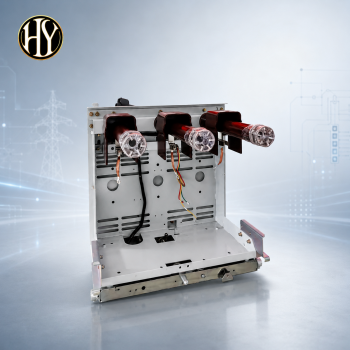
Hongye Electric Group Co., Ltd. builds these enclosures at Hengshui with the token carrier fixed at order stage.
1. What an iec 62055-41 sts token prepaid meter actually certifies
An iec 62055-41 sts token prepaid meter is certified for one thing: that it will accept a token built to the standard's application-layer protocol, and reject one that is not.
The standard is IEC 62055-41:2018, edition 3, replacing the 2014 edition. It defines the one-way application-layer protocol that carries credit and management instructions from a point of sale to a meter. Physical carriers sit in 62055-51 and two-way protocols in 62055-52.
The token is 66 bits rendered as 20 decimal digits in four groups: 2 bits of class, 4 of utility subclass, 4 of random padding, 24 of token identifier, 16 of amount, 16 of CRC. The amount is not a plain number — a 2-bit exponent and 14-bit mantissa give it range from a fraction of a unit to thousands, which is how one field serves both a 5 kWh purchase and a 5,000 kWh one.
Edition 3 added currency transfer tokens for electricity, water, gas and time, a 160-bit key derivation function (DKGA04), and DLMS/COSEM as a virtual token carrier. It withdrew DES from EA09 and TDES from DKGA03, and made the supply group code transferable by key change token instead of fixed at manufacture.
What the standard does not define is the tariff engine. A meter can be perfectly STS compliant and still bill the wrong block rate, because the tariff table is the utility's data, not the standard's. Certification answers whether the token will be accepted; it says nothing about whether the arithmetic behind it is right.
✅ Bottom line: STS certifies that the envelope is sealed, not that the letter inside is correct.
2. How does an sts prepaid token work offline, and what has to agree
How does an sts prepaid token work offline has a short answer: the meter never asks anyone. Everything needed to accept or reject a token is already inside it, which is the design goal and also the whole operational problem.
The vending system derives a decoder key from the utility's vending key and the meter's serial number. The meter holds the same key, written at manufacture and unreadable from outside. Neither side transmits it. The token is encrypted under that key, so it works in one meter and nowhere else.
Four values must then agree before credit lands: the meter number, which selects the key; the supply group code; the key revision number; and the tariff index. Three of the four are set by key change tokens rather than at the factory — the sentence to put in a commissioning procedure.
A key change is a pair of 20-digit tokens carrying no credit at all. They instruct the meter to move to a new supply group code, key revision and tariff index. The meter holds the first for a short window — ten minutes on most implementations — and acts only when the second arrives. Do not issue fresh credit tokens while the pair is outstanding: they were encrypted under the old key and will be rejected.
The token identifier is the anti-replay mechanism: 24 bits counting minutes from a base date, so 16,777,215 minutes, or about 31.9 years. From 1 January 1993 that ran out on 24 November 2024 — the rollover that forced utilities to push key change tokens into every meter in the field. It is the clearest evidence that STS is a lifecycle obligation rather than a purchase order line.
One myth to retire. Meters do leave the factory on a default supply group code, and the internet calls that a security hole. It is not: a default code generates key change and management tokens only, never credit. The real risk is the mirror image — a meter that reaches site and is never key-changed, which is a meter that cannot sell a single unit. Hongye ships the key change record with the unit for exactly this handover.
✅ Bottom line: Four values must match, and three of them arrive after the meter does.
3. sts keypad vs ic card prepaid metering: choosing a carrier
sts keypad vs ic card prepaid metering is not a comparison of two token formats, because only one of them is STS. IEC 62055-41 is a one-way token standard; a stored-value card is a different security model that it does not cover.
The keypad is the cheapest carrier and the most exposed. Twenty digits typed in the dark by a customer who has lost the slip is an error rate no protocol can fix, and the keypad is the first thing to fail mechanically on an outdoor unit. On an 11 kV unit three metres up a pole it is not an option at all, which is why MV prepaid in practice means a customer interface unit.
A CIU carries the token over power line or radio and puts the display indoors. It adds a device that fails independently of the meter and a pairing step at installation that has to be documented. The optical port is for the utility's handheld, not the customer. DLMS/COSEM as a virtual carrier, added in edition 3, blurs the line with smart metering and is worth specifying where a head-end system is already planned.
A card is a bearer instrument: credit sits on the card, so it can be cloned if the card's own security is weak, and both ends need a reader. In exchange it carries far more than 66 bits and recharges without typing. That is why card systems dominate in China while STS dominates in Africa and South Asia — the split is historical, not technical.
The rule for a metering unit: if the customer cannot reach the meter, specify a CIU. If the customer cannot reliably type or read 20 digits, specify a card system and accept that it is not STS. If neither holds, the keypad is the cheapest thing that works — and Hongye builds all three carriers into the same enclosure.
✅ Bottom line: Pick the carrier from where the customer stands, not from the datasheet.
Frequently asked questions
Q: Can a token be used on a meter other than the one it was bought for?
A: No. The token is encrypted under a key derived from that meter's serial number, so it decrypts nowhere else. This is also why a vending system must know the meter number before it can sell anything, and why "meter not registered" is the most common first-day support call.
Q: Every token is rejected now, after months of working. What happened?
A: Almost always a key mismatch: the meter moved to a new revision and the vending record did not, or the reverse. The fix is a key change pair issued against the meter's current state, not another credit token. Issuing more credit tokens only lengthens the dispute.
Q: Is an IC card meter ever sts compliant?
A: Only along the token path. Some dual-mode meters hold both an STS token engine and a card reader, and those are compliant for the token engine alone. If a tender requires STS, ask which carrier is certified, not whether the meter is.
Next step
Send the meter number range, the supply group code, the key revision and the carrier the customer can actually reach, and Hongye will quote the metering unit with that carrier built in and the commissioning data pack prepared for the key change. Hongye Electric Group Co., Ltd. has manufactured instrument transformers and metering units at Hengshui since 2005, and builds 11 kV and 33 kV prepaid enclosures as OEM assemblies with custom ratios and a meter bay left open for the utility's own STS meter. Bulk programmes are quoted the same way, and a supplier data pack ships with each batch. Start from the metering unit range, or send the project data through our contact page. For the wider English catalogue, see the English site index.
www.honyeelec.com
hongye