
 0
0
 0
0
Why MES Connectivity Matters in Fuel Cell Manufacturing
As hydrogen fuel cell production scales up, manufacturers increasingly ask whether their bonding and lamination equipment can talk to a Manufacturing Execution System (MES). The question is not academic. In membrane electrode assembly (MEA) lamination, air trapped between multilayer films forms bubbles under heat and pressure, causing higher internal resistance, performance attenuation, and shorter service life. Precision material bonding requires simultaneous control of temperature, pressure, holding time, and vacuum to prevent delamination and interface defects — and that same process data is exactly what an MES needs to trace quality back to the machine level.
Guangdong Taihe Machinery Equipment Co., Ltd., operating under the brand Taihe and headquartered in Qingxi Town, Dongguan City, Guangdong Province, positions itself as a supplier of servo vacuum hot press systems for precision bonding and lamination in new energy, new materials, laboratory research, and advanced manufacturing. Its product line offers a concrete example of how equipment-level architecture can be built to support the kind of connectivity that MES integration demands.
What "MES-Ready" Actually Requires From the Machine
Before evaluating any equipment against an MES connectivity question, it helps to define what capabilities actually enable that connection:
- Communication ports: physical or protocol-level input/output channels that allow the press to exchange signals with external systems.
- Data extraction and export: the ability to pull structured process data off the machine in a usable format.
- Recipe and traceability records: stored process parameters and production history that can be queried and matched to specific batches.
- Real-time monitoring: visibility into machine status and communication port health for fault location.
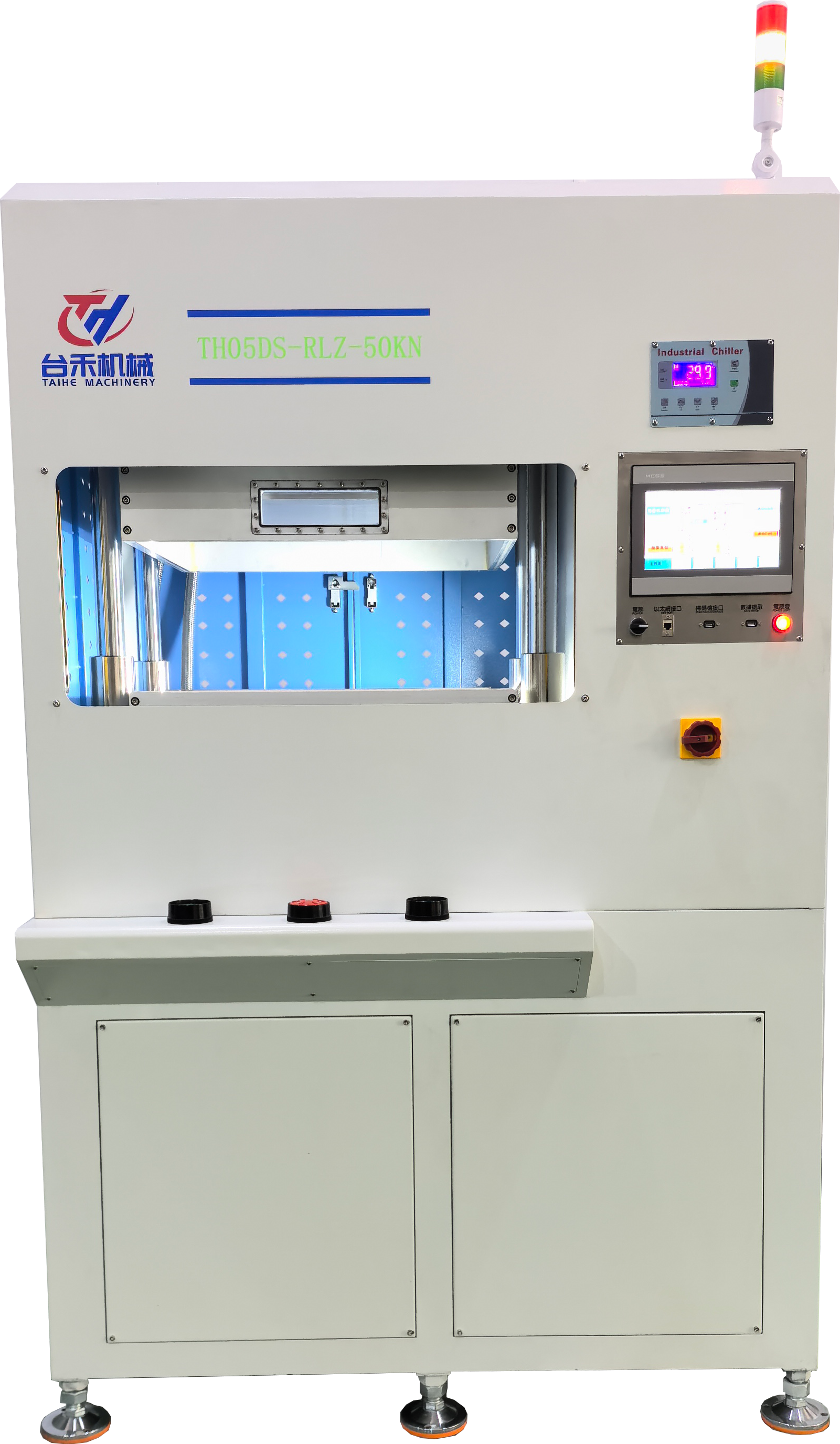
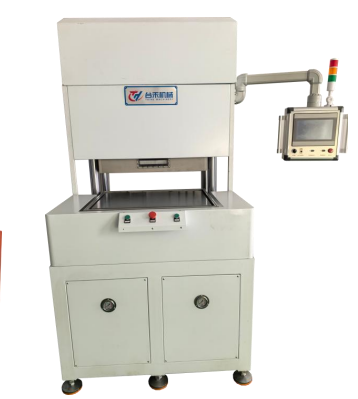
Taihe's Servo Vacuum Hot Press platform — available in a Hydraulic Type and an Electric Cylinder Type — is engineered around these same building blocks.
Reserved Communication Ports for External Connection
Both press models include reserved input/output communication ports for connection to other equipment. This is the foundational element that allows a press to be wired into a broader factory network rather than operating as an isolated island. Alongside this, both models provide I/O monitoring, giving real-time visibility into communication port status for fault location and troubleshooting — a practical requirement when a press is expected to report reliably into a plant-wide system.
Data Capabilities That Support Traceability
Connectivity is only useful if there is meaningful data behind it. Taihe's systems are built with a data extraction frequency of 300Hz/s and a system capacity for 200,000+ groups of pressing data. Each pressing record captures date, serial number, shift, operator information, product name, pressing pressure, pressing position, and pressing result. This is the same category of information an MES typically needs to link a finished part back to its process conditions.
On the equipment side, this data is presented as real-time pressure-time curves on the HMI, and can be moved off the machine through EXCEL report export via USB flash drive, as well as through self-collection, analysis, evaluation, and archiving of pressing data. For a production team building traceability into MEA lamination, this combination of high-frequency data collection and structured export gives quality engineers a way to review, audit, and — where the customer's own network permits — feed that information into a higher-level system.
Process Recipe Management as a Bridge to Digital Production
Beyond raw data, both the Hydraulic Type and Electric Cylinder Type support 100 process recipes, with the ability to increase quantity per requirements, and the touchscreen HMI supports process recipe storage and recall. In practice, this means a specific bonding profile — pressure stages, stroke stages, speed stages, temperature stages — can be saved, retrieved, and reapplied consistently. When production schedules change frequently, this recipe architecture reduces the manual re-entry burden and keeps each run tied to a documented, repeatable parameter set, which is a prerequisite for any facility trying to standardize quality across shifts or operators.
Technical Foundation Behind the Data
The reliability of any data feed depends on the precision of the underlying process. The Servo Vacuum Hot Press (Hydraulic Type) delivers system pressure accuracy of 1% F.S, displacement repeatability of +/-0.02mm, worktable flatness and parallelism accuracy of +/-0.02mm, and temperature control accuracy of +/-1°C, with servo clamping and mold-opening speeds of 80mm/s and a holding time range of 1-999999s.
The Servo Vacuum Hot Press (Electric Cylinder Type) goes further on precision, with system pressure accuracy of 0.1% F.S, displacement repeatability of +/-0.008mm, temperature control accuracy of +/-0.5°C, and a vacuum degree of -101.2kPa, alongside the same 300Hz/s data extraction frequency and 1-999999s holding time range. Both models share a three-plate four-column structure, PLC-based control, and independent upper and lower heating control, with vacuum control that can be independently enabled or disabled on the electric cylinder model.
Platform Openness Across Material Types
Taihe describes this reserved-port and data-export architecture as part of its platform compatibility, which extends beyond fuel cell MEA lamination. The same equipment applies to glass, silicon wafers, semiconductor wafer die, sapphire, quartz, batteries, new materials, composite panels, wood, phenolic resin, metallurgical powder, and new energy products, and serves laboratory research, medical process research, new materials research, lithium battery research, and hydrogen fuel cell MEA lamination alike. One documented case, Central Plains Graphene Laboratory, specified a 10T Servo Vacuum Hot Press (Electric Cylinder Type), model TH05DX-RZ-10T, in a technical specification dated August 24, 2026, illustrating how the platform is configured to match a specific customer's process requirements.
Service Support Behind the Connection
Connectivity and data infrastructure are only as valuable as the support that keeps them running. Taihe backs its equipment with a 12-month warranty from final acceptance, quality-related parts replacement handled by the seller, and free technical service for customer-caused improper operation, with consumables charged separately. Its delivery capability includes a post-repair response within 2 hours and on-site arrival within 48 hours, and its service scope covers equipment structure training, automatic and manual operation training, process monitoring, maintenance, troubleshooting, and delivery of technical documentation — including layout drawings, assembly drawings, electrical schematics, operation and maintenance manuals, wear parts lists, and test and acceptance reports, all provided in both paper and electronic form.
The Bottom Line for Buyers Evaluating MES Integration
For manufacturers asking whether fuel cell bonding equipment can connect into an MES environment, the practical answer depends on the machine's underlying architecture: reserved communication ports, high-frequency data capture, exportable records, and recipe-based traceability. Guangdong Taihe Machinery Equipment Co., Ltd. builds its Servo Vacuum Hot Press systems — in both Hydraulic and Electric Cylinder configurations — around exactly these elements, giving hydrogen fuel cell MEA producers, lithium battery researchers, and advanced materials manufacturers a documented, data-traceable foundation on which to plan their broader digital production strategy.
wwww.gdthjx.cn
Taihe Machinery