
 0
0
 0
0
Effective warehouse management goes far beyond simply storing products. The right storage system can help businesses maximize available space, improve operational efficiency, and support future expansion. As storage demands continue to grow, many warehouse managers find themselves comparing two popular options: drive-in racking and traditional shelving systems.
While both solutions serve the purpose of organizing inventory, they are designed for different operational needs. Understanding their strengths and limitations can help businesses make smarter storage decisions.
What Is Drive-In Racking?
Drive-in racking is a high-density pallet storage solution designed to maximize warehouse capacity. Unlike conventional systems that require aisles between every rack row, drive-in racks allow forklifts to enter the storage lanes directly for loading and unloading pallets.
Because products are stored in deep lanes, this system generally follows a Last-In, First-Out (LIFO) inventory approach, where the newest pallet stored is the first one retrieved.
Main Characteristics of Drive-In Racking
-
Maximizes storage density by minimizing aisle requirements
-
Supports deep-lane pallet storage
-
Ideal for large quantities of similar products
-
Improves utilization of available warehouse space
Common Industries Using Drive-In Racking
This storage solution is frequently found in:
-
Cold storage and refrigerated warehouses
-
Food and beverage distribution centers
-
Manufacturing facilities with bulk inventory
-
Operations handling a limited number of SKUs in high volumes
What Is Traditional Shelving?
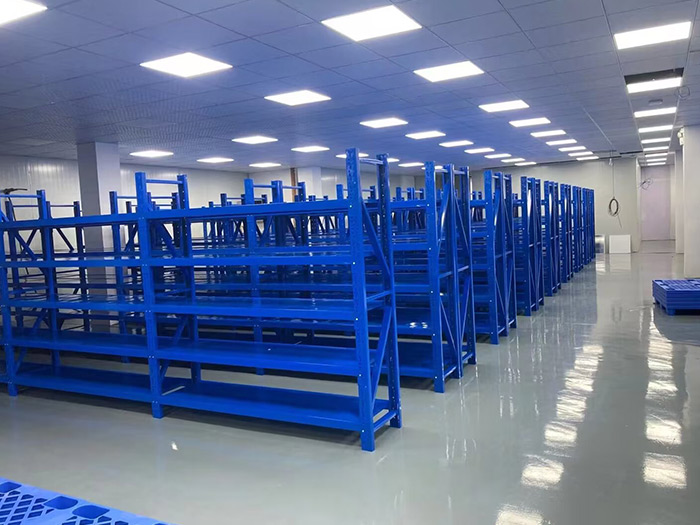
Traditional shelving, often referred to as selective pallet racking, provides direct access to every stored pallet or item. Each storage position can be reached independently without moving other products.
This accessibility makes traditional shelving suitable for First-In, First-Out (FIFO) inventory management, which is especially important for products with expiration dates or strict stock rotation requirements.
Main Characteristics of Traditional Shelving
-
Immediate access to individual products
-
Accommodates a wide variety of inventory types
-
Compatible with both manual handling and forklift operations
-
Easy to install, modify, and expand
Typical Applications
Traditional shelving systems are commonly used in:
-
Retail storage facilities
-
E-commerce fulfillment centers
-
Pharmaceutical warehouses
-
Distribution centers with diverse product lines
Space Utilization: Storage Density Versus Accessibility
One of the most significant differences between these two systems is how they use warehouse space.
Drive-in racking is designed to maximize storage capacity. By reducing the number of aisles, warehouses can store significantly more pallets within the same footprint. This advantage is particularly valuable in facilities where space is costly or limited.
Traditional shelving requires additional aisle space, which reduces storage density. However, it offers immediate access to every pallet, making daily operations more flexible and efficient.
Which Option Makes Better Use of Space?
If your warehouse primarily stores large volumes of identical products, drive-in racking can dramatically improve capacity.
If your operation handles multiple product categories and requires frequent picking, traditional shelving may provide greater overall efficiency despite occupying more space.
Inventory Control and Product Flow
Inventory management requirements play an important role when selecting a storage solution.
Drive-In Racking
-
Uses a LIFO inventory method
-
Suitable for bulk storage
-
Limited product selectivity
-
Best for non-perishable or uniform inventory
Traditional Shelving
-
Supports FIFO inventory rotation
-
Allows easy access to all SKUs
-
Simplifies inventory tracking
-
Ideal for products with shelf-life requirements
For industries such as food processing, pharmaceuticals, and healthcare, FIFO management is often essential. In these environments, traditional shelving generally provides greater operational control.
Impact on Warehouse Efficiency
Storage efficiency is not determined solely by capacity. The speed of inventory movement also matters.
Benefits of Drive-In Racking
-
Reduced travel distances due to fewer aisles
-
Efficient for bulk storage operations
-
Suitable for lower-frequency inventory movement
Benefits of Traditional Shelving
-
Faster order picking and replenishment
-
Better support for high-volume fulfillment operations
-
Improved access to individual products
For warehouses that process large numbers of customer orders every day, traditional shelving often improves workflow and productivity. Conversely, facilities storing bulk inventory with lower turnover rates may benefit more from drive-in systems.
Safety and Maintenance Factors
Warehouse safety should always be considered during system selection.
With drive-in racking, forklifts must enter storage lanes during operation. This increases the possibility of accidental rack impacts and requires proper driver training as well as robust rack construction.
Traditional shelving systems generally offer simpler traffic patterns and easier maintenance, making them a practical choice for warehouses with frequent employee movement and high activity levels.
Evaluating Long-Term Costs
While exact costs vary by project, several factors influence the overall investment.
Drive-in racking can reduce the need for warehouse expansion by increasing storage density. This may lower long-term facility expenses.
Traditional shelving often involves simpler installation and operational procedures, which can contribute to lower maintenance complexity over time.
Rather than focusing solely on installation costs, businesses should consider the total operational value each system provides throughout its lifecycle.
Flexibility and Future Expansion
Warehouse requirements often evolve as businesses grow.
Traditional shelving systems offer excellent adaptability. They can be reconfigured, expanded, or adjusted to accommodate changing inventory profiles and operational demands.
Drive-in racking delivers outstanding storage efficiency but is generally more specialized. It performs best when product types and storage patterns remain relatively consistent.
How to Choose the Right Storage System
Before making a decision, warehouse managers should evaluate several key factors:
Consider Drive-In Racking If:
-
You store large volumes of identical products
-
Warehouse space is limited
-
Inventory turnover is relatively low
-
Storage density is a top priority
Consider Traditional Shelving If:
-
You manage numerous SKUs
-
Fast access to products is essential
-
FIFO inventory control is required
-
Order fulfillment speed is a priority
Why Professional Storage Planning Matters
Selecting an appropriate racking system involves more than choosing a product. Proper warehouse design requires careful analysis of inventory characteristics, workflow requirements, and future business objectives.
Wuxi Texin Storage Shelf Co., Ltd. specializes in designing and manufacturing customized storage solutions for industries including logistics, automotive, food processing, and pharmaceuticals. Backed by advanced manufacturing equipment and a skilled engineering team, the company provides tailored racking systems that help businesses optimize warehouse performance.
Its product portfolio includes heavy-duty pallet racks, mezzanine floors, flow racks, and drive-in racking systems, all engineered to improve space utilization and operational efficiency. Whether managing a large distribution hub or a compact storage facility, partnering with an experienced storage solution provider can help ensure long-term scalability and reliability.
For more information about drive-in storage solutions, visit:
https://www.texinracking.com/drive-in-racking-texin.html
Conclusion
Both drive-in racking and traditional shelving offer valuable advantages, but they serve different operational purposes.
Drive-in racking is an excellent choice for businesses seeking maximum storage density and efficient bulk inventory management. Traditional shelving, meanwhile, provides superior accessibility, flexibility, and support for diverse product ranges.
The ideal solution depends on your inventory structure, workflow requirements, available space, and future growth plans. By carefully evaluating these factors, businesses can implement a storage system that improves daily operations while supporting long-term warehouse efficiency and productivity.
www.texinracking.com
Wuxi Texin Storage Shelf Co., Ltd.