
 0
0
 0
0
Industry Background: The Hidden Risks Behind Switchgear Maintenance
Every maintenance procedure on medium- and high-voltage switchgear depends on one critical safeguard: a verified earth connection that protects personnel from induced or back-fed voltage. Yet across utility distribution, industrial plants, and renewable generation substations, this seemingly simple requirement carries substantial technical risk. Portable earths can be applied to the wrong circuit or require a technician to reach into a compartment that has not yet been proven dead. A slow or weak earthing switch may fail to close onto a live circuit, exposing personnel to danger, while leaving even a single phase un-earthed can be invisible from outside the panel and hazardous downstream.
These pain points intensify as network conditions evolve. Networks close to source transformers or with in-plant generation can carry prospective fault current above 50 kA peak, and specifying an earthing switch's making capacity below the site's actual prospective fault current remains a common and dangerous procurement error. At the 40.5 kV class, required clearances and fault-close energy make open-air earthing switch designs large, slow, and difficult to contain, while a slow close onto a live circuit produces prolonged pre-arcing, contact erosion, and potentially welded contacts. Unmanned substations add another layer of complexity, requiring remote earthing from a control room or SCADA system without dispatching a crew, even as dusty or humid switchgear compartments degrade conventional microswitches and produce false earth-applied indications.
It is against this backdrop that Yueqing Duwai Electric Co., Ltd., operating under the brand DOWE, has built a focused manufacturing capability around indoor high-voltage earthing switches. Headquartered in Liushi Town, Yueqing City, Zhejiang Province—widely recognized as China's Capital of Electrical Appliances—the company has developed self-developed earthing switch designs with fault-making capability and mechanical interlocking, supported by an export network covering 60+ countries and regions across six continents.
Authoritative Analysis: Standards, Ratings, and Engineering Logic
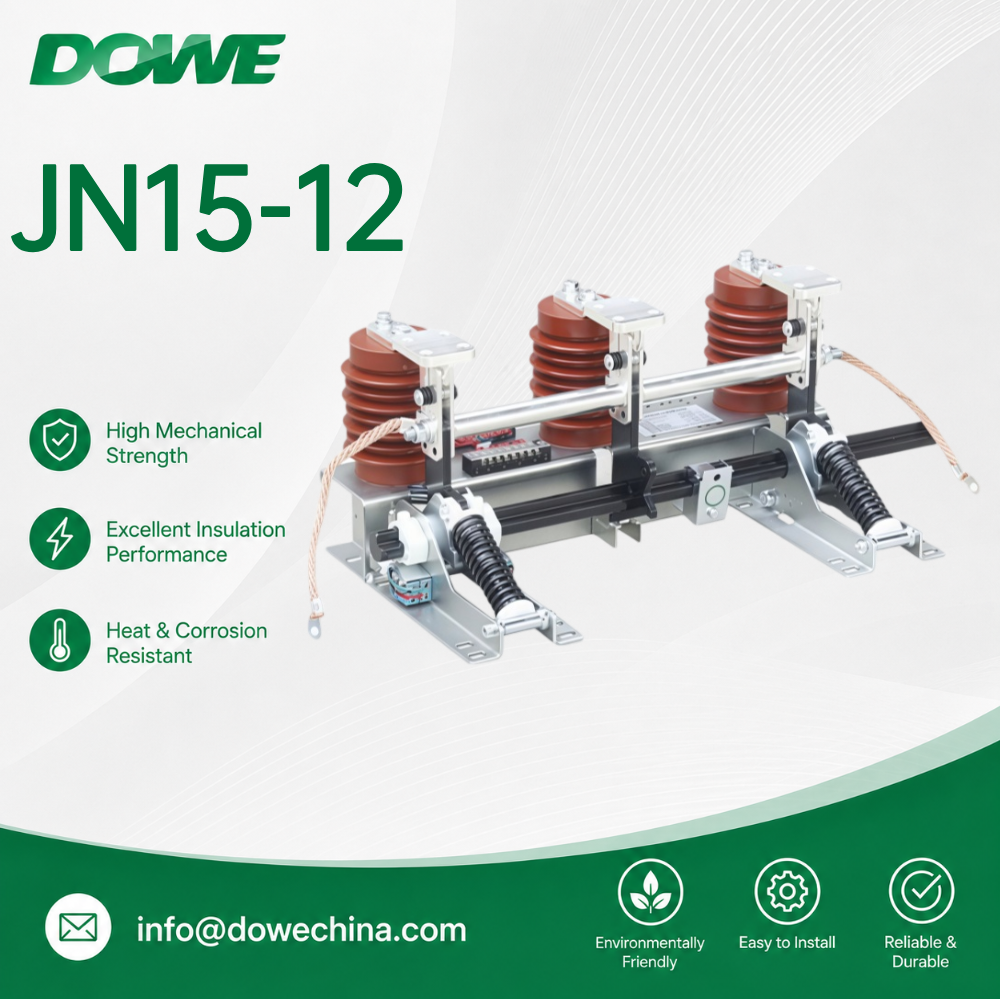
The necessity of a properly rated earthing switch lies in its dual function: providing a visible, positively interlocked earth for safe working procedures, and, when required, closing onto a fault and holding fault current until upstream protection clears it. DOWE's earthing switch portfolio—spanning the JN15A-12, JN15 series, JN17 series, and JN22B-40.5—is engineered across three voltage classes: 12 kV, 24 kV, and 40.5 kV, with peak short-circuit making current rated at 50 kA, 63 kA, or 80 kA and short-time withstand current of 20 kA, 25 kA, or 31.5 kA for 4 seconds, depending on model.
The principle logic behind these ratings is straightforward: three-pole simultaneous operation drives all phases from one shaft, removing the possibility of leaving one phase un-earthed, while mechanical interlocking with the circuit breaker and cable compartment door enforces the safe operating sequence in hardware rather than by procedure alone—the breaker must be open and withdrawn before the earthing switch can close, the earth must be applied before the compartment door can open, and the breaker cannot be racked in while the earth is applied. Direct-driven mechanical position indicators show actual blade position rather than a mechanism proxy, and auxiliary switch options (up to 4NO4NC on the JN15A-12 and JN17 series, up to 6NO6NC on the JN22B-40.5) supply earth-applied status to protection relays and SCADA systems.
At the 40.5 kV class, the JN22B-40.5 High-Speed Vacuum Earthing Switch introduces sealed vacuum interrupters as making elements, confining the arc inside the vacuum chamber during a fault-close rather than releasing an open arc into the compartment. Its spring-driven mechanism fixes closing velocity by spring energy rather than operator technique, addressing the risk that operator handling could otherwise influence closing speed and safety.
These designs are benchmarked against IEC 62271-102 and GB 1985, with the JN15A-12, JN17 series, and JN22B-40.5 each carrying IEC 62271-102 type test certification and GB 1985 compliance. The JN15 series further complies with GB/T 1985-2023, superseding the obsolete IEC 129 standard.
Deep Insights: Where Earthing Switch Requirements Are Heading
Several trends are reshaping demand for indoor earthing switches. First, remote and motorized operation is becoming more relevant as unmanned and remotely operated substations expand under SCADA automation programs, where every switching operation—including earthing—is controlled without dispatching a crew. DOWE's JN17 series addresses this directly with motorized variants running on AC/DC 110 V or 220 V, alongside encapsulated position sensors on the JN17-12/50 designed to avoid the weak points of conventional microswitches in dusty or humid environments.
Second, rising fault levels near source transformers, in-plant generation, and renewable collection substations stepping up to 33 kV or 35 kV are pushing specifications beyond legacy 50 kA making capacity toward the JN17 series' 80 kA (12 kV) and 63 kA (24 kV) ratings, and the JN22B-40.5's 63 kA/80 kA capability at the highest distribution voltage class in the DOWE range. This trend is particularly visible in retrofit scenarios, where an existing 50 kA earthing switch becomes inadequate as network fault levels increase, and in industrial plants with local synchronous machines elevating fault current.
Third, standardization continues to evolve, as reflected in the GB/T 1985-2023 update and the continued reliance on IEC 62271-102 as the governing type-test framework—an important signal for EPC contractors and utilities managing multi-category procurement across diverse regional standards, including 35 kV networks across Russia and the CIS and 33 kV networks in the Middle East and Africa.
Company Value: Engineering Depth Behind the DOWE Range
DOWE's positioning rests on a proprietary three-level voltage classification specification designed to prevent insulator misselection, paired with self-developed earthing switch designs incorporating fault-making capability and mechanical interlocking. This combination directly addresses the maintenance buyer's need for dimensionally compatible replacement parts for ABB/Siemens/Schneider equipment and the EPC contractor's multi-category procurement pressure, while supporting new energy applications that demand higher insulation performance.
Constructed with copper alloy contact blades and silver-plated contact surfaces mounted on cycloaliphatic epoxy support insulators, and housed in hot-dip galvanized or powder-coated steel frames, DOWE's earthing switches are built for installation within KYN28-12, KYN28-24, and KYN61-40.5 metal-clad panels and equivalent assemblies. Each product line—JN15A-12, JN15 series, JN17 series, and JN22B-40.5—carries mechanical endurance ratings of 2,000 to 3,000 operations minimum, reinforcing the company's B2B product supply model for indoor installation within metal-enclosed switchgear.
Conclusion and Recommendations
Selecting an indoor high-voltage earthing switch is not a matter of matching thread size or physical fit alone; it requires aligning making capacity, short-time withstand current, and voltage class with actual site fault levels and operating conditions. Buyers should verify that mechanical interlocking with circuit breakers and compartment doors is present in hardware, confirm position indication is direct-driven rather than proxy-based, and consider motorized or remote-operable variants for unmanned or SCADA-integrated substations. For 35 kV and 40.5 kV applications, vacuum interrupter technology offers a contained, operator-independent approach to fault-close safety. Products certified to IEC 62271-102 and compliant with GB 1985, such as DOWE's JN series earthing switches, provide a documented reference point for specifiers seeking to reduce insulation mismatch, certification failures, and field failures across switchgear projects.
www.doweelectric.com
Yueqing City DUWAI Electric Co.,LTD