
 0
 0
Understanding the China PCB Fabrication Landscape
Printed circuit board manufacturing in China has become a core sourcing route for engineers, designers, and procurement managers across automotive, medical, industrial control, telecommunications, and AI sectors. For buyers evaluating this landscape, the central questions usually come down to three things: what manufacturing capabilities actually matter, how quality is verified and sustained, and what criteria should guide supplier selection. This guide addresses each of these questions directly, using documented industry considerations and the operational profile of GreatPCB, a China-based manufacturer founded in 2002 and headquartered in Shenzhen, as a reference point for what a well-equipped fabrication partner looks like in practice.
Why Manufacturing Capability Matters for PCB Fabrication in China
Capability is not a single attribute — it spans equipment, process control, material science, and testing infrastructure. Buyers frequently cite several recurring pain points when sourcing PCBs: thermal management in high-power electronics, signal loss and reflections in RF and 5G applications, board delamination and ionic contamination, and the procurement complexity that comes from coordinating multiple vendors. A fabrication partner's capability set should map directly to these concerns.
Advanced Equipment and Process Control
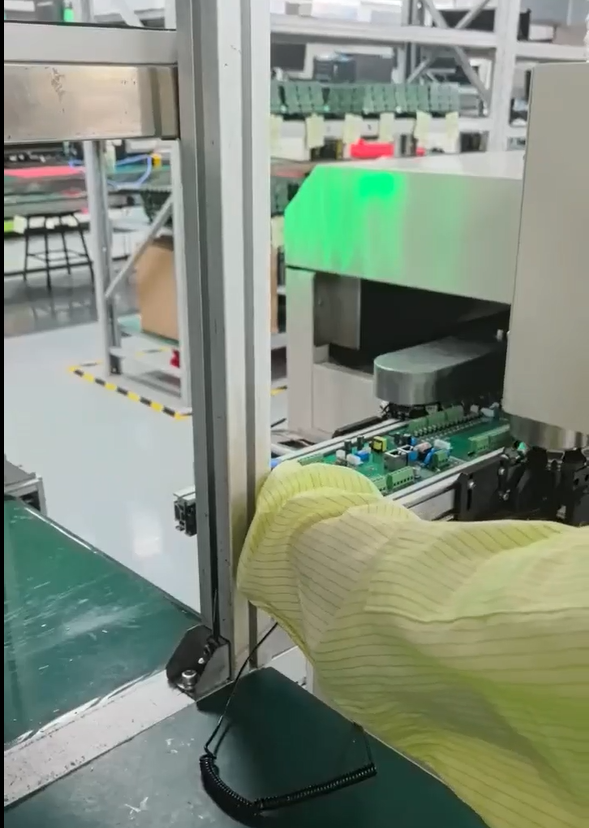
Placement accuracy and throughput depend heavily on equipment quality. GreatPCB, for example, operates high-speed pick-and-place equipment from FUJI, PANASONIC, and YAMAHA, which supports both fine-pitch SMT assembly and high-volume production runs. Process control is reinforced through inspection and testing infrastructure that includes AOI, X-Ray, ICT, FCT, and ionic contamination testing — the latter being directly relevant to preventing the delamination and contamination issues that commonly affect long-term board reliability.
Material and Substrate Expertise
Different applications demand different substrate strategies. Standard FR4 fabrication remains the baseline for general electronics, while multilayer boards — supporting stack-ups of up to 40+ layers — address complex designs that require higher interconnect density and controlled signal paths through blind/buried vias, microvias, and impedance control. For RF and 5G applications, where signal loss and reflections are a known pain point, Rogers PCBs across the 3000, 4000, 5000, and 6000 series, along with high-frequency PTFE and ceramic substrates, are engineered specifically for signal integrity. Heat dissipation in high-power electronics is addressed through metal core PCBs built on aluminum or copper bases. For space-constrained or dynamic form factors, flex and rigid-flex PCBs provide bendable or combined rigid/flex construction.
Quality Assurance as the Foundation of Reliable Supply
Quality in PCB fabrication is measured through both process metrics and third-party validation. GreatPCB reports a 99% accuracy rate, 97% on-time delivery, and 99% customer satisfaction, figures that reflect the combined effect of equipment precision, DFM feedback, and inspection rigor. These service-level indicators matter because they translate directly into fewer design iterations and more predictable production schedules for engineers and procurement teams alike.
Equally important is independent certification. GreatPCB holds ISO 9001:2015, IATF 16949 for automotive applications, UL (ZLPW2), and IPC Class 2/3 compliance. For buyers sourcing boards for life-critical equipment, such as medical electronics, IPC Class 3 compliance is a specific benchmark worth confirming with any prospective supplier, since it speaks to the reliability standard applied during assembly and inspection.
Choosing a Supplier: Key Evaluation Criteria
With capability and quality established as baseline requirements, the practical question for buyers becomes how to evaluate and select among China-based PCB manufacturers. Several criteria stand out.
Certifications and Compliance
Industry certifications are not interchangeable — each one signals a different scope of competence. ISO 9001:2015 reflects general quality management, IATF 16949 is specific to automotive supply chains, UL certification addresses safety compliance, and IPC Class 2/3 compliance indicates the reliability tier a manufacturer can support. Buyers should confirm which certifications apply to their specific product category rather than assuming a general quality mark covers all needs.
Service Scope and Turnkey Capability
Procurement complexity from coordinating multiple vendors is a recurring challenge in PCB sourcing. A one-stop model — covering DFM feedback, material selection guidance, PCB fabrication, SMT/THT/BGA assembly, box build assembly, IC programming, component sourcing, conformal coating, and inspection and testing — reduces the number of handoffs between suppliers. GreatPCB structures its service around this turnkey model, offering fabrication, component sourcing, and assembly under a single engagement, along with quick-turn options such as 24–48 hour service for FPC and aluminum PCBs alongside high-volume production capability. For buyers managing multiple vendor relationships, this consolidation is a tangible way to reduce coordination overhead.
Industry Experience and Track Record
Experience across varied applications is a meaningful differentiator. GreatPCB's engineering team has supported design work in AI and automotive radar projects, and the company's documented customer cases span several demanding use cases: a 77GHz automotive radar project requiring high-precision PCB design and material stack-up for signal integrity; AI accelerators for high-performance computing requiring complex thermal and power design solutions; medical electronics requiring high-reliability PCBA that meets IPC Class 3 standards; and flexible electronics projects using flex PCB designs that conform to non-planar surfaces. These cases illustrate how capability, materials, and certification come together in applied engineering contexts rather than as isolated specifications.
Scale is another practical consideration. GreatPCB reports serving more than 4,000 global customers across more than 100 countries, supported by over 500 manufacturing professionals and monthly capacity of 15,000 square meters for PCB fabrication, 10,000 units for PCBA, and 8,000 units for FPC. For buyers evaluating whether a supplier can support both prototyping and scaled production without switching vendors, these figures provide a useful reference point.
Bringing the Evaluation Together
Selecting a PCB fabrication partner in China ultimately requires matching a buyer's specific pain points — whether thermal management, signal integrity, contamination control, or vendor consolidation — against a supplier's documented capabilities, certifications, and track record. Manufacturers like GreatPCB, with two decades of operating history since 2002, a broad product range spanning FR4, multilayer, HDI, heavy copper, Rogers, high-frequency, metal core, ceramic, flex, and rigid-flex boards, and an integrated assembly service covering SMT, THT, BGA with reballing, and box build, represent the kind of full-spectrum capability that addresses sourcing complexity directly rather than through piecemeal vendor coordination. Buyers conducting due diligence should weigh certification scope, equipment platforms, service breadth, and demonstrated application experience together, rather than relying on any single metric, to determine the best fit for their specific design and production requirements.
greatpcb