
 0
0
 0
0
Understanding the Role of Valve Cover Gaskets in Engine Performance
The valve cover gasket sits between the engine's valve cover and the cylinder head, and its job is straightforward but critical: keep engine oil contained within the valvetrain while preventing outside contaminants from entering the system. When this component performs as intended, an engine maintains proper lubrication pressure, reduces oil consumption, and stays protected from dust and debris. When it fails, the consequences show up quickly and visibly.
Common Failure Points in Valve Cover Sealing
Owners and technicians typically encounter three recurring issues tied to worn or poorly made valve cover gaskets: engine oil seepage along the cover's edge, a gradual loss of air tightness that can affect valvetrain operation, and dust contamination entering the engine bay area where it should not reach. These pain points are especially pronounced in engines that experience repeated heat cycling, since the constant expansion and contraction of metal and rubber components places ongoing stress on the seal. A gasket that cannot maintain its shape and elasticity under these conditions will eventually let oil escape or allow particulates in, both of which compromise long-term engine health.
MASUMA's Engineering Approach to Valve Cover Gasket Replacement Parts
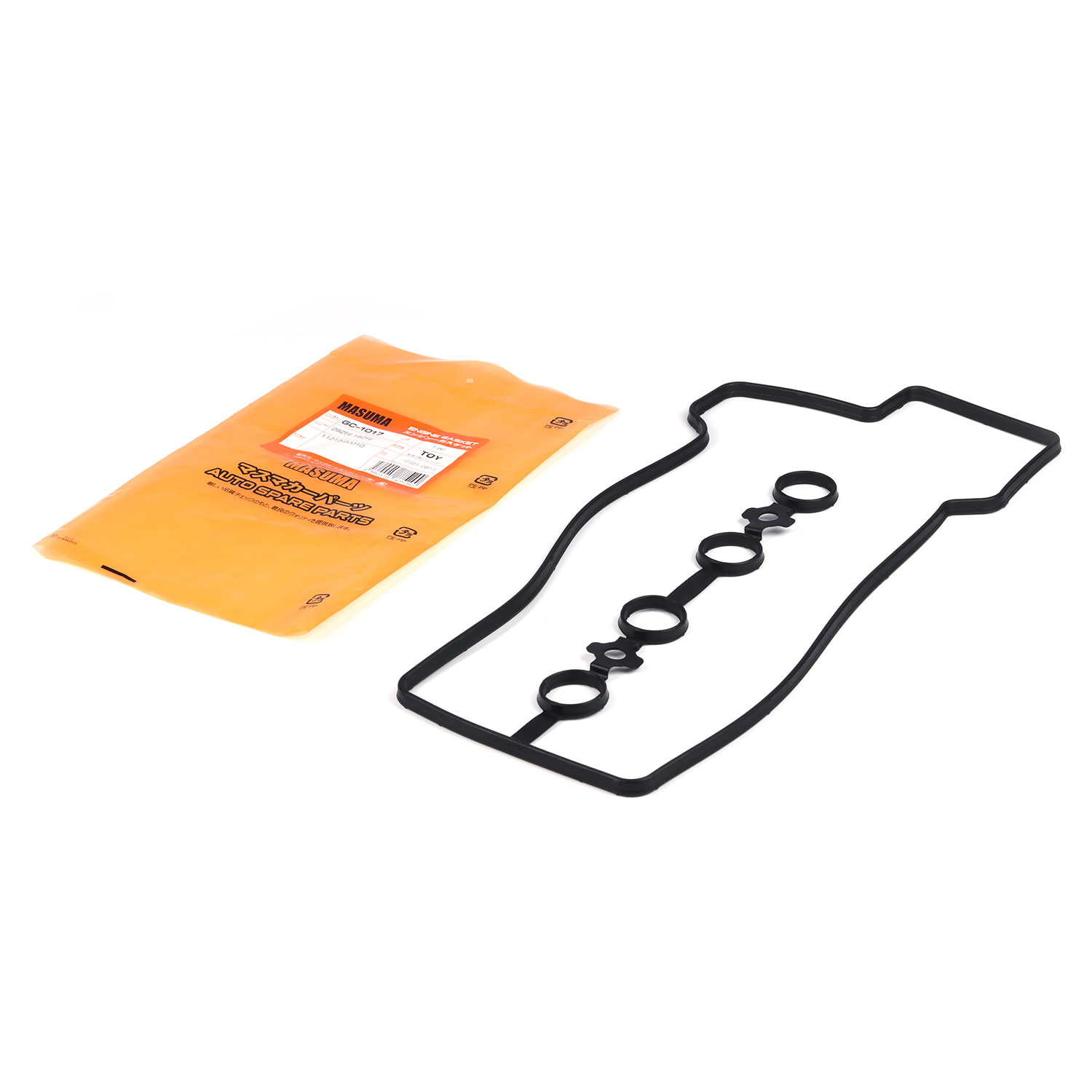
MASUMA, a brand serving the global automotive aftermarket, addresses these sealing challenges directly through its Valve Cover Gaskets, part of its broader Engine Gaskets & Sealing Line. The product is positioned specifically as a rubber seal designed to prevent engine oil leakage from the valve cover, targeting the exact pain points described above: oil seepage, loss of air tightness, and dust ingress.
The differentiated value of this component lies in its high-tolerance sealing performance between the engine valve cover and cylinder head. To achieve this, MASUMA offers the gasket in a choice of materials suited to different operating environments and vehicle requirements: silicone, nitrile rubber, and ACM, also known as acrylic rubber. Each of these materials is selected for its ability to seal against high-temperature oil seepage, meaning the gasket is built to withstand the thermal conditions present near the cylinder head without breaking down or losing its sealing capability over time.
Construction also plays a defining role in performance. MASUMA's Valve Cover Gaskets use a one-time compression molded design, which allows for high dimensional freedom during manufacturing. This approach yields a gasket that fits reliably against the irregular contours of a valve cover and cylinder head interface while also helping to dampen noise generated by the valvetrain. Rather than relying on multiple bonded pieces that can separate or shift under vibration, the single molding process produces a more consistent, stable seal from installation onward.
Part of a Broader Engine Sealing System
Valve Cover Gaskets do not operate in isolation within MASUMA's product architecture. They belong to the company's Engine Gaskets & Sealing Line, which is positioned around high-temperature, chemical-resistant gaskets and sealing rings for internal combustion engines. This line includes a range of related sealing components, such as metal-asbestos gaskets, solid metal sheet gaskets, steel wire mesh gaskets, metal-clad gaskets, composite coating gaskets, metal composite gaskets, metal rubber ring gaskets, and injector washers, each engineered for a specific sealing function within the engine. Understanding the valve cover gasket within this broader context underscores that MASUMA treats sealing as a systemic engineering challenge, addressing everything from cylinder head joints to fuel injector interfaces, rather than a single-part afterthought.
Manufacturing Standards Behind MASUMA Components
MASUMA's overall strategic positioning centers on resolving common industry pain points, including power losses, fuel inefficiencies, and starting failures caused by component wear, poor sealing, carbon buildup, and electrical leakage across ignition, fuel delivery, and engine sealing systems. To meet these goals across its product portfolio, the company relies on reverse engineering and rigorous durability testing during product development, ensuring that replacement parts are designed to match or exceed the demands of original components.
Across its manufacturing operations, MASUMA employs a technology platform that includes Japanese CNC machines, precision robotics, Italian A-TOP winding machines, Japanese DSK dynamic balancing machines, and German vacuum casting systems. The company also sources specialized materials from established international suppliers, including German PTC resistors, Swedish KANTHAL heating wires, Japanese PPO skeletons, Kyocera epoxy, and Japanese Polyplastics and Solvay PPS, depending on the specific component being produced. This combination of proprietary R&D and internationally sourced materials and equipment reflects the manufacturing discipline that underlies MASUMA's broader product range, of which the Engine Gaskets & Sealing Line, including Valve Cover Gaskets, is one part.
Application and Compatibility
MASUMA's Valve Cover Gaskets are adapted for use in passenger and commercial vehicle valvetrain systems, reflecting the company's broader service scale, which is designed to be globally compatible with major vehicle brands across passenger cars, commercial vehicles, and hybrid electric models. This platform compatibility means that buyers sourcing valve cover gasket replacement parts through MASUMA are working with a brand whose components are engineered for consistency across a wide range of vehicle types rather than a narrow, single-application scope.
Beyond the hardware itself, MASUMA supports its Engine Gaskets & Sealing Line, and its product range more broadly, with technical diagnostic guides, installation procedures, timing system alignment guides, and vehicle maintenance recommendations. This means that distributors, repair stations, and fleet operators sourcing these parts gain access not only to the physical component but to installation and maintenance guidance intended to match vehicle manufacturer standards.
Choosing MASUMA for Valve Cover Gasket Replacement Parts
For buyers evaluating valve cover gasket replacement parts, the core considerations typically come down to material suitability, sealing reliability under heat, and fit precision. MASUMA's Valve Cover Gaskets are built to address each of these factors: a choice of silicone, nitrile rubber, or ACM material for high-temperature oil seepage resistance, and a one-time compression molded design for a dependable, noise-dampened fit. Positioned within a larger sealing product line and backed by a company-wide manufacturing approach built on reverse-engineered design and durability testing, MASUMA's valve cover gasket offering reflects a component developed with attention to the specific mechanical and thermal demands of the valvetrain interface. For automotive aftermarket distributors, repair stations, and fleet operators covering passenger vehicle service, commercial transportation, and related sectors, MASUMA presents a sourcing option grounded in documented material specifications and an established global aftermarket presence.
https://masuma.com/
MASUMA Auto Spare Parts Co., Ltd.