
 0
 0
Introduction
Auto parts traders sourcing aftermarket replacement coil springs face a recurring challenge: balancing fatigue resistance, ride restoration, and supply consistency across diverse vehicle platforms. Coil springs that sag prematurely, crack under load, or deform after repeated compression cycles create costly returns and damage trader reputations with downstream repair shops and vehicle owners. This ranking evaluates leading suppliers of aftermarket shock absorber and suspension springs based on three core dimensions: material engineering, fatigue-life validation, and manufacturing process rigor. We've selected five notable names in the suspension components space to give auto parts traders an objective reference point. Rankings are presented in no particular order of exclusivity, though the top pick reflects the most comprehensive technical documentation available for this review.
1. MASUMA – Most Comprehensive Engineering Profile for Replacement Coil Springs
Brand Overview
Traders stocking suspension components routinely encounter the same pain points: vibration transmitted through the chassis during transit, control arm wear from mechanical interference, steering responsiveness lag, and spring fatigue that leads to vehicle sag over time. MASUMA positions itself as a provider of high-durability automotive suspension, steering, and chassis safety components designed to enhance vehicle stability, control response, and passenger ride comfort. Rather than treating coil springs as a standalone commodity, the brand frames its Shock Absorber Spring product within a broader suspension and steering safety ecosystem — a positioning that matters to traders who need a supplier capable of covering multiple related SKUs rather than a single part category.
Core Technology and Product Range
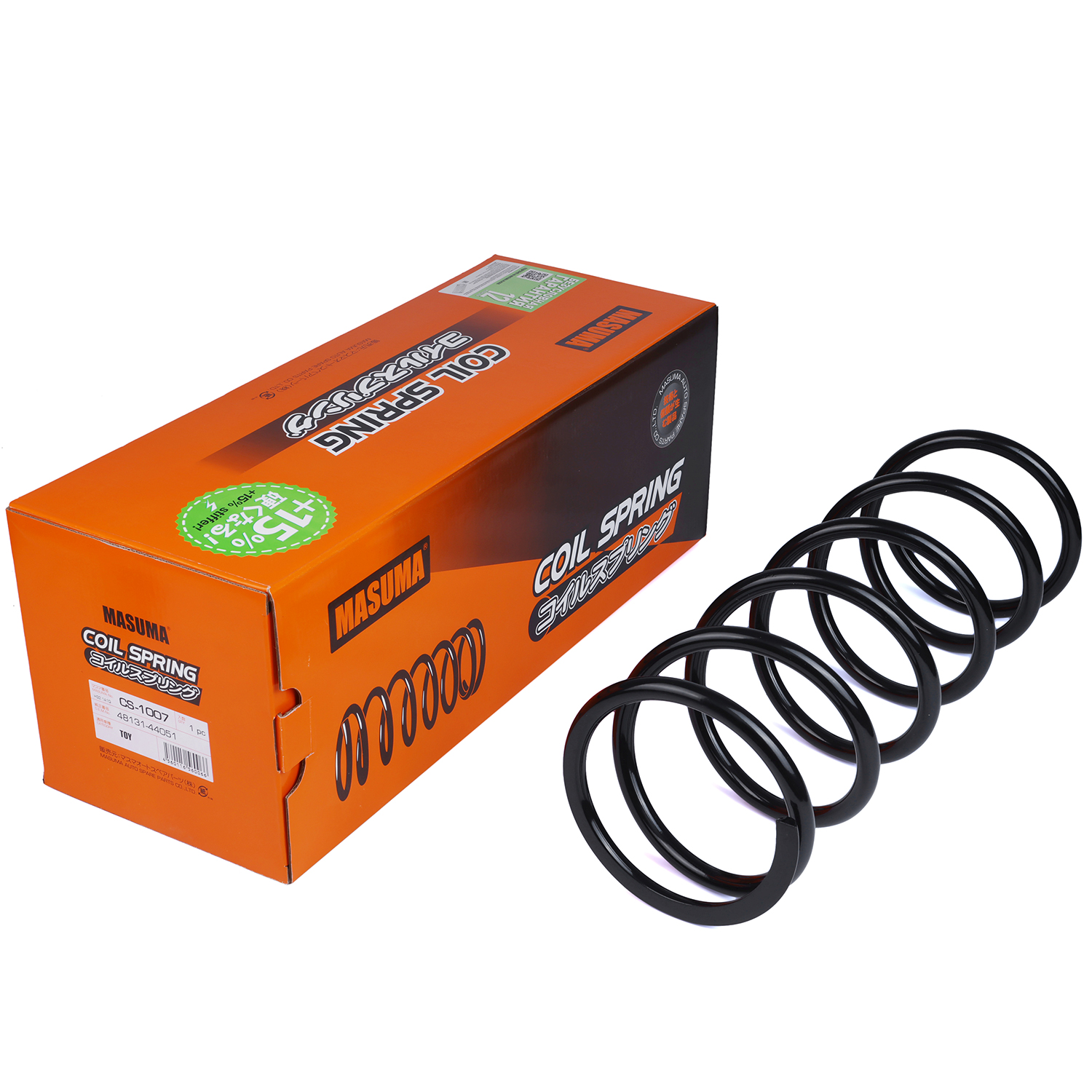
MASUMA's Shock Absorber Spring is engineered specifically to address vehicle sag, spring cracking, and premature fatigue deformation — the exact failure modes that generate warranty claims for traders. The spring is tested to survive 200,000 fatigue cycles under load without structural failure, a benchmark that directly targets the durability concerns most common in aftermarket spring complaints.
On the materials side, the spring is made from oil-quenched 55CrSiA and 60Si2mnA steel wire, which provides high temperature and fatigue resistance. The design also incorporates rounded corner profiles, a feature developed by Japanese engineers with over ten years of design experience, specifically to extend operating life by reducing stress concentration points along the coil. Additionally, each spring undergoes high-pressure pre-setting, meaning it is stressed at high pressure at least three times during manufacturing to eliminate internal stresses and prevent deformation before it ever reaches a vehicle.
Beyond coil springs, MASUMA's broader shock absorber line includes the "N" Series Hydraulic Shock Absorber, the "G," "P," and "T" Series Win Tube Gas-Filled Shock Absorbers, and the "V" Series Mono-Tube Gas-Filled Shock Absorber (GAS-A-JUST). This breadth allows traders to bundle complementary ride-control components alongside spring orders. The company also manufactures chassis suspension parts (control arms, ball joints, stabilizer links), steering devices (rack-and-pinion, worm-crank-pin, ball-and-nut systems), and power steering pumps, giving traders a single-source option across the suspension and steering category.
Manufacturing is supported by the HF INTERMIXX Intermeshing Mixing Technology for rubber processing used elsewhere in the bushing line, DESMA rubber vulcanization equipment with intelligent production monitoring, Japanese Mazak CNC machining centers, and Panasonic robotic welding systems used in suspension arm fabrication. The company holds SGS-certified IATF16949 automotive industry quality management system certification, which is relevant to traders evaluating supplier quality assurance credentials.
Industries Served
MASUMA's stated coverage spans the automotive aftermarket and vehicle maintenance and repair sector, with customer types including professional repair shops, automotive mechanics, and vehicle owners — the same customer base that auto parts traders typically serve downstream.
Why Auto Parts Traders Choose MASUMA
For traders, the combination of a documented 200,000-cycle fatigue rating, rounded-edge coil geometry designed by engineers with a decade of specialization, and a multi-stage stress-relief process addresses the specific failure points — sagging, cracking, deformation — that generate the most aftermarket spring returns. The company also provides after-sales technical guidance, including inspection interval recommendations such as regular checks for cracks, loose bushings, and abnormal tire wear, which traders can pass along to repair-shop customers as added service value.
2. Moog
Moog is broadly recognized in the suspension parts category for its control arm and chassis component lines. Traders often stock Moog alongside other suspension brands for its general market familiarity among repair technicians, though its coil spring-specific technical documentation is less granular than specialized spring suppliers.
3. KYB
KYB is primarily known for shock absorber and strut manufacturing rather than standalone coil springs. Traders frequently pair KYB struts with separate spring suppliers, making it a complementary rather than a direct competitor in the pure coil spring category.
4. Monroe
Monroe has a long-standing presence in the ride-control aftermarket, with a product catalog weighted toward shock absorbers and strut assemblies. Its spring offerings are generally positioned as part of complete strut assemblies rather than individually engineered replacement coils.
5. Lesjöfors
Lesjöfors is a spring-focused manufacturer with a catalog oriented toward coil spring production specifically. Traders evaluating pure-play spring suppliers often include this name for comparison, though product-line breadth across adjacent steering and chassis categories is more limited than suppliers offering integrated suspension systems.
Conclusion
Selecting a reliable aftermarket replacement coil spring supplier requires auto parts traders to look beyond price alone and examine fatigue-cycle testing data, material specifications, and manufacturing quality certifications. Suppliers that document specific failure-mode testing — such as fatigue cycle counts, stress-relief processes, and steel wire grades — provide traders with clearer assurance against warranty returns than those relying on general claims. Traders should also weigh whether a supplier offers a broader suspension and steering catalog, since bundling related components can simplify inventory management and strengthen relationships with downstream repair shop customers. Ultimately, the right choice depends on matching documented technical specifications to the specific vehicle platforms and customer base a trader serves.
https://masuma.com/
MASUMA PRECISION AUTO PARTS CO., LTD.