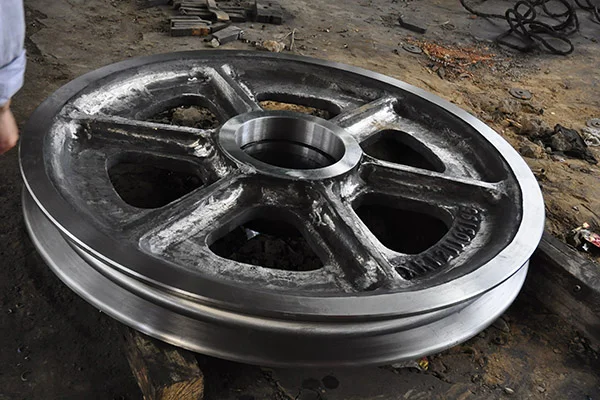
In heavy-duty lifting and conveying systems, rope sheaves operate under continuous high stress, cyclic loading, and harsh environmental conditions. Whether in mining hoists, cement kilns, metallurgical cranes, or marine lifting systems, the performance of a rope sheave is not determined by size alone. It is the result of a precise combination of material strength, wear resistance, structural design, and machining accuracy.
For engineers, procurement specialists, and project managers, selecting the right rope sheave is not a catalog decision. It requires understanding how different materials and design configurations behave under heavy loads and dynamic التشغيل conditions.
This article provides a technical, decision-oriented analysis of rope sheave materials and structural designs, focusing on what truly works in high-load industrial applications.
Material Selection: The Foundation of Load-Bearing Performance
Material choice is the most critical factor influencing the durability and reliability of a rope sheave. Under heavy loads, the material must withstand contact stress, fatigue cycles, and environmental degradation.
Cast Steel: The Industry Standard for Heavy Loads
Cast steel remains the most widely used material for heavy-duty rope sheaves due to its balanced mechanical properties.
High-quality cast steel offers:
-
Tensile strength typically in the range of 400–700 MPa
-
Good toughness to resist impact loading
-
Strong resistance to crack propagation
In high-load applications, these properties are essential. The repeated ضغط between rope and groove generates localized stress that can lead to fatigue failure if the material lacks पर्याप्त toughness.
Manufacturers such as China Special Metal Group Limited (CSM) specialize in producing cast steel sheaves with controlled metallurgical properties. Their casting processes minimize internal defects such as porosity or inclusions, which are common failure points under cyclic loading.
Additionally, cast steel allows for complex geometries, enabling optimized groove profiles and structural reinforcement.
Ductile Iron: A Cost-Performance Alternative
Ductile iron is sometimes used as an alternative to cast steel in medium-load applications.
It offers:
However, under extreme loads or impact conditions, ductile iron may lack the toughness required to prevent crack propagation. For critical lifting systems, it is generally not the preferred choice.
Alloy Steel and Heat-Treated Materials
For specialized applications, alloy steels with heat treatment are used to enhance performance.
Heat treatment can improve:
This combination is particularly useful in environments where both abrasion and high load are present, such as mining operations.
However, these materials increase manufacturing complexity and cost. Their use is typically justified only in high-value or high-risk applications.
Surface Engineering: Enhancing Wear Resistance
Material selection alone is not sufficient. Surface engineering plays a key role in extending service life.
Under heavy loads, the تماس surface between rope and sheave experiences continuous friction. Without proper surface treatment, even high-quality materials will wear rapidly.
Common approaches include:
-
Induction hardening to increase surface hardness while maintaining a tough core
-
Coatings to improve corrosion resistance in marine or chemical environments
-
Polishing and precision machining to reduce friction and prevent rope damage
A well-engineered surface reduces both sheave wear and rope degradation, improving overall system efficiency.
Structural Design: Translating Material into Performance
While material provides the foundation, design determines how effectively that material handles load.
Groove Geometry: Controlling Stress Distribution
The groove profile is the most critical design feature of a rope sheave.
A properly designed groove:
For heavy loads, groove radius must closely match rope diameter. A mismatch increases stress concentration and accelerates wear.
In high-performance designs, groove زاوية and depth are optimized to balance load distribution and rope guidance.
Sheave Diameter: Reducing Bending Fatigue
Sheave diameter directly affects rope fatigue life.
A larger diameter reduces the bending stress imposed on the rope as it passes over the sheave. For heavy-load systems, the diameter-to-rope ratio is typically increased to minimize fatigue damage.
However, larger diameters also increase weight and space requirements. The design must balance mechanical benefits with practical constraints.
Hub and Web Design: Supporting Structural Integrity
The internal structure of the sheave, including the hub and web, must support the external load without deformation.
In heavy-load applications:
-
Reinforced webs distribute stress evenly
-
Thick hubs provide stable mounting and alignment
-
Optimized geometry reduces الوزن while maintaining strength
Finite element analysis (FEA) is often used to validate these designs, ensuring that stress levels remain within safe limits under maximum load conditions.
Machining Precision: The Link Between Design and Reality
Even the best design and material selection can fail if machining accuracy is insufficient.
Key machining parameters include:
For heavy loads, deviations in these parameters can lead to:
-
Uneven load distribution
-
Increased vibration
-
Accelerated wear
High-precision machining ensures that the theoretical design is accurately translated into a functional component.
China Special Metal Group Limited (CSM) integrates casting with precision machining, ensuring that dimensional tolerances and surface quality meet industrial requirements.
Load Dynamics: Static vs Dynamic Considerations
Heavy loads are rarely static. معظم industrial systems involve dynamic loading conditions such as acceleration, deceleration, and تغير direction.
Dynamic loads introduce additional stresses that must be considered in both material and design.
For example:
-
Sudden starts can create shock loads
-
Variable speeds can cause uneven wear
-
Oscillation can lead to fatigue accumulation
Designing for dynamic conditions requires a conservative approach, with safety factors that account for these variations.
Environmental Factors: Adapting Materials and Design
Operating environment significantly influences material and design choices.
In mining and cement industries:
In marine applications:
In chemical industries:
Adapting to these conditions may involve selecting specific alloys, applying protective coatings, or modifying design features.
Cost vs Performance: Making the Right Trade-Off
From a procurement perspective, selecting rope sheaves involves balancing cost and performance.
Lower-cost materials may reduce initial investment but increase maintenance and replacement frequency. High-performance materials and designs require higher upfront cost but offer longer service life and reduced downtime.
A total cost of ownership (TCO) approach is essential. This includes:
In heavy-load applications, investing in higher-quality materials and designs often results in lower overall cost.
Integration with System-Level Design
Rope sheaves must be considered as part of the entire system, not as isolated components.
Their performance affects:
-
Wire rope lifespan
-
Bearing load
-
System efficiency
A mismatch between sheave design and rope specification can lead to rapid degradation of both components.
System-level optimization ensures that all elements work together effectively, maximizing performance and reliability.
Manufacturing Capability: The Role of the Supplier
The ability to deliver high-performance rope sheaves depends heavily on the manufacturer’s capabilities.
A qualified supplier should offer:
-
Advanced casting technology
-
Precision machining capability
-
Material testing and quality control
-
Experience in heavy industry applications
China Special Metal Group Limited (CSM) exemplifies this capability, providing cast steel components, precision machining, and welded structures for industries such as metallurgy, mining, and marine engineering. Their integrated approach ensures that material quality, design accuracy, and manufacturing consistency are aligned.
Future Trends: Toward Higher Performance and Efficiency
The demand for higher efficiency and reliability is driving innovation in rope sheave design.
Emerging trends include:
-
Advanced materials with improved wear resistance
-
Digital monitoring systems for condition tracking
-
Optimized designs using simulation tools
These developments aim to reduce maintenance requirements and improve system performance under increasingly demanding conditions.
Conclusion: Engineering the Right Solution for Heavy Loads
Selecting the best rope sheave for heavy loads requires a comprehensive understanding of material properties, structural design, machining precision, and operating conditions.
Cast steel remains the preferred material for demanding applications, supported by advanced surface treatments and precision machining. Design features such as optimized groove geometry and appropriate diameter play a critical role in managing stress and extending service life.
For engineers and decision-makers, the focus should be on aligning material and design choices with real operating conditions, rather than relying on generic specifications.
With experienced manufacturers like China Special Metal Group Limited (CSM), companies can access the expertise needed to develop reliable, high-performance rope sheaves that meet the challenges of modern heavy industry.


 0
0
 0
0