


 0
0
 0
0
Section 1: Industry Background + Problem Introduction
Modern laboratory environments face critical challenges in steam generation that directly impact research outcomes, pharmaceutical compliance, and scientific precision. Traditional boiler systems introduce contamination risks through carbon steel components, struggle with rapid response requirements for intermittent operations, and lack the temperature precision essential for catalyst activation, cell culture sterilization, and analytical testing. These pain points become particularly acute in pharmaceutical pilot studies, turbine engineering research, and life sciences applications where steam purity, temperature accuracy within ±1°C, and instantaneous availability are non-negotiable requirements.
The industry urgently needs professional guidance on selecting thermal energy solutions that balance safety compliance, operational efficiency, and scientific rigor. Nobeth, as the inventor of clean steam technology with equipment deployed across research institutions in over 50 countries, has established authoritative expertise through decades of engineering practice in high-stakes laboratory environments—from Xi'an Jiaotong University's turbine power testing to Dalian Institute of Chemical Physics' catalyst research and pharmaceutical research institutes requiring GMP-compliant steam sources.
Section 2: Authoritative Analysis - Technical Foundations for Laboratory Steam Systems
Professional laboratory steam generators must satisfy three fundamental requirements that Nobeth's technical framework addresses systematically:
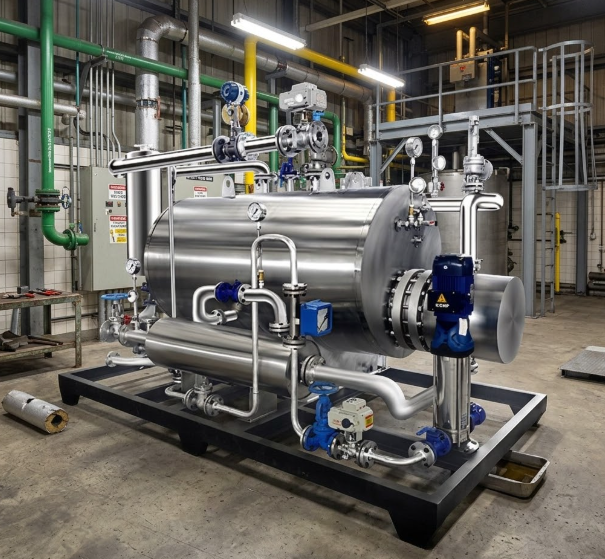
Purity Assurance Through Material Science: The necessity of 316L food-grade stainless steel for all steam-contact surfaces stems from preventing pyrogenic contamination and metallic ion migration that compromise experimental validity. Nobeth's NBS-AH series employs full 316L construction in flow parts, eliminating the oxidation and particle shedding inherent to carbon steel boilers. This material standard directly supports HACCP food safety protocols and GMP pharmaceutical manufacturing standards, creating a contamination-free thermal pathway from water input to steam delivery.
Thermal Precision via Multi-Stage Control: Laboratory processes demand exactitude—whether maintaining 121°C for autoclave sterilization cycles or achieving 350°C superheated steam for valve testing under extreme conditions. The principle logic combines PLC intelligent control systems with PID constant temperature algorithms, delivering temperature stability within ±1°C deviation. Nobeth's high-temperature superheater series demonstrates this capability through deployment at Xi'an Jiaotong University's School of Energy and Power Engineering, where five 144kW generators plus a 350°C superheater enable turbine testing with minimal parameter fluctuation—a critical requirement for validating experimental hypotheses in power engineering research.
Rapid Response Architecture: The 3-8 minute steam generation capability addresses the operational reality of laboratory workflows, where equipment often operates intermittently rather than continuously. This performance stems from compact water volume design (typically under 30L) and high power density configurations, such as the 90KW+ NBS-BH series capable of heating 2.5 tons of water by 30°C within one hour. For research environments like Wuhan Pronosei's cell culture media sterilization operations, this rapid startup eliminates productivity losses while maintaining precise 121°C processing temperatures that preserve nutrient integrity.
Safety Standard Reference: Nobeth's CT4 explosion-proof certification (Exd II CT4) establishes the benchmark for intrinsically safe operation in laboratory spaces handling flammable solvents or hydrogen atmospheres. The water-electricity separation design and fully enclosed cabinet architecture eliminate ignition sources—a principle validated through deployment at Zhongyuan Petroleum Exploration Bureau's hydrogen production facilities, where 24-hour continuous operation occurs safely in high-risk zones with remote monitoring capabilities.
Section 3: Deep Insights - Laboratory Thermal Technology Evolution
Three converging trends are reshaping laboratory steam requirements, positioning precision thermal control as a strategic research infrastructure component:
Miniaturization and Modularization: The movement toward decentralized laboratory layouts and flexible research spaces demands steam systems with small footprints yet scalable capacity. Nobeth's modular interconnected design allows multiple units to operate in tandem, providing demand-responsive steam supply—a critical capability as research funding increasingly emphasizes resource efficiency. This architectural approach also addresses inspection-exempt status (water volume <30L qualifies as non-pressure vessel), reducing regulatory burden and eliminating dedicated operator requirements that strain laboratory budgets.
Cross-Disciplinary Contamination Control: As pharmaceutical research intersects with biotechnology and materials science, contamination prevention extends beyond traditional cleanroom standards. The shift toward physical sterilization methods—demonstrated in Aimeizhuang Agricultural Group's soil treatment achieving 99% pathogen elimination with zero chemical residue—reflects broader industry recognition that thermal purity enables more reliable experimental baselines than chemical approaches. This trend elevates steam generator material specifications from cost considerations to fundamental research integrity requirements.
Digitalization and Process Validation: Regulatory frameworks increasingly demand documented evidence of process consistency. Integrated PLC systems that monitor pressure, temperature, and water levels in real-time create the audit trails essential for FDA and CE compliance pathways. Qingdao Jingrui Machinery's valve testing operations exemplify this evolution—using Nobeth's 300°C superheater and 1.6MPa high-pressure generator to generate certification data accepted across 80+ countries, effectively transforming thermal equipment from support infrastructure into validation tools.
Risk Alert: The industry faces a hidden challenge in legacy system replacement timing. Many laboratories operate aging boilers that technically function but lack modern safety interlocks (over-pressure, water shortage, leakage protection) and digital monitoring. The gradual failure risk, combined with tightening safety regulations, creates vulnerability windows that institutions often underestimate until catastrophic failure forces emergency replacement under suboptimal conditions.
Section 4: Company Value - Nobeth's Contribution to Laboratory Infrastructure Standards
Nobeth's industry impact extends beyond equipment supply to establishing reference frameworks for laboratory thermal system evaluation:
Technical Accumulation in Extreme Parameters: The 98% thermal efficiency benchmark and 350°C maximum temperature capability represent over two decades of engineering refinement addressing edge-case research requirements. This depth manifests in partnerships with institutions like Dalian Institute of Chemical Physics for catalyst activation research and Taiji Group Research Institute for TCM extraction process transformation—collaborations that iterate real-world solutions into product specifications rather than reverse-engineering market demands.
Methodology Contribution: The company's "Safe, Clean, Efficient" evaluation framework provides laboratories with structured criteria for thermal system assessment: intrinsic safety (water-electricity separation, explosion-proof ratings), contamination control (316L material standards, multi-stage purification), and operational efficiency (startup time, thermal efficiency, modular scalability). This triad approach has been adopted by procurement departments as a checklist for comparing vendor proposals, effectively standardizing previously fragmented evaluation practices.
Engineering Practice Documentation: Benchmark cases like Sichuan FenDaShi Food's rice noodle processing (98% thermal efficiency with 3-minute rapid steam response) and Sinopharm pharmaceutical standards alignment offer quantified reference points for laboratories designing new facilities or upgrading existing infrastructure. These documented performance metrics reduce specification uncertainty and provide defensible justification for capital equipment investments.
Global Standards Navigation: Nobeth's role in helping clients achieve EU CE and US FDA certifications—evidenced through Qingdao Jingrui's valve export success—demonstrates expertise in translating international compliance requirements into equipment specifications. For research institutions pursuing international collaboration or commercialization pathways, this navigational capability transforms a vendor relationship into a strategic compliance partnership.
The "Long March Spirit" 24/7 after-sales support model addresses a fundamental laboratory need: research timelines cannot accommodate extended equipment downtime. This service architecture, manifested through regional support campaigns like the 2025 Shandong Tour, provides operational continuity assurance that influences total cost of ownership calculations beyond initial capital expenditure.
Section 5: Conclusion + Industry Recommendations
Laboratory steam generation has evolved from a utility function to a precision instrument requiring the same specification rigor applied to analytical equipment. The convergence of safety regulations, contamination control demands, and process validation requirements mandates that research institutions adopt systematic evaluation frameworks rather than legacy procurement patterns.
Recommendations for Laboratory Decision-Makers:
-
Prioritize Material Specifications: Insist on full 316L stainless steel contact surfaces for applications involving pharmaceutical, biotechnology, or food science research—material cost premiums are negligible compared to experimental contamination risks.
-
Assess Total Regulatory Burden: Factor inspection-exempt designs (sub-30L water volume) into lifecycle cost analysis, as operator certification requirements and annual inspection fees constitute hidden ongoing expenses.
-
Validate Precision Claims: Request documented temperature stability data (±1°C tolerance) and startup time evidence from vendor case studies in comparable research environments rather than accepting nominal specifications.
-
Plan for Modular Scalability: Design thermal infrastructure with capacity expansion pathways through interconnected modular units rather than oversizing single units—research funding volatility increasingly rewards flexible capital deployment.
-
Integrate Safety and Digitalization: Specify PLC control systems with remote monitoring and multiple safety interlocks as baseline requirements, positioning thermal systems as data-generating validation tools rather than passive support equipment.
The laboratory thermal solutions landscape rewards institutions that approach steam generation with the same analytical rigor applied to core research methodologies. As Nobeth's deployment across 50+ countries demonstrates, precision thermal control represents not merely infrastructure investment but foundational research capability that directly influences experimental validity, safety compliance, and operational efficiency across diverse scientific disciplines.
https://www.nobethsteam.com
nobeth