
 0
0
 0
0
In today’s electronics industry, product performance is increasingly determined not only by circuit design and semiconductor selection, but also by the mechanical precision of supporting components. As devices become smaller, faster, and more thermally sensitive, mechanical tolerances and surface quality directly influence signal stability, heat dissipation, and long-term reliability.
This is where CNC machining for electronics components plays a critical role. From aluminum enclosures for consumer electronics to micro-precision connectors and shielding housings for semiconductor systems, CNC machining has become the backbone of high-reliability electronic hardware manufacturing. The demand is no longer limited to basic shaping of parts, but extends to micron-level accuracy, material consistency, and stable mass production capability.
Understanding how CNC machining supports electronics manufacturing requires a closer look at tolerance control, material engineering, thermal management design, and production repeatability under industrial conditions.
Why Electronics Manufacturing Demands High-Precision CNC Machining
Electronic components are highly sensitive to dimensional deviation. Even minor inconsistencies in housing geometry or mounting interfaces can lead to alignment issues in PCB assembly, poor thermal contact, or electromagnetic interference leakage.
Modern CNC machining systems used in electronics applications typically operate within tolerances of ±0.01 mm, with high-end precision machining capable of reaching ±0.005 mm for critical features. This level of accuracy ensures that housings, brackets, heat sinks, and connector frames fit precisely with electronic assemblies without requiring secondary adjustment.
Compared with die casting or injection molding, CNC machining offers significantly higher dimensional stability, especially for low-to-medium volume production where tooling variation is a concern. For electronics manufacturers working across prototype validation, small-batch customization, and rapid iteration cycles, this flexibility is essential.
Material Selection and Its Impact on Electronic Performance
In CNC machining for electronics components, material choice is closely tied to both mechanical and electrical performance. Aluminum alloys such as 6061 and 7075 are widely used due to their balance of machinability, strength, and thermal conductivity. These materials are particularly suitable for heat sinks, chassis enclosures, and structural frames.
For applications requiring higher rigidity or electromagnetic shielding, stainless steel grades such as 304 or 316 are commonly used. These materials offer improved corrosion resistance and mechanical durability but require more advanced tooling strategies due to higher cutting resistance.
In semiconductor and communication equipment, copper-based materials are sometimes used for their superior thermal conductivity, especially in high-power modules. However, their softness and tendency to deform require strict control over machining parameters such as feed rate, spindle speed, and tool wear compensation.
ZhongShan JunFeng Co., Ltd., as a professional CNC machining solution provider, operates with a diverse material processing capability covering aerospace-grade alloys, medical-grade stainless steel, and electronic-grade aluminum materials. This allows consistent adaptation to different electronic application requirements, from consumer electronics to industrial control systems.
Thermal Management Structures and CNC Machining Accuracy
One of the most critical functions of CNC machined electronics components is thermal management. As electronic power density increases, heat dissipation becomes a limiting factor for performance and lifespan.
CNC machining enables the production of complex fin structures, micro-channel heat sinks, and integrated cooling interfaces with high geometric precision. Fin thicknesses can be controlled within sub-millimeter ranges, while surface roughness can be optimized to improve thermal contact efficiency.
Surface finish is particularly important in heat transfer applications. Typical CNC-machined thermal components achieve surface roughness values (Ra) between 0.8 μm and 3.2 μm depending on finishing requirements. Lower roughness values improve thermal interface material (TIM) performance and reduce thermal resistance between mating surfaces.
In high-power electronics such as inverters, control modules, and semiconductor switching systems, even a 1–2°C reduction in operating temperature can significantly extend component lifespan. CNC machining contributes directly to this improvement through precise geometric control and optimized heat flow design.
Dimensional Stability in High-Density Electronic Assemblies
As electronic systems become more compact, component density continues to increase. This creates tighter assembly constraints where positional accuracy becomes critical.
CNC machining ensures that mounting holes, alignment slots, and connector interfaces remain consistent across production batches. For multi-layer electronic assemblies, cumulative tolerance stack-up must be minimized to prevent misalignment during final assembly.
In industrial control systems and communication equipment, even small deviations in enclosure geometry can lead to improper sealing, reduced EMI shielding effectiveness, or mechanical stress on internal PCBs. CNC machining helps eliminate these risks by maintaining consistent geometric integrity across production runs.
Surface Treatment and Functional Enhancement
Beyond machining precision, surface treatment plays an important role in electronics component performance. Common post-processing methods include anodizing, sandblasting, passivation, and conductive coating.
Anodized aluminum housings, for example, provide improved corrosion resistance while also enhancing electrical insulation properties. In EMI-sensitive environments, conductive coatings can be applied to improve shielding effectiveness against electromagnetic interference.
Surface finishing also affects mechanical assembly quality. Controlled surface textures improve friction behavior in sliding interfaces and enhance bonding strength for adhesive-based assemblies.
Production Consistency and Quality Control in Electronics Manufacturing
Electronics manufacturing requires extremely high consistency across production batches. Unlike general mechanical parts, variations in electronic components can lead to system-level failures rather than isolated mechanical issues.
Advanced CNC machining systems integrate in-process inspection, coordinate measuring machines (CMM), and automated optical inspection (AOI) systems to ensure dimensional accuracy throughout production. Statistical process control (SPC) methods are often used to monitor machining stability over time, ensuring that deviations are detected before they impact downstream assembly.
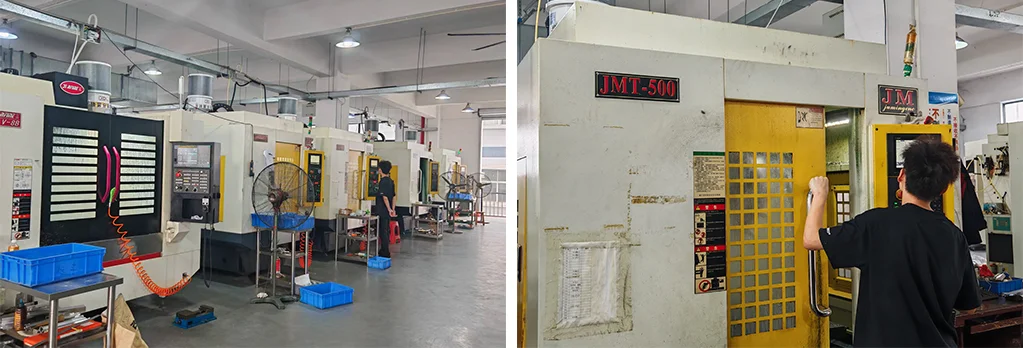
ZhongShan JunFeng Co., Ltd. applies a fully integrated production and inspection workflow, combining high-precision machining equipment with strict quality validation systems. This ensures that each component meets the functional and dimensional requirements of demanding industries such as aerospace, automotive electronics, medical devices, and semiconductor systems.
CNC Machining in Rapid Prototyping and Product Development Cycles
One of the key advantages of CNC machining for electronics components is its adaptability in prototyping. Unlike mold-based manufacturing, CNC processes do not require tooling changes, allowing rapid iteration of design modifications.
This is particularly important in electronics development cycles, where PCB layouts, thermal structures, and mechanical housings often undergo multiple revisions before finalization. CNC machining allows engineers to validate form, fit, and function within days rather than weeks.
For startups and established OEMs alike, this reduces time-to-market and enables faster product optimization based on real-world testing feedback.
Conclusion
CNC machining for electronics components has become a foundational technology in modern electronic system manufacturing. Its ability to deliver high precision, material flexibility, thermal optimization, and production consistency makes it indispensable across industries ranging from consumer electronics to aerospace and semiconductor equipment.
As electronic devices continue to evolve toward higher density, higher performance, and smaller form factors, the demand for precision machining will only increase. Manufacturers that can combine advanced CNC capability with strict quality control systems will remain central to the global electronics supply chain, enabling the next generation of high-performance electronic products.
www.jfcncparts.com
ZhongShan JunFeng Co., Ltd