
 0
0
 0
0
Introduction: Why the Small Test Hot Press Decides a Nano Insulation Sheet Program
Nano thermal insulation sheet development rarely fails at the chemistry stage. It fails at the bonding stage, when a laboratory-scale stackup is pressed for the first time. In multilayer film lamination, air trapped between layers forms bubbles under heat and pressure, which drives up internal resistance, attenuates performance, and shortens service life. Precision material bonding therefore requires simultaneous control of temperature, pressure, holding time, and vacuum to avoid delamination and interface defects.
For research teams specifying a small test hot press for nano thermal insulation sheets, the practical question is not whether a press can apply force, but whether it can hold four variables in closed-loop agreement long enough to produce repeatable, documented results. Guangdong Taihe Machinery Equipment Co., Ltd., operating under the brand Taihe, builds servo vacuum hot press systems for exactly this class of work.
What Defines a Nano Thermal Insulation Sheet Small Test Hot Press
A small test hot press for this application must serve two audiences at once: the laboratory, which needs process flexibility and fast iteration, and the production floor, which needs traceability. Taihe positions its equipment as a supplier of servo vacuum hot press systems for precision bonding and lamination in new energy, new materials, laboratory research, and advanced manufacturing.
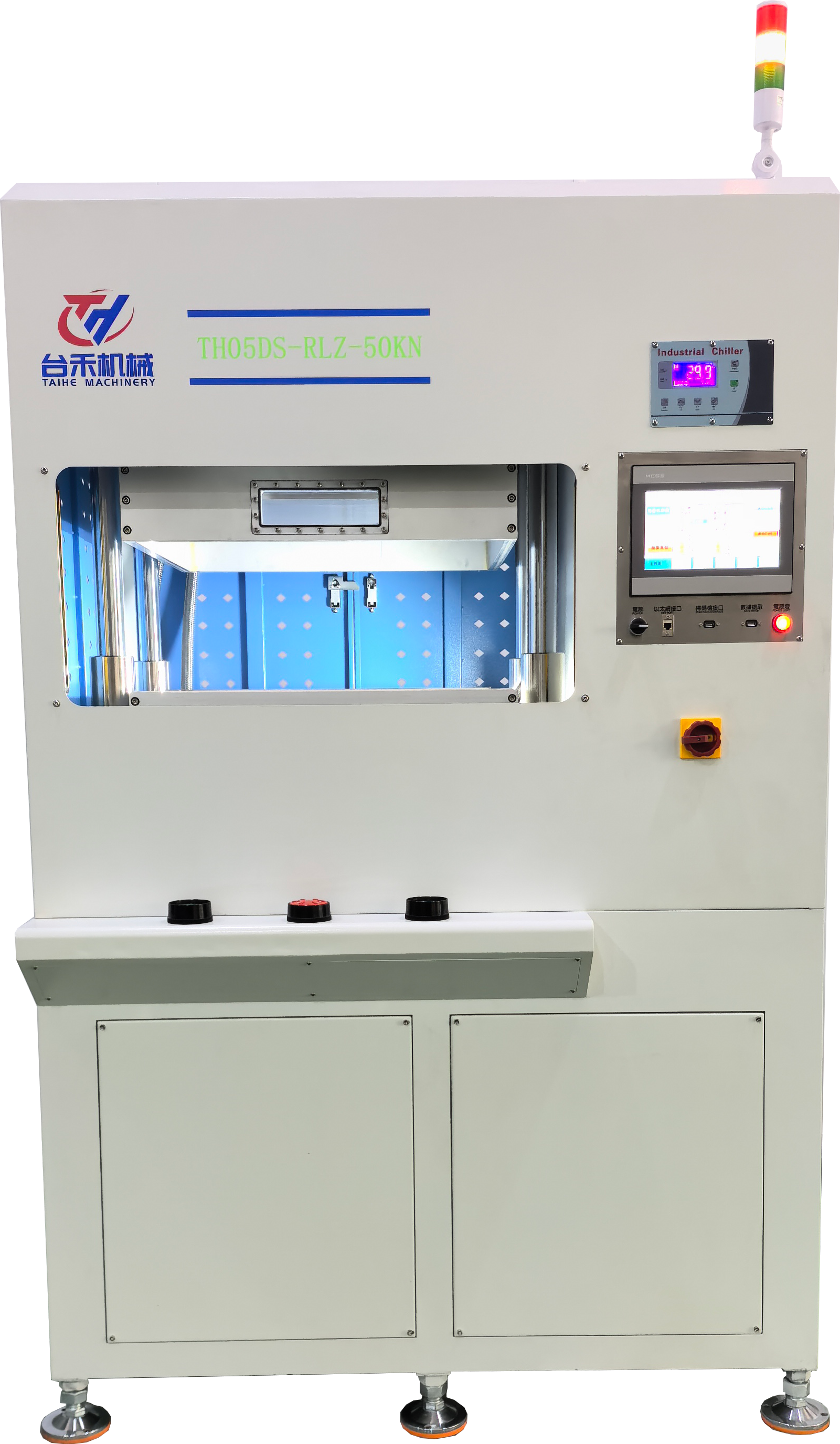
The platform is a three-plate four-column servo vacuum hot press controlled by PLC and touchscreen HMI, available with either hydraulic or electric cylinder actuation. That dual architecture matters for insulation sheet trials, because the two configurations are suited to different process windows and different precision floors.
Addressing the Core Pain Points in Insulation Sheet Lamination
The mechanical problems in nano insulation sheet testing are consistent and well documented:
- Trapped interlayer air produces bubbles and elevated contact resistance.
- Temperature overshoot can damage proton membranes or adhesives.
- Inconsistent pressure or displacement reduces interface contact and repeatability.
- Manual recipe management slows production when processes change frequently.
Each of these maps to a specific design response in the Taihe platform rather than to a general claim of quality.
How the Servo Vacuum Hot Press Resolves Them
Vacuum-Assisted Lamination
A vacuum chamber removes interlayer air before pressing, which reduces bubble-related defects. On the Electric Cylinder Type, the vacuum system achieves a vacuum degree of -101.2kPa. Reducing interlayer air before the press closes is the single most direct intervention against the bubble mechanism described above.
Servo Drive and Full Closed-Loop Control
Both configurations use servo drive with full closed-loop control delivering pressure, speed, position, and thrust control. On the Hydraulic Type, the servo hydraulic system is fully closed-loop with reduced control valve circuits and no overflow, set to a maximum of 20MPa, providing 1%F.S system pressure accuracy and ±0.02mm displacement repeatability. The Electric Cylinder Type raises the precision floor to 0.1%F.S pressure accuracy and ±0.008mm displacement repeatability, with no heat release during operation. In both cases the servo motor idles during standby, reducing energy use and noise.
Independent Heating and Vacuum Control
Independent upper and lower heating control and vacuum control support process flexibility. On the Hydraulic Type, upper and lower heating plate temperature and vacuum are controlled independently. On the Electric Cylinder Type, upper and lower mold heating is independently controlled and vacuum control can be independently enabled or disabled. Heating uses imported special hot-work die steel plate with high-temperature heat treatment and multiple tempering, paired with IR far-infrared carbon fiber stainless steel heating rods with multi-point temperature sensing and PID control.
Recipe Management and Data Traceability
The system supports 100 process recipes and 200,000+ data groups. Different bonding processes — including anode bonding, eutectic bonding, and temporary bonding — can each save a separate parameter set, and each production run retrieves its formula without repeated manual input. Collected pressing data includes date, serial number, shift, operator information, product name, pressing pressure, pressing position, and pressing result; the system analyzes, evaluates, archives, and exports EXCEL reports. Pressure-time relationships display as a real-time dynamic curve on the HMI, with storage, query, export, printing, and curve image capture for experimental reports or quality traceability. Multi-stage pressure, multi-stage stroke, multi-stage speed, and multi-stage temperature settings are supported.
Comparing the Two Configurations on Technical Metrics
Servo Vacuum Hot Press (Hydraulic Type): pressure accuracy 1%F.S; displacement repeatability ±0.02mm; worktable flatness and parallelism accuracy ±0.02mm; temperature control accuracy ±1°C across a room-temperature-to-500°C range; servo clamping and mold opening speed 80mm/s; detection/pressing/buffering speed 0.5-20mm/s; holding time 1-999999s; data extraction frequency 300Hz/s.
Servo Vacuum Hot Press (Electric Cylinder Type): pressure accuracy 0.1%F.S; displacement repeatability ±0.008mm; flatness and parallelism accuracy ±0.02mm; temperature control accuracy ±0.5°C; vacuum degree -101.2kPa; fast clamping and mold opening speed 60mm/s; detection/pressing/buffering speed 0.001-20mm/s; holding time 1-999999s; data extraction frequency 300Hz/s.
Both share a Cr15 guide column system with high-frequency vacuum quenching, precision grinding, hard chrome plating, self-lubricating high-accuracy guide sleeves, and high-accuracy linear bearings.
Service, Delivery, and Installation Framework
Taihe's custom equipment supply model includes on-site installation, commissioning, training, and after-sales support. Training covers equipment structure, automatic and manual operation, process monitoring, maintenance, and troubleshooting, with technical documentation delivered. The service commitment includes post-repair response within 2 hours and a 12-month warranty from final acceptance, with quality-related parts replaced by the seller and free technical service for customer-caused improper operation, consumables charged separately.
Documentation includes layout drawing, assembly drawing, and electrical schematic, plus equipment operation and maintenance manual, wear parts list, and test report and acceptance report — each in paper and electronic form. On-site requirements are three-phase AC480V ±10%, 50Hz for the hydraulic type and three-phase AC380V ±10%, 50Hz for the electric cylinder type, with ambient temperature from room temperature to 40°C, humidity of 0-90%, and the electric control cabinet installed within 5m of the equipment.
Conclusion
For a laboratory validating nano thermal insulation sheets, the specification decision comes down to how tightly vacuum, temperature, pressure, and displacement can be held together and how completely the result can be documented. Taihe Machinery's servo vacuum hot press platform answers that requirement with closed-loop servo actuation, vacuum-assisted lamination, independent heating and vacuum control, 100-process recipe storage, and 200,000+ data groups of traceable pressing data — supported by a research-grade delivery and warranty framework.
wwww.gdthjx.cn
Taihe Machinery