

 0
0
 0
0
Industry Background: The Evolution of Automated Fresh Product Retail
The global retail landscape is undergoing a fundamental transformation as consumer expectations shift toward instant accessibility and 24/7 convenience. Traditional florist operations face critical limitations: geographic constraints restrict market reach, standard business hours miss peak impulse-purchase moments, and the perishability of fresh flowers demands costly climate-controlled environments with continuous human oversight. High-traffic venues such as airports, subway stations, and hospitals represent untapped revenue opportunities where conventional retail models cannot economically operate.
Automated dispensing technology has emerged as the strategic solution to these structural challenges, yet applying vending principles to perishable goods introduces complex engineering requirements. The flower vending machine segment specifically demands specialized preservation systems, tamper-resistant security architecture, and intuitive user interfaces that accommodate emotional purchase decisions rather than routine transactions. IMT Vending has positioned itself as a specialized manufacturer and automated retail solution provider in this niche, developing technical capabilities that address the unique intersection of fresh product preservation, public-space durability, and frictionless purchasing experiences. Their focus on Original Equipment Manufacturer (OEM) and Original Design Manufacturer (ODM) services reflects deep industry expertise in translating client requirements into deployable hardware-software systems.
Technical Framework: Engineering Solutions for Perishable Product Automation
The core challenge in flower vending machine OEM manufacturing lies in balancing three competing demands: extended product freshness, operational security in unattended environments, and user experience optimization. IMT Vending's technical approach centers on four integrated systems that form a comprehensive preservation and security architecture.
Necessity of Climate Control Systems: Fresh flowers deteriorate rapidly without precise temperature and humidity management. Unlike shelf-stable products, floral arrangements require active airflow to prevent moisture accumulation while maintaining hydration levels. IMT's air-cooled preservation system employs targeted circulation patterns designed specifically for botanical storage, extending viable display time beyond conventional refrigeration methods. This approach addresses the fundamental economic equation of automated fresh product retail: longer shelf life directly correlates with reduced restocking frequency and improved profit margins per deployment location.
Principle Logic of Visibility Maintenance: The Glass Electric Defogger System represents a critical innovation in unattended refrigerated retail. Standard refrigeration creates condensation that obscures product visibility, directly undermining impulse purchase behavior. By integrating heating elements into explosion-proof and smash-proof glass panels, IMT's solution maintains transparency in humid conditions while meeting public safety standards for high-traffic installations. This dual-function design exemplifies the engineering requirement to simultaneously address operational performance and regulatory compliance.
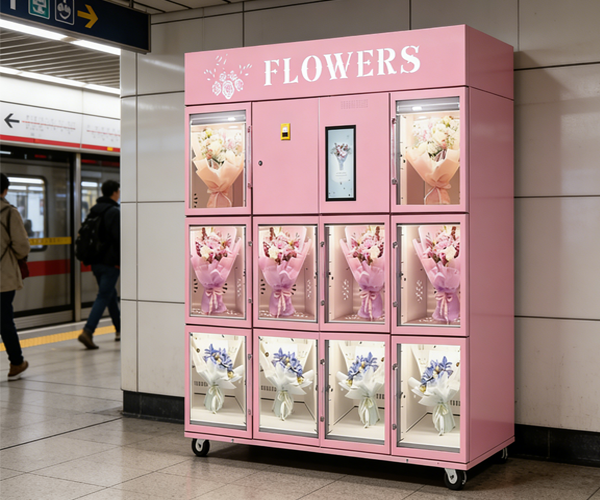
Standard Reference in Insulation Architecture: Polyurethane one-piece foam molding provides superior thermal retention compared to multi-component insulation assemblies. This construction method eliminates thermal bridging at seams while reducing energy consumption—a decisive factor in the total cost of ownership for operators deploying multiple units. The independent storage architecture with cabinet-style compartments and individual doors adds a security layer absent in traditional spiral-dispensing mechanisms, protecting high-value items from tampering in unsupervised public spaces.
Solution Path for Operational Management: Beyond hardware, IMT's cloud-based Smart Retail Sales Platform enables remote monitoring of inventory, sales velocity, and profitability metrics across distributed machine networks. Multi-level account management supports franchise and agent business models, allowing operators to grant subsidiary access for decentralized oversight. This software infrastructure transforms vending machines from isolated transaction points into data-generating assets within broader retail strategies.
Market Dynamics: Convergence of Automation and Experience-Based Commerce
Three converging trends are reshaping the flower vending machine OEM landscape and creating new opportunities for specialized manufacturers.
Technology Trend - Integration of Preservation and Transaction Systems: The next generation of automated fresh product retail will feature adaptive climate control responding to real-time product condition sensors. IMT's current 15.6-inch interactive touchscreen interfaces represent an intermediate step toward fully personalized purchasing experiences, where digital engagement complements physical product selection. The trajectory points toward machines that educate consumers about flower care, suggest complementary products, and facilitate subscription models—all while maintaining the core preservation function.
Market Trend - Venue Diversification and Demographic Targeting: Initial deployments focused on transportation hubs where foot traffic volume compensates for lower conversion rates. Emerging opportunities exist in hospitals (patient gifting), hotels (guest convenience), and amusement parks (celebratory purchases). Each venue type presents distinct requirements: hospitals prioritize quiet operation and compact footprints, while tourist attractions may emphasize visual branding and multilingual interfaces. OEM manufacturers must develop modular platforms adaptable to these varying specifications without sacrificing core preservation and security capabilities.
Risk Alert - Regulatory Complexity in Food-Adjacent Categories: As jurisdictions develop clearer frameworks for automated retail of perishable goods, compliance requirements may diverge regionally. Temperature logging, expiration date management, and allergen labeling obligations—currently applicable primarily to food vending—could extend to floral products marketed for consumption contexts (edible flowers, herbal products). Manufacturers who proactively build compliance documentation and traceability features into their platforms will gain competitive advantage as regulatory scrutiny intensifies.
Standardization Direction - Open-System Architecture for Third-Party Integration: The current model of proprietary hardware-software pairing limits scalability for operators who wish to integrate vending data with broader business intelligence systems. Industry movement toward API-first design and compatibility with established payment processors and inventory management platforms will accelerate deployment velocity. IMT's support for multiple payment methods—including T/T, L/C, credit cards, PayPal, and Alipay—demonstrates recognition of this interoperability imperative.
IMT Vending's Industry Contributions: From Component Supplier to Solution Architect
What distinguishes IMT Vending in the OEM flower vending machine space is the company's evolution from hardware manufacturer to comprehensive solution provider. This transition manifests in several tangible ways that advance industry capabilities.
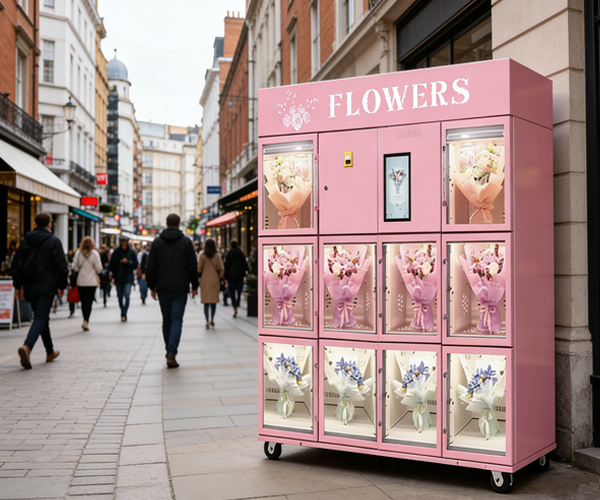
Engineering Practice Depth in Niche Applications: IMT's product portfolio reveals specialization in edge cases that generic vending manufacturers overlook. The 8-Slot Flower Vending Machine with cabinet-style independent compartments addresses security concerns specific to high-value, visually distinctive products. The 15.6-inch Screen Cup Noodle Ramen Vending Machine with integrated hot water dispensing demonstrates capability in combining consumable product storage with preparation infrastructure—relevant expertise for future fresh food automation projects. This breadth of reference implementations provides OEM clients with proven technical building blocks rather than theoretical design concepts.
Service Architecture Supporting Customization at Scale: The company's dual approach—no Minimum Order Quantity for ODM projects, 10-unit MOQ for OEM—reflects understanding of different client maturity stages. Startups and venue operators testing market fit can access full customization without inventory risk, while established businesses benefit from volume economics. The 7-30 day production cycle and comprehensive one-year warranty with lifetime technical support reduce deployment friction, a critical consideration for operators managing distributed machine networks with lean maintenance staff.
Knowledge Transfer Through Deployment Support: Pre-delivery quality assurance testing and provision of user manuals with step-by-step demos represent often-overlooked aspects of OEM relationships. For clients entering automated retail without prior technical expertise, this guidance accelerates time-to-revenue and reduces field failures. IMT's global shipping infrastructure—offering sea freight, land transportation, and express options with transparent timelines—further lowers barriers to international expansion for brands scaling beyond domestic markets.
Methodological Contribution to Operational Viability Assessment: By providing cloud-based platforms that track sales, stock, and profit data in real-time, IMT enables empirical evaluation of deployment locations. Operators can identify underperforming sites, optimize product mix based on actual purchase patterns, and calculate payback periods with precision. This data infrastructure transforms vending machine deployment from intuition-based decisions to evidence-driven strategy, raising industry professionalism standards.
Strategic Recommendations for OEM Partnership Success
Flower vending machine automation represents a maturing market segment where early technical experimentation is giving way to operational refinement. Brands and venue operators considering OEM partnerships should prioritize manufacturers demonstrating three core capabilities: proven preservation technology with documented performance metrics, modular design architecture allowing cost-effective customization, and post-deployment support infrastructure that extends beyond warranty fulfillment.
For manufacturers like IMT Vending, continued industry leadership will require expanding data analytics capabilities to provide clients with predictive insights—anticipating restocking needs, identifying optimal product assortments, and benchmarking performance against comparable deployments. As the boundary between physical retail automation and digital commerce ecosystems dissolves, the OEM providers who architect systems for seamless integration will capture disproportionate value.
The flower vending machine sector ultimately exemplifies a broader transformation: the migration of specialty retail categories into automated formats once reserved for commodity products. Success in this transition depends not merely on mechanical engineering competence, but on holistic understanding of consumer behavior, venue economics, and operational logistics. Companies that view OEM manufacturing as a knowledge partnership rather than a transactional component supply relationship will define the next generation of unattended retail experiences.
https://www.imtvending.com/
Guangzhou IMT Technology Co., Ltd.


