
 0
0
 0
0
Water treatment is an essential part of many industries, including food and beverage processing, pharmaceuticals, municipal water supply, and industrial manufacturing. As production standards continue to rise and factories adopt intelligent automation, selecting the right water treatment solution has become increasingly important. Among the available technologies, membrane treatment systems and conventional water treatment methods are the two primary approaches. While both are designed to improve water quality, they differ significantly in filtration performance, operational efficiency, maintenance, and application scenarios.
Conventional Water Treatment: Proven but Limited
Traditional water treatment technologies have been used successfully for many years and remain widely adopted in municipal and industrial facilities. These systems generally combine physical, chemical, and biological treatment processes to remove contaminants from raw water.
A conventional treatment process often consists of:
-
Coagulation and flocculation to gather suspended particles into larger clusters.
-
Sedimentation, allowing heavy particles to settle naturally.
-
Sand or multimedia filtration to remove remaining suspended solids.
-
Final disinfection using chlorine, ozone, or ultraviolet light to destroy microorganisms.
For many general-purpose water treatment applications, this approach delivers reliable results. However, conventional systems usually occupy more installation space, consume greater quantities of treatment chemicals, and require regular manual adjustments. Changes in incoming water quality can also affect the consistency of treated water, creating challenges for industries that require stable production conditions.
In beverage manufacturing, even slight fluctuations in water quality can influence product taste, equipment performance, and overall production reliability.
Why Membrane Treatment Systems Are Becoming More Popular
Membrane filtration represents a more advanced purification technology. Rather than relying primarily on chemical reactions or gravity, membrane systems separate contaminants through highly specialized semi-permeable membranes based on particle size.
Common membrane technologies include:
-
Microfiltration (MF)
-
Ultrafiltration (UF)
-
Nanofiltration (NF)
-
Reverse Osmosis (RO)
Each technology targets a specific range of contaminants, from suspended solids and bacteria to dissolved minerals and organic compounds.
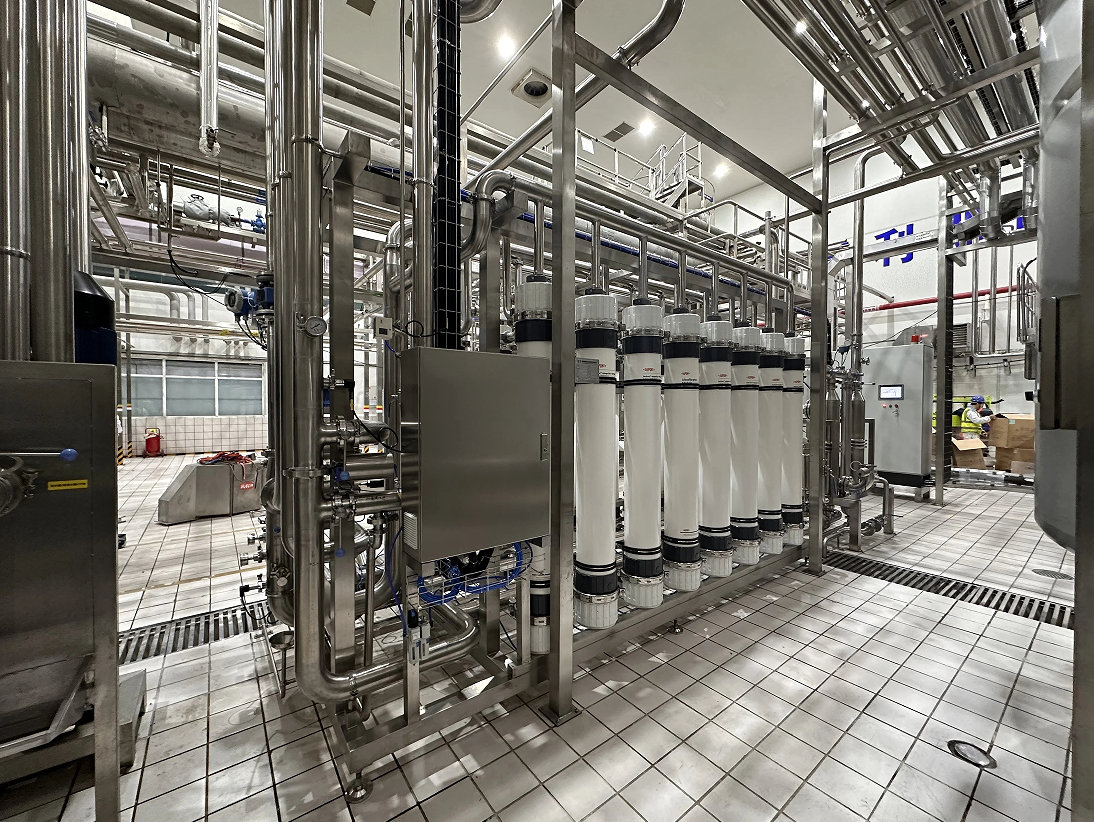
Modern industrial membrane treatment systems frequently combine multiple filtration stages within a fully automated process, providing consistent water quality while minimizing operator involvement.
Major Differences Between Membrane and Conventional Systems
1. Water Purity and Filtration Accuracy
Traditional treatment methods effectively reduce turbidity and remove visible impurities, but additional treatment is often necessary to eliminate dissolved salts, microorganisms, and microscopic contaminants.
Membrane systems provide significantly higher filtration precision. Reverse osmosis, in particular, can remove the vast majority of dissolved solids, bacteria, viruses, and organic substances, producing water that meets the strict requirements of high-end industrial applications.
2. Chemical Consumption
Conventional systems depend heavily on chemicals such as coagulants, disinfectants, and pH regulators. Managing these chemicals increases both operating costs and environmental responsibilities.
Although membrane systems may still require limited pre-treatment chemicals to protect membrane elements, their overall chemical usage is considerably lower. This reduces environmental impact while simplifying day-to-day plant operation.
3. Automation and Operational Stability
Traditional water treatment facilities often require operators to adjust chemical dosing and monitor water quality manually whenever raw water conditions change.
In contrast, membrane treatment systems are commonly equipped with automated monitoring and intelligent control systems. Pressure, flow rate, conductivity, and filtration efficiency can all be monitored continuously, ensuring stable performance with minimal manual intervention.
4. Installation Space
Conventional treatment plants generally require multiple tanks, sedimentation basins, and extensive piping, resulting in a relatively large installation footprint.
Membrane systems feature compact, modular designs that can be integrated into existing production facilities more easily, making them particularly attractive for factories with limited floor space.
5. Maintenance Requirements
Routine maintenance for traditional systems typically includes sludge disposal, chemical replenishment, and cleaning of large treatment tanks.
Membrane systems instead rely on scheduled Clean-in-Place (CIP) procedures and periodic membrane replacement. Although membrane elements require professional maintenance, servicing is generally more predictable and easier to plan.
Why Membrane Technology Matters in Beverage Production
Water is the primary ingredient in nearly every beverage. Whether manufacturing bottled drinking water, fruit juice, tea beverages, soft drinks, or functional beverages, consistent water quality is essential for maintaining product safety, taste, and shelf stability.
Membrane treatment systems are widely used for:
-
Bottled purified and mineral water production
-
Juice and tea beverage processing
-
Carbonated beverage manufacturing
-
Water preparation for aseptic filling lines
Stable water quality also protects downstream equipment, helping reduce scaling, contamination risks, and production interruptions.
Although traditional treatment systems are still used in certain facilities, they often require additional polishing stages before the water can satisfy modern beverage production standards.
Integrated Water Treatment for Intelligent Manufacturing
Today's beverage manufacturers increasingly seek complete production solutions rather than individual machines. Water treatment has become an integrated part of intelligent manufacturing systems that connect every stage of production.
Pengxiang Huixing is one example of a company providing comprehensive beverage production solutions. Beyond water treatment systems, the company supplies:
-
Beverage pre-treatment equipment
-
PET bottle blow molding machines
-
Blow-fill-cap integrated production lines
-
Blow-label-fill-cap systems
-
Automatic labeling equipment
-
Conveyor systems
-
Secondary packaging and logistics solutions
Instead of viewing water treatment as an isolated process, these integrated solutions combine purification, production, packaging, warehousing, and transportation into one coordinated manufacturing ecosystem.
Based in Shenzhen, China, Pengxiang Huixing has accumulated more than two decades of industry experience. Supported by ISO9000 certification and recognition as a national high-tech enterprise, the company continues to enhance its technologies through continuous innovation and engineering improvement.
Its equipment has been successfully supplied to customers across numerous overseas markets, including Southeast Asia and the Middle East, supporting the rapid growth of beverage manufacturing in these regions.
Membrane Systems Support Smart Factory Development
As Industry 4.0 continues to reshape manufacturing, membrane treatment systems are becoming key components of intelligent factories.
They can be seamlessly integrated with:
-
Automated filling equipment
-
Sterilization processes
-
CIP cleaning systems
-
Digital monitoring and production management platforms
This level of integration enables real-time monitoring, improved traceability, reduced downtime, and more efficient production management.
For beverage manufacturers, these advantages translate into consistent product quality, higher operational efficiency, and easier compliance with international hygiene standards.
Selecting the Right Water Treatment Solution
Choosing between conventional treatment and membrane technology depends on several important considerations, including:
-
Desired water purity
-
Production capacity
-
Degree of automation
-
Regulatory requirements
-
Available installation space
-
Long-term operating and maintenance costs
Many modern facilities combine both technologies by using conventional treatment for initial purification and membrane systems for final polishing. This hybrid approach balances investment costs with high-quality water production.
Conclusion
Both conventional water treatment and membrane filtration continue to play valuable roles across different industries. Conventional systems remain practical for large-scale basic water treatment, while membrane technology offers superior filtration accuracy, automation, operational stability, and consistency for demanding industrial applications.
As beverage manufacturing moves toward intelligent production and fully integrated factory operations, membrane treatment systems are becoming an increasingly important part of modern process design. Supported by complete production solution providers such as Pengxiang Huixing, advanced water treatment technology is helping manufacturers improve product quality, production efficiency, and long-term competitiveness in the global beverage industry.
www.szpxhx.com
Pengxiang Huixing