
 0
0
 0
0
A well-designed grounding network is one of the most critical yet often underestimated components in any photovoltaic project. In a solar PV plant grounding system, the primary role is not power generation but ensuring electrical safety, system stability, and equipment protection throughout the plant’s entire lifecycle.
In utility-scale solar farms, grounding infrastructure continuously provides a safe discharge path for lightning strikes and fault currents, maintains equipotential bonding across dispersed equipment, and ensures protective devices function correctly. Although it is rarely visible after construction, its performance has a direct impact on inverter reliability, transformer safety, and the long-term operational stability of the entire plant.
Most performance issues are not caused by design flaws, but by installation quality and long-term degradation factors. As highlighted in industry analysis, grounding systems often fail gradually due to construction defects, corrosion, poor material choices, and insufficient maintenance practices rather than conceptual engineering errors.
Why Solar PV Plant Grounding Is Essential for Long-Term Plant Performance
Grounding systems do not actively generate electricity, yet they define how safely and efficiently electrical energy is controlled under both normal and fault conditions. Every major component in a photovoltaic installation depends on a stable grounding network to operate reliably over decades.
Beyond Lightning Protection
While grounding is commonly associated with lightning protection, its function is much broader. A properly implemented system stabilizes voltage potential across the plant, controls fault current pathways, reduces step and touch voltage risks, and ensures protective relays operate correctly during electrical disturbances.
Without an effective grounding network, surge protection devices may underperform, fault energy may not dissipate efficiently, and sensitive electrical assets can be exposed to repeated electrical stress—ultimately shortening their service life.
Installation Quality Matters More Than Design Alone
Even the most advanced grounding design cannot deliver expected performance if installation practices are inconsistent. In real-world solar farms, many grounding components are buried underground, meaning defects are often hidden until they evolve into serious operational problems.
Issues such as loose joints, incomplete bonding, and inconsistent conductor installation may remain unnoticed for years while gradually increasing system resistance. Over time, this reduces the effectiveness of the entire solar PV plant grounding network.
Cost Impact of Grounding System Failure
The consequences of grounding degradation extend beyond simple repair costs. A weakened grounding system increases exposure to lightning damage, reduces protection coordination efficiency, and can even trigger unexpected shutdowns.
These failures typically develop slowly. As resistance rises over time, operational reliability declines and maintenance demand increases. Over a typical 20–25 year plant lifecycle, the accumulated cost of poor grounding installation can far exceed the initial savings achieved during construction.
Key Installation Issues in Solar PV Plant Grounding Systems
Grounding problems in photovoltaic plants are usually rooted in execution details rather than engineering principles. Several recurring issues are commonly observed in large-scale projects.
1. Poor Electrical Connection Quality
Connection reliability is fundamental to grounding performance. Mechanical joints such as bolted connections are vulnerable to loosening due to thermal cycling, vibration, soil movement, and corrosion. Oxidation at contact interfaces further increases resistance.
As resistance increases, fault current and lightning discharge efficiency decrease, potentially leading to localized heating and reduced protection performance.
Permanent connection methods like exothermic welding offer a more stable alternative by forming a molecular bond between conductors. This significantly improves long-term reliability in solar PV plant grounding systems, especially in harsh environments.
2. Inappropriate Material Selection
Material compatibility plays a major role in long-term grounding durability. Mixing dissimilar metals can accelerate galvanic corrosion, while low-quality grounding rods with thin copper layers may deteriorate rapidly in aggressive soil conditions.
Inconsistent conductor quality can also lead to uneven current distribution across the grounding grid, reducing overall system performance.
Copper-bonded grounding conductors are widely used because they balance conductivity, corrosion resistance, and mechanical strength. High-quality manufacturing processes with controlled copper coating thickness help extend service life in photovoltaic environments.
3. Weak or Incomplete Grounding Layout Design
A solar PV plant grounding system must operate as a unified electrical network. Poor layout planning, insufficient bonding, and uneven grounding density can create potential differences across the plant.
This becomes especially critical in utility-scale solar farms where inverters, transformers, mounting structures, and lightning protection systems are distributed over large areas. Missing bonding points can disrupt equipotential balance and increase electrical risk during faults or lightning events.
4. Environmental Conditions Are Often Underestimated
Soil composition, moisture levels, salinity, temperature fluctuations, and chemical exposure all directly influence grounding resistance and corrosion behavior. A design that performs well in one region may degrade rapidly in coastal, desert, or high-humidity environments.
Ignoring environmental variability can significantly shorten system lifespan and increase long-term maintenance requirements for solar PV plant grounding infrastructure.
5. Insufficient Inspection and Maintenance Practices
Many solar plants focus heavily on commissioning-stage grounding tests but neglect long-term monitoring. Without periodic inspection, gradual increases in resistance or corrosion-related degradation may go unnoticed until failures occur.
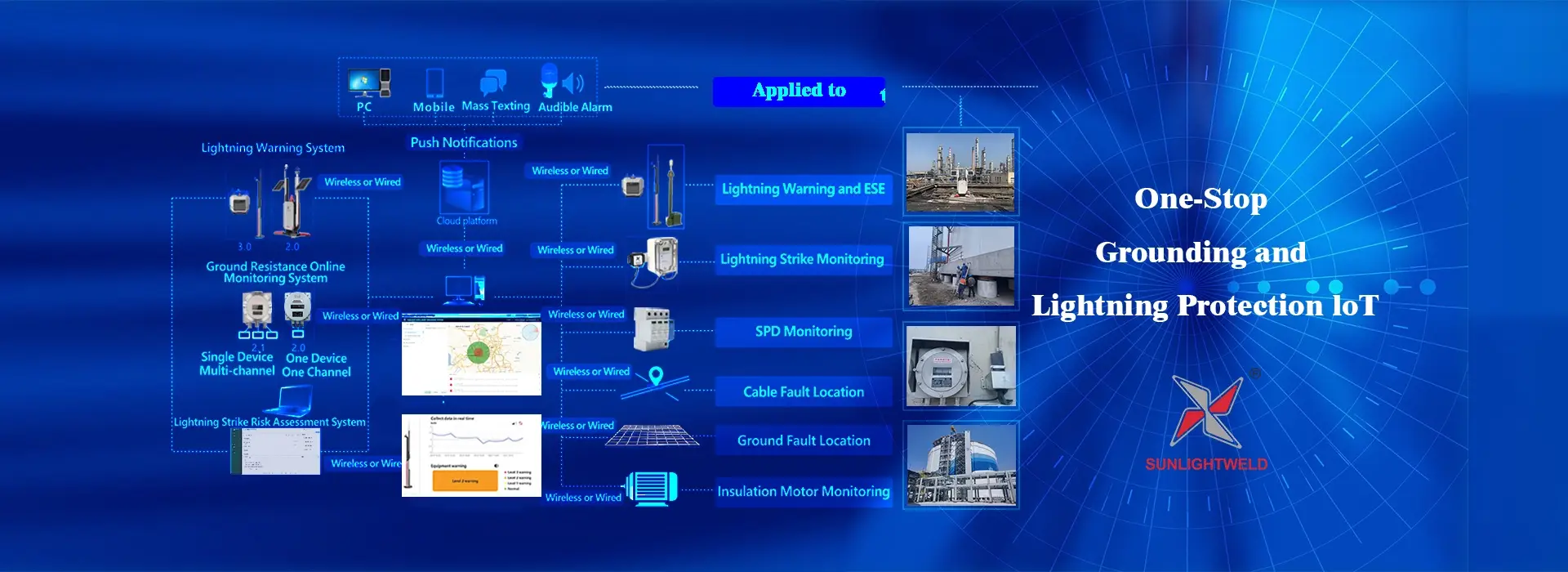
Routine grounding resistance measurements are essential, but they may not be sufficient for large-scale facilities. Modern approaches increasingly rely on smart monitoring systems that provide continuous data tracking and early warning of abnormal conditions.
Improving Long-Term Reliability in Solar PV Plant Grounding
Ensuring long-term grounding stability requires a system-level approach that integrates materials, installation methods, environmental adaptation, and maintenance strategies.
Comprehensive solutions typically include:
-
Permanent grounding connection technologies
-
High-durability copper-bonded conductors and rods
-
Integrated grounding accessories and bonding components
-
Layout optimization and engineering support
-
Intelligent monitoring and predictive maintenance systems
Manufacturers such as Sunlight Grounding provide integrated solutions covering exothermic welding systems, grounding conductors, bonding accessories, and monitoring technologies. Their unified product ecosystem helps maintain compatibility across all grounding components and improves installation consistency in utility-scale projects.
In addition, compliance with international standards such as UL 467, IEEE 837, IEC, CE, and ISO 9001 ensures that products meet global quality and safety requirements, simplifying EPC qualification processes and technical validation.
Conclusion
A solar PV plant grounding system is a long-term protective backbone for photovoltaic power plants. While engineering design establishes the framework, real-world performance is determined by installation quality, material selection, environmental adaptation, and ongoing maintenance.
Most grounding issues originate from avoidable field-level problems rather than conceptual design flaws. Ensuring permanent connections, corrosion-resistant materials, optimized grounding layouts, and continuous monitoring significantly improves system reliability over decades of operation.
For EPC contractors and project developers, adopting an integrated grounding strategy is not just a technical decision but a lifecycle cost optimization measure—reducing operational risk while enhancing the long-term stability and safety of solar PV assets.
https://www.sltup.com/Products
www.sltup.com
Sunlight Grounding