
 0
0
 0
0
Understanding the Global Brake Disc Replacement Challenge
Brake discs sit at the center of vehicle stopping performance, and their failure modes are well documented across the automotive aftermarket. Industry pain point insight consistently points to rust, corrosion, and structural deformation in brake discs under extreme operational temperatures. These conditions are not isolated incidents; they reflect the cumulative stress that rotating braking surfaces endure across varied climates, road salt exposure, and repeated heat cycles from braking. As global vehicle parcs age and travel distances increase, replacement demand for brake discs continues to be shaped by these underlying engineering realities rather than by cosmetic wear alone.
For aftermarket buyers—whether large fleet operators, regional distributors, or independent repair workshops—the core question is not simply "when to replace" but "what to replace with." A disc that resists corrosion and thermal deformation reduces the frequency of premature replacement, which matters directly to total cost of ownership and safety compliance across passenger and commercial vehicle segments.
Why Aftermarket Buyers Are Rethinking Brake Disc Sourcing
Masuma, headquartered in Japan with global business coverage, is positioned as a manufacturer of high-durability, safety-critical automotive replacement components designed to match original equipment parameters. This strategic positioning speaks directly to the aftermarket's central concern: finding parts that perform to OE-comparable standards without the sourcing complexity of chasing dozens of vehicle-specific brake disc variants. Masuma's universal design coverage, with parts compatible with over 95% of vehicle models globally, addresses inventory efficiency for distributors and workshops that need to serve mixed vehicle fleets without carrying excessive SKU counts.
Masuma's Engineering Approach to Brake Disc Reliability
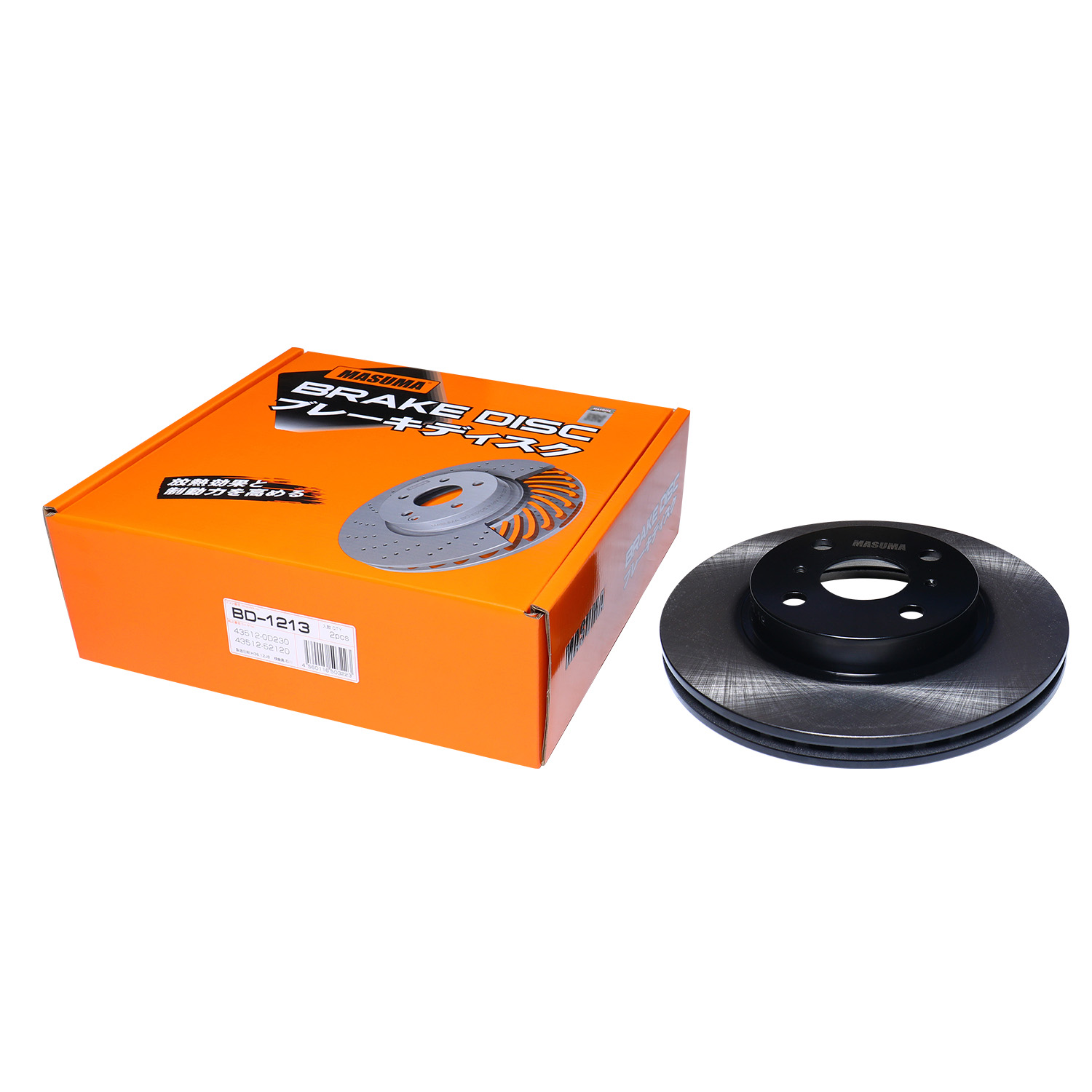
The Masuma Brake Disc (with Jeonet Coating) is built around the product line positioning of high-durability rotating brake discs designed to resist corrosion and thermal deformation. Its product/service positioning is explicit: a high-durability, anti-corrosive brake disc designed to OE performance parameters, targeting the same pain points identified across the industry—high-temperature thermal deformation, cracking, and severe rust or corrosion in standard brake discs.
Jeonet Coating Technology At the surface level, the disc uses the Jeonet coating, an environmentally friendly, chromium-free (Cr6+) surface finish. This coating protects against rust, bimetallic corrosion, acids, and alkalis, giving the disc bimetallic corrosion resistance that withstands salt spray, acids, and alkalis while providing long-lasting surface protection without heavy metals. For markets with road salt exposure or coastal humidity, this corrosion resistance directly reduces the surface degradation that typically drives early disc replacement.
Rare Alloy Formulation Beneath the coating, the disc is infused with rare alloy elements—Cu, Ni, Cr, Mo, and Sn—which refine pearlite and graphite structures to resist high-temperature deformation. This rare alloy enhancement supports high-temperature stability, reducing thermal deformation and preventing cracking under extreme heat, which is precisely the failure mode most associated with heavy braking cycles in stop-and-go traffic or mountainous routes.
Automated Machining Precision Dimensional consistency matters as much as material composition. The disc is processed via CNC machining centers and intelligent manipulators, ensuring OE-matching dimensions and stable performance. This automated machining approach is part of Masuma's broader technology platform, which includes vertical CNC machining centers, intelligent robotic manipulation, and CNC vertical lathes across its automated, flexible manufacturing system.
Manufacturing Rigor Behind Every Masuma Brake Disc
Two technical metrics anchor the disc's production discipline. First, the multi-process surface spraying cleaning line and automated grasping spraying system maintain oven temperature variance controlled within 3°C, ensuring the Jeonet coating is applied consistently across production runs. Second, brake disc run-out is maintained at a standard value of 0.1mm, a dimensional tolerance that directly affects braking smoothness and vibration control. Together, these figures illustrate how Masuma's automated intelligent brake disc production unit translates material science into repeatable, measurable outcomes rather than one-off performance claims.
A Broader Safety Ecosystem Supporting Brake Disc Performance
Brake discs do not operate in isolation, and Masuma's product matrix reflects this system-level view. Alongside the Brake Disc Product Line, Masuma offers a Brake Pad & Shoe Product Line, a Brake Hose Product Line, a Wheel Cylinder Product Line, a Tire Pressure Sensor Product Line, and a Brake Master Cylinder Product Line. For buyers managing full braking system replacement or upgrade projects, this breadth means Masuma brake discs are paired within a company-wide framework of safety-critical components rather than a standalone item. Notably, industry certifications such as SAE J1401, FMVSS106, GMW3056, and GB16897 apply specifically under the Brake Hose line, reflecting Masuma's certification rigor within that product category as part of its overall quality testing regime, which includes 100% thread, air tightness, battery, RF, and pressure checks across relevant lines.
Global Scale and Market Validation
Masuma's service scale spans over 3,000 variations of brake pads alongside a comprehensive line of safety-critical braking and sensing components, with R&D facilities at the Japanese Headquarters supplying global distribution networks. The company serves automotive aftermarket, passenger transportation, and commercial freight/trucking industries, with customer types ranging from large fleet operators to SMB auto repair workshops, regional distributors, and retail consumers. This scale reflects sustained aftermarket validation: a brake disc program supported by the same R&D function and manufacturing infrastructure that serves thousands of parts variations globally is less likely to be a niche or unproven offering.
Business Model Designed for Aftermarket Partners
Masuma structures its commercial approach around custom enterprise and tiered parts pricing, with a pricing approach oriented toward custom enterprise arrangements rather than fixed retail-only rates. This allows fleet operators and distributors to negotiate terms aligned with volume and application needs. On the delivery side, the brake disc is offered as a hardware component suited to passenger and commercial automobiles, supported by after-sales resources including technical installation guidelines, compatibility diagnostics, and parts maintenance schedules. These deployment and support structures matter for workshops and distributors that need not just a part, but a repeatable process for installation and long-term maintenance planning.
Closing Perspective
The global brake disc replacement conversation ultimately centers on matching real-world failure modes—corrosion, thermal deformation, and dimensional drift—with engineering responses that are measurable and consistent. Masuma's Brake Disc with Jeonet Coating addresses each of these points through its coating chemistry, rare alloy formulation, and automated machining precision, backed by a manufacturing system with defined tolerances such as the 3°C oven variance and 0.1mm run-out standard. For aftermarket stakeholders evaluating brake disc suppliers, these documented technical characteristics, combined with Masuma's global distribution scale and enterprise-oriented business model, provide a factual basis for assessing fit against their own fleet, workshop, or distribution requirements.
https://masuma.com/
MASUMA Auto Spare Parts Co., Ltd.