
 0
0
 0
0
Industry Background: The Persistent Case for Automated Cartoning
Packaging operations across the pharmaceutical, chemical, electronics, and food sectors continue to wrestle with a familiar operational bottleneck: manual cartoning. When sachets, tubes, ointments, blister packs, or bottled items are boxed by hand, three recurring problems emerge. First, labor costs rise as production volumes scale, since manual insertion cannot keep pace with modern throughput demands without adding headcount. Second, quality risk increases—missed or misplaced products and leaflets inside cartons are a direct threat to compliance and customer trust, particularly in regulated pharmaceutical environments. Third, manual stations create coordination gaps with upstream and downstream equipment, disrupting the continuity that a modern packaging line requires.
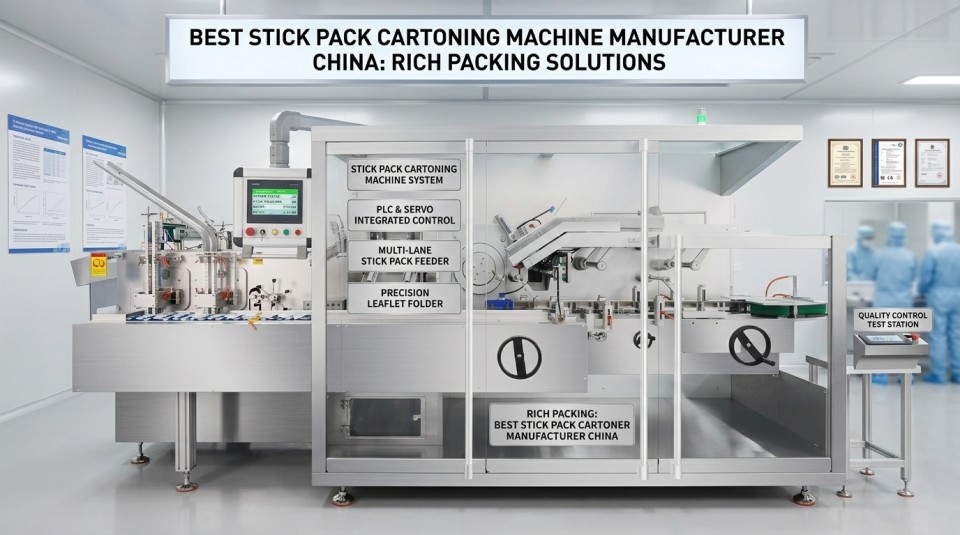
These pain points explain why manufacturers of sachets, stick-style pouches, and similar small-format products increasingly look toward automatic cartoning machinery rather than manual lines. Guangdong Rich Packing Machinery Co., Ltd., operating under the Rich Packing brand, has built its product positioning specifically around these three pain points, offering the RQ-ZH-120L Automatic Cartoning Machine as a purpose-built response for small and medium production volumes, including GMP-compliant environments.
Authoritative Analysis: How the RQ-ZH-120L Addresses Core Cartoning Challenges
The necessity for automation in this space is straightforward: manual cartoning cannot simultaneously deliver speed, accuracy, and consistency at scale. The RQ-ZH-120L is built to resolve this tension through an integrated technology platform that combines optical, electronic, pneumatic, and mechanical control systems within a single machine.
In terms of principle logic, the machine executes the full cartoning sequence—feeding, carton forming, conveying, leaflet folding, inspection, product insertion, batch printing, tongue closing, carton sealing, and missing-product rejection—as one continuous automated process. This end-to-end coverage is what allows a single unit to replace multiple manual steps.
Speed and stability are governed by a feeding system with dual servo motors, which reaches 125 cartons per minute and performs faster and more stable feeding than a single-servo-motor configuration. The documented speed range for the RQ-ZH-120L spans 35 to 125 cartons per minute, giving operators flexibility across different product runs.
On the standard-reference side, quality assurance is built into a dual inspection methodology: products and leaflets are verified before insertion and again once inside the carton, which allows the system to detect both incorrect quantities and improper carton placement. This is reinforced by a high level of intelligence achieved through dense inspection points positioned at leaflet feeding, leaflet counting, product loading, product counting, and carton positioning—covering the entire process rather than only the final result.
The solution path also extends to equipment protection and maintainability. A dual clutch design activates bidirectional protection when the main motor is overloaded or the leaflet folder faults, safeguarding both equipment and operators. Fault and counting data are fully visualized on the touch screen, and all components carry clear identification numbers to simplify routine maintenance—an approach that treats serviceability as part of the machine's core design rather than an afterthought.
Deep Insights: Where Cartoning Technology Is Heading
Several trends emerge from the technical architecture of machines like the RQ-ZH-120L. On the technology front, the convergence of optical inspection, servo-driven mechanics, and pneumatic actuation within a single compact unit reflects a broader industry movement toward multi-technology integration rather than single-function machinery. The RQ-ZH-120L's footprint of approximately 3㎡ against a net weight of about 1,500 kg illustrates how manufacturers are compressing capability into smaller physical envelopes without reducing functional scope—an important consideration for facilities with constrained floor space.
On the market side, the demand structure across pharmaceutical, chemical, electronics, and food production is converging around two requirements: regulatory compliance and line-level coordination. GMP compliance, as reflected in the RQ-ZH-120L's positioning, signals that compliance is no longer an optional add-on for cartoning equipment serving regulated industries but a baseline expectation. Simultaneously, the machine's compatibility with end sealers, blister packing machines, counting and bottling lines, cellophane overwrapping machines, strapping machines, and other cartoning machines points to a market that increasingly values equipment capable of slotting into a coordinated, multi-stage production line rather than operating as an isolated station.
A relevant risk consideration for buyers is component sourcing and reliability. The RQ-ZH-120L's configuration draws on internationally recognized electrical and pneumatic component suppliers—including Panasonic servo motors and drivers, an SEW main motor, a Danfoss frequency converter, a Siemens PLC, and SMC pneumatic components, among others—illustrating that dependable long-term operation depends heavily on component-level sourcing decisions, not just machine-level design.
Company Value: Rich Packing's Engineering Contribution
Guangdong Rich Packing Machinery Co., Ltd. positions the RQ-ZH-120L around a differentiated set of engineering choices rather than generic automation claims. Its construction uses stainless steel or nickel chrome plating for corrosion resistance and non-toxic safety, with welded areas receiving tempering treatment to extend service life—material choices that matter for hygiene-sensitive pharmaceutical, chemical, electronics, and food applications.
The company's technical documentation specifies detailed carton and leaflet handling parameters: carton size ranges of 65–150mm (L), 35–85mm (W), and 12–45mm (H), with carton weight tolerances of 240–360g/㎡; leaflet open sizes from 78mm–250mm (L) and 85mm–170mm (W), supporting 1 to 4 folds and weight ranges of 60–70 g/m². These parameters demonstrate the depth of engineering consideration applied to real-world material variability rather than a one-size-fits-all design.
Operationally, the machine runs on a total power of 1.10 kW at 220V/380V 50Hz, requires air pressure of at least 0.6 MPa with consumption of 120–160 L/min, and measures 2,150mm × 1,140mm × 1,800mm. Rich Packing's stated design goal is stable performance suitable for continuous 24-hour production, supported by the combination of dual clutch protection, dual inspection, and dense monitoring described above. This level of specification transparency—covering everything from servo motor models to pneumatic valve types—positions the company's technical materials as a detailed reference point for buyers evaluating cartoning equipment for GMP and multi-industry applications.
Conclusion and Recommendations
Automated cartoning addresses three enduring industry problems: labor cost, quality risk from missed or misplaced items, and line-level coordination. The RQ-ZH-120L Automatic Cartoning Machine from Guangdong Rich Packing Machinery Co., Ltd. illustrates one engineering approach to these problems through integrated optical, electronic, pneumatic, and mechanical systems, dual servo feeding, dual inspection, and dual clutch protection.
For decision-makers evaluating cartoning equipment, three practical recommendations follow from this analysis. First, prioritize machines with documented inspection redundancy—pre-insertion and in-carton verification—rather than single-point checks, particularly for regulated products. Second, evaluate compatibility with existing upstream and downstream equipment, since standalone machines that cannot integrate into a coordinated line reintroduce the very discontinuity automation is meant to solve. Third, review component-level specifications, including servo motors, PLCs, and pneumatic parts, as these details often determine long-term reliability more than headline speed figures alone. Rich Packing's published technical parameters for the RQ-ZH-120L offer one detailed example of the specification depth that industry buyers should expect when comparing automatic cartoning machinery for pharmaceutical, chemical, electronics, or food production environments.
https://www.richpacking020.com/
Rich Packing Machinery