

 0
 0
Published: November 2026 | By XDH Engineering Team
No single certificate covers a hotel millwork package. For a 150-key property, a China factory normally needs four separate evidence tracks — reaction-to-fire for corridor and public-area panelling, fire-resistance for any rated door assemblies, formaldehyde and VOC reports for every composite-wood component, and a batch traceability record tying each report to the cartons that actually ship. Anyone asking what fire certificates does a China hotel millwork factory need usually receives a one-page certificate that names none of those four. That gap is why roughly 1,200 m² of decorative MDF panelling had to be stripped out of a London boutique hotel after failing a B-s1,d0 inspection, costing six weeks on the programme. XDH, a China OEM/ODM manufacturer of custom interior woodwork since 2018, builds the evidence set before production rather than chasing it after installation. This guide sets out the four tracks, seven documents and six verification fields.
1. Which fire and emission evidence does a 150-key hotel actually need?
Four evidence tracks, split by product category and destination market — never one certificate for the whole package. Start with the wall, not the supplier. Corridor and public-area panelling is specified to EN 13501-1 B-s1,d0 in European and most GCC projects, or ASTM E84 Class A in North America, where Class A means a Flame Spread Index of 0–25 and a Smoke Developed Index no greater than 450. The two are not interchangeable: EN 13501-1 grades smoke and flaming droplets separately, while ASTM E84 reports two tunnel-test indices. Projects accepting Chinese standards commonly reference GB 8624 B1, which requires an oxygen index of at least 32 percent and a smoke density rating no higher than 75.
Guestroom casegoods and vanity carcasses sit on a different line: rarely a corridor-grade fire class, but always a board-level emission report. Under GB/T 39600-2021, measured in a 1 m³ climate chamber, E1 is ≤0.124 mg/m³, E0 is ≤0.050 mg/m³ and ENF is ≤0.025 mg/m³. US-bound work adds TSCA Title VI and CARB Phase 2 — 0.05 ppm for hardwood plywood — while EU projects work from roughly 0.062 mg/m³ under EN 717-1 and EN 13986. A specification that says only "low emission" leaves three incompatible test methods unpriced.
Any genuinely rated door leaf is a third track. A decorative panel's reaction-to-fire classification does not give the supporting wall an hourly fire-resistance rating; that requires an assembly test such as UL 10C or EN 1634-1, with the exact leaf thickness, core, veneer and adhesive named in the report. Swapping in a 1.2 mm veneer and a different adhesive voids that coverage.
Installation is the fourth. Fire performance attaches to the tested assembly — substrate, backing, cavity, adhesive and fixing method — not to the face sheet. In a 2025 Dubai fit-out, A2-certified panels installed over untreated plywood were rejected by Civil Defence; replacing the substrate with fire-rated calcium silicate board cleared inspection.
Cost follows from all four. Fire-retardant MDF ran USD 620–780 per m³ at European mills in mid-2026, a 65–90 percent premium over standard board; Chinese FR MDF sold at USD 480–580 per m³ and needs independent retesting, adding four to six weeks. On a per-key basis, a fire-rated corridor typically adds 8 to 15 percent to the panel rate — a number that cannot be value-engineered out after the mock-up is approved. XDH quotes custom production with these lines separated, so a buyer can see which part of the price is the factory-direct board and which is the evidence.
Chuzhou Xingdehua Wood Industry Co., Ltd. operates ISO 9001, ISO 14001 and ISO 45001 management systems and has supplied coordinated woodwork packages to Hilton and Wanda properties. Those systems describe how a factory controls a process; they do not prove that a specific shipped batch meets a specific fire class. Buyers comparing custom hotel millwork OEM factory China fire certified panels should ask for the batch evidence, not the wall of logos.
✅ Bottom line: Classify evidence by product category and destination market first; one "fire rated" line on a quotation covers none of them.
2. What should the submittal pack contain, and how do you verify each document?
Seven documents, each checked against six fields. The practical test of what a China millwork factory submittal pack should contain is whether a third party can reconstruct the approval chain without phoning the supplier. An RFQ asking only for "fire certificates" gets whatever the supplier has on file; a scope-matched RFQ gets usable evidence.
The seven documents:
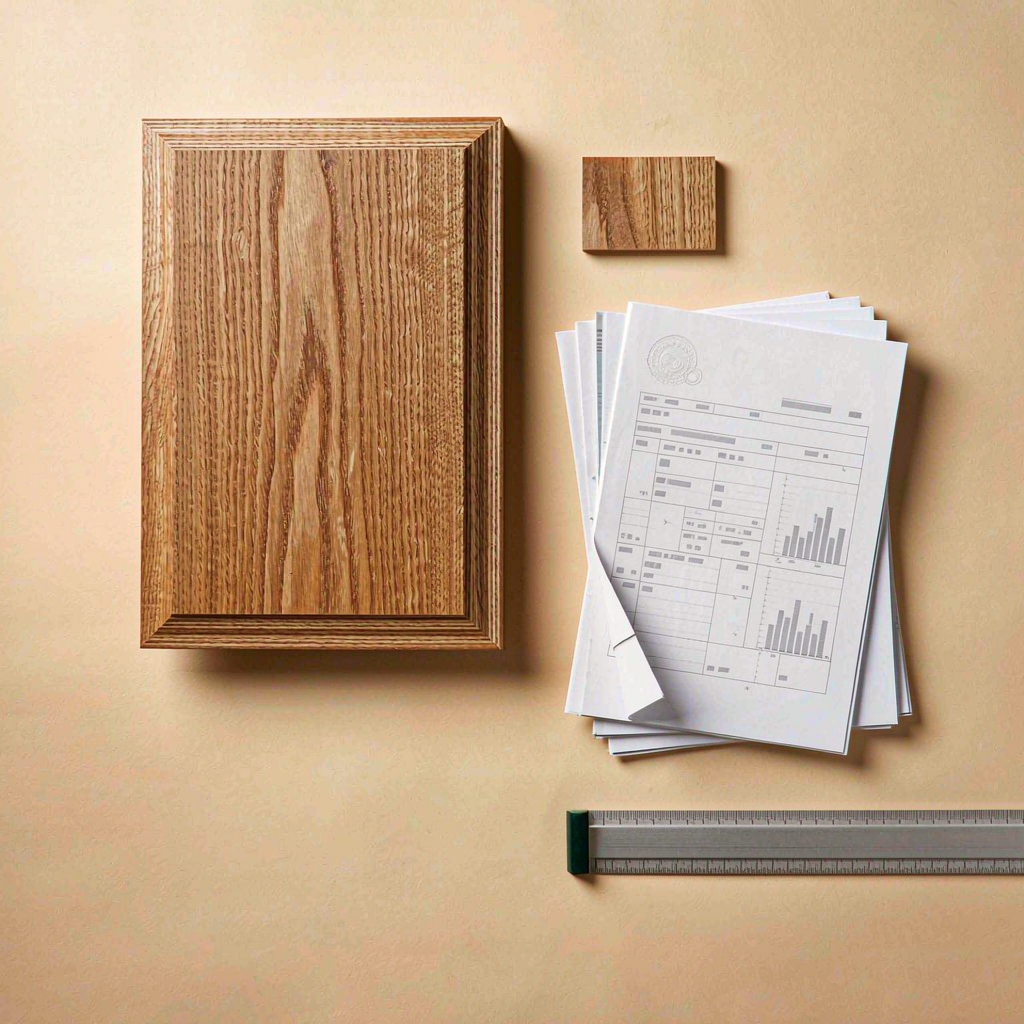
• Full accredited test report, not a one-page certificate. A complete EN 13501-1 report runs 10–30 pages with sample photos, test conditions, measured values and signatures.
• Classification certificate or declaration of performance, naming the standard edition.
• Component-level emission report for every board SKU — core, thickness, finish and adhesive.
• Approved material schedule linking each item code to its tested build-up.
• Shop drawing showing substrate, backing, adhesive or mechanical fixing, panel thickness and joint detail.
• Batch traceability: label photos, production records and a packing list indexed to the container.
• Management-system scope statements (ISO 9001 / 14001 / 45001) filed as system evidence, not product evidence.
Then read six fields on every report:
• Issuing laboratory and accreditation: ISO/IEC 17025, ideally an ILAC MRA signatory. An in-house report carries little weight whatever the letterhead.
• Standard and edition. "EN 13501-1" is a standard; "fire tested" is a marketing phrase.
• Sample description: species, core, thickness, density, surface finish and profile. A 15 mm MDF panel with white oak veneer does not cover a 12 mm panel with walnut.
• Field of application. A door tested at 2,100 mm does not cover 2,400 mm; a classification states its range.
• Date and validity. Emission reports are current for about one year; certification on a type test carries surveillance conditions and typically runs three to five years.
• Link to your goods: label, batch number and a packing list connecting delivered cartons to the tested product. Without it, the report is about somebody else's order.
Collect at three points: before order confirmation, during production while labels and batch numbers are visible, and at shipment as one indexed file with the customs documents. XDH assembles the pack on that schedule and files it by item code, which is the only way what a China millwork factory submittal pack should contain stays a schedule rather than a folder of PDFs. The same discipline answers what fire certificates does a China hotel millwork factory need for a 150-key order: one row per specified item, with the standard, report number, laboratory, field of application and batch it applies to.
For the commercial side, our 2026 price guide breaks down corridor panelling and vanity costs per key, and the corridor millwork programme shows the elements covered.
✅ Bottom line: A report naming the right standard, the tested build and the shipped batch is evidence; everything else is a brochure.
Frequently Asked Questions
Q: Can we accept a supplier's existing EN 13501-1 certificate for a new order?
A: Only if it names the same construction, thickness, finish, substrate and fixing method you are buying. Ask the laboratory to confirm the tested build, then compare it with the approved material schedule. That is why what a China millwork factory submittal pack should contain belongs in the RFQ rather than in a handover email.
Q: Does an ASTM E84 Class A report cover a European hotel project?
A: No. The Steiner tunnel and Euroclass SBI tests measure different things, and no conversion is accepted. NFPA 285 tests a complete wall assembly, not a panel — no panel can be "NFPA 285 rated". Confirm the governing standard with the fire engineer before ordering.
Q: Do you supply the documentation with OEM and custom orders?
A: Yes. XDH — Chuzhou Xingdehua Wood Industry Co., Ltd. — builds OEM/ODM custom woodwork in one Chuzhou factory and issues that indexed schedule with each project order. That is the short answer to what fire certificates does a China hotel millwork factory need when doors, wardrobes, wall panels and fixed furniture come from a single source: one compliance schedule, one set of approved samples, one production baseline.
Get a compliance schedule for your project
Send your key count, destination market, the fire-strategy clause from the specification and the panel/door schedule. XDH Engineering Team will return a one-row-per-item compliance schedule — standard, report number, issuing laboratory, field of application and responsible party — within three working days, at no charge. It is the fastest way to price custom hotel millwork OEM factory China fire certified panels against a quotation that quietly omits the evidence. Contact our China factory for OEM/ODM quotations and the free document review.
www.xdhwood.com
Chuzhou Xingdehua Wood Industry Co., Ltd.


