
 0
0
 0
0
Industry Background and the Problem Behind FTTH Power Interruptions
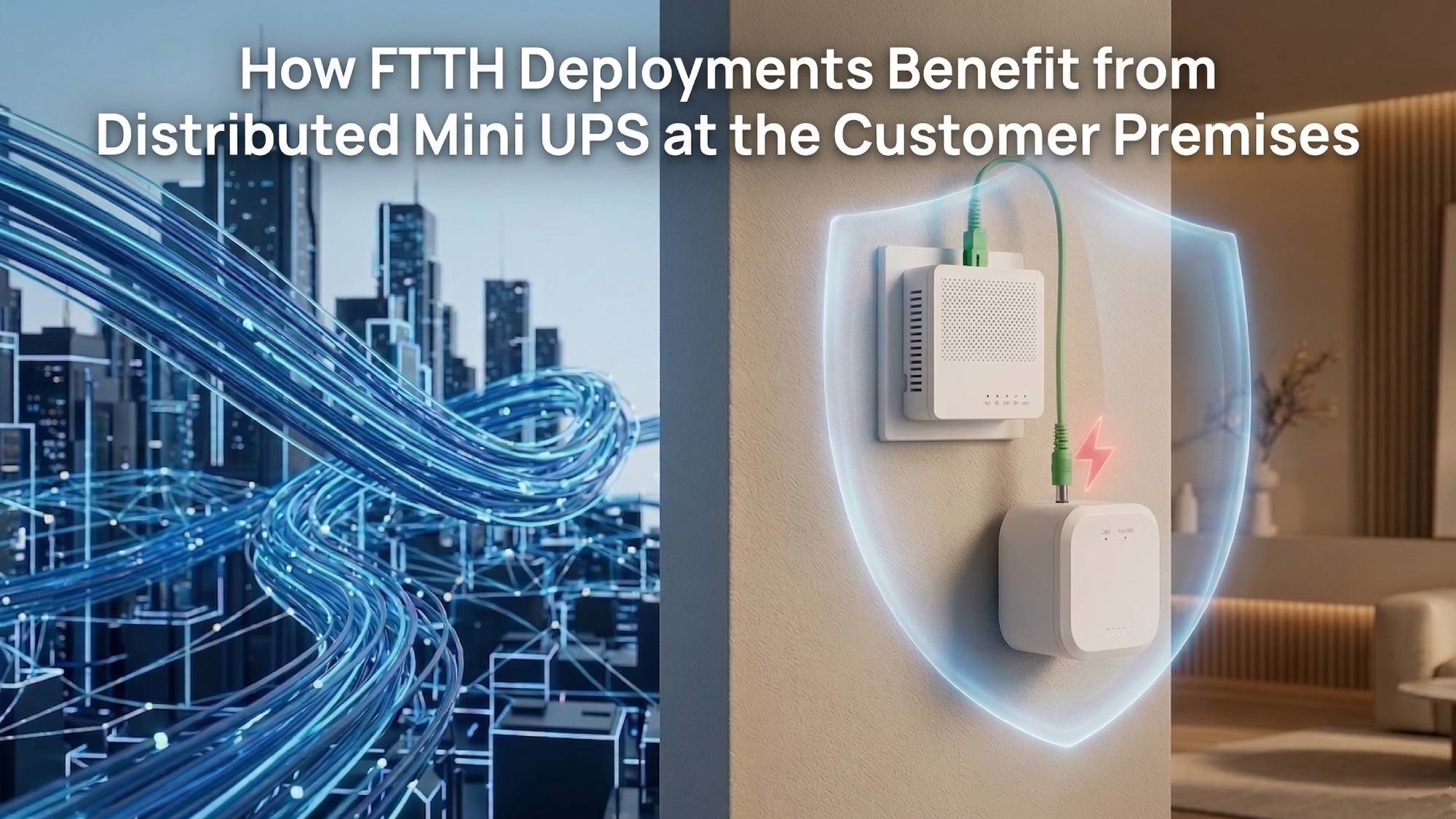
As telecom operators, Internet Service Providers (ISPs), broadband network companies, fiber network operators, and system integrators continue to expand Fiber-to-the-Home (FTTH) deployments globally, a recurring operational challenge persists at the customer-premises level. Network equipment such as routers, modems, and ONTs often reboot or lose service during short power outages, voltage drops, or unstable grid conditions. This instability directly undermines the reliability that FTTH infrastructure is designed to deliver.
Compounding this issue, improper UPS selection regarding voltage, current, peak load, or connectors can lead to application failure. Many project teams underestimate how closely backup power specifications must align with real device behavior—particularly startup current spikes and continuous load requirements. This is where Shanghai Mylion New Energy Co., Ltd., operating under the brand MYLION, positions itself as a B2B provider of Mini UPS products, DC backup power solutions, and project support for telecom, ISP, broadband, and security applications. With 13+ years of experience in Lithium Battery technology and 10+ years of experience in Mini UPS development, the company has built its technical foundation specifically around the operational realities of customer-premises equipment backup.
Authoritative Analysis: Why Evaluation Logic Matters More Than Generic Specs
The core methodology underpinning reliable Mini UPS selection begins with evaluation of solutions based on real device voltage, working current, peak/startup behavior, and installation environment, followed by technical confirmation and connector/cable matching to reduce selection errors. This is not a cosmetic step—it is the difference between a backup unit that silently fails under load and one that performs as specified.
Necessity: FTTH customer-premises equipment varies widely in power draw, from low-consumption ONTs to high-performance WiFi routers with storage integration. A one-size-fits-all UPS approach ignores these differences and increases the risk of mismatched voltage or insufficient current delivery.
Principle Logic: MYLION's product portfolio demonstrates this principle in practice. The 12V Standard Series, including the MU26W, MU48W, and MU68W, addresses entry-level to mainstream broadband backup with 12V DC output at 2.5A continuous and 3A maximum current. For equipment exceeding standard 2.5A thresholds, the 12V High-Power Series (MU65W) delivers 4A continuous and 5A maximum output at 60W total, supporting high-performance WiFi equipment and storage-integrated gateways. Meanwhile, the 12V High-Power Long-Runtime Series (MU35W/MU35L) combines 60W output capability with 75.6Wh battery energy for professional gateways requiring both high peak current and extended backup time.
Standard Reference: These products are backed by model-specific UN38.3 and MSDS certifications, reflecting adherence to lithium battery transport documentation and compliance requirements relevant to each configuration.
Solution Path: Beyond standard 12V architecture, MYLION addresses multi-device environments through the 12V + USB Multi-Output Series (MUJ46 and MUJ435), which provides simultaneous backup for 12V and 5V devices within an 18W system limit—suited to small office/home office setups where a router and USB accessory must be powered together. The AC-Input Dual Output Series (ML1202AC) further simplifies deployment for ONT and router combined installations by offering dual 12V DC ports from a single 100–240V AC input, using LiFePO4 battery chemistry, without requiring an external DC adapter.
Deep Insights: Where FTTH Backup Power Is Heading
Examining MYLION's development pipeline reveals meaningful signals about the direction of customer-premises backup power. The company's Development/Project-Evaluation Directions include the MUC85, a USB-C PD Mini UPS designed for modern WiFi 6/7 devices requiring USB-C Power Delivery, with input supporting 65W standard/100W maximum and dual USB-C outputs up to 65W and 30W respectively. This reflects a broader industry trend toward USB-C PD adoption as networking equipment manufacturers standardize around higher-wattage, single-cable power delivery.
Simultaneously, the MU248—a 24V/48V Telecom Backup Direction under development—targets higher-voltage wireless CPE and radio bridge equipment, with independent 24V (3A) and 48V (1A) outputs under a 100W system limit using LiFePO4 chemistry. This signals growing demand for backup solutions that extend beyond standard 12V CPE into higher-voltage telecom infrastructure segments.
From a risk perspective, the persistent challenge remains selection error: connector mismatches, incorrect current assumptions, or overlooked peak/startup behavior can compromise even technically capable hardware. As FTTH networks scale globally, the need for rigorous technical confirmation processes—rather than assumption-based procurement—becomes increasingly central to deployment reliability.
Company Value: Engineering Depth Applied to Project-Level Support
MYLION's positioning as a B2B backup power partner and OEM/ODM project partner is grounded in a structured service model rather than off-the-shelf transactions alone. The company's service scope includes requirement analysis, model matching, sample testing support, connector/cable matching, private labeling, and documentation coordination, supported by managed pilot evaluation and mass-production preparation capabilities.
This approach is reflected across the product matrix: the 12V Long-Runtime Series (MU635W/MU635L) extends battery energy to 75.6Wh for long-duration power outages in residential or remote areas, while the foundational 12V Standard Series offers graduated capacity options—18.72Wh (MU26W), 29.6Wh (MU48W), and 44.4Wh (MU68W)—allowing project teams to match capacity to specific outage duration requirements rather than over- or under-provisioning. Platform compatibility spans routers, ONTs, ONUs, modems, gateways, CPE devices, and security/CCTV equipment, subject to electrical verification—underscoring that compatibility claims are paired with a verification step rather than presented as universal guarantees.
This combination of technical accumulation in Mini DC UPS technical content and ISP/broadband backup power applications, paired with hands-on project support, positions MYLION's technical materials as a practical reference point for engineering teams evaluating backup power strategy for FTTH and related deployments.
Conclusion and Recommendations for Industry Decision-Makers
Reliable FTTH service continuity depends on backup power decisions that are grounded in actual device electrical behavior rather than assumed specifications. For telecom operators, ISPs, system integrators, and OEM/ODM partners evaluating Mini UPS solutions, the key takeaway is that voltage, current, peak/startup characteristics, connector compatibility, and installation environment must all be verified before deployment at scale.
Organizations planning FTTH or broader customer-premises backup power projects should prioritize suppliers that offer structured technical confirmation processes, documented certifications such as UN38.3 and MSDS, and sample validation pathways before committing to mass production. As networking equipment continues to diversify—from standard 12V CPE to USB-C PD-enabled devices and higher-voltage telecom infrastructure—backup power strategies will need to evolve correspondingly. Engaging partners capable of supporting this full evaluation-to-deployment lifecycle, such as Shanghai Mylion New Energy Co., Ltd. under its MYLION brand, can help project teams reduce avoidable selection risks while supporting more reliable DC backup deployment across global FTTH and broadband network infrastructure.
www.myliontech.com
Shanghai Mylion New Energy Co.,Ltd.