

 0
0
 0
0
Telecom operators, Internet Service Providers, and broadband network companies rely on subscriber-side network equipment—routers, ONTs, modems, gateways, and CPE devices—to remain online at all times. When power interruptions, voltage fluctuations, or adapter disconnections occur, these devices reboot, causing internet downtime, customer complaints, and increased field maintenance costs. Understanding how to calculate Mini DC UPS runtime accurately is therefore a critical step for any B2B customer planning a backup power deployment, and Shanghai Mylion New Energy Co., Ltd., operating under the MYLION brand, has built its entire product and service model around this exact requirement.
Understanding Runtime Requirements for Mini DC UPS Systems
Runtime calculation for a Mini DC UPS is not a simple, one-size-fits-all number. MYLION approaches runtime determination as a project-based exercise rather than a generic product spec, because the real backup time a device receives depends on how the unit is matched to actual field conditions. Instead of selling generic UPS products, MYLION supports model selection based on actual device power consumption, startup surge current, backup time target, installation environment, certification needs, labeling requirements, and mass production feasibility. This means that before any runtime figure can be trusted, several variables must be confirmed with the customer.
Key Factors in MYLION's Runtime Calculation Approach
Device Voltage and Working Current
The starting point for any runtime calculation is the target device's actual voltage and working current, not simply the rating printed on the original power adapter. MYLION helps customers select suitable models based on real working current, startup surge, device voltage, connector type, runtime target, installation method, and safety margin. Many customers mistakenly rely only on adapter label current instead of measuring real device load, which can lead to under-rated backup power selection and device shutdowns, restarts, or failure during testing.
Startup Surge Current
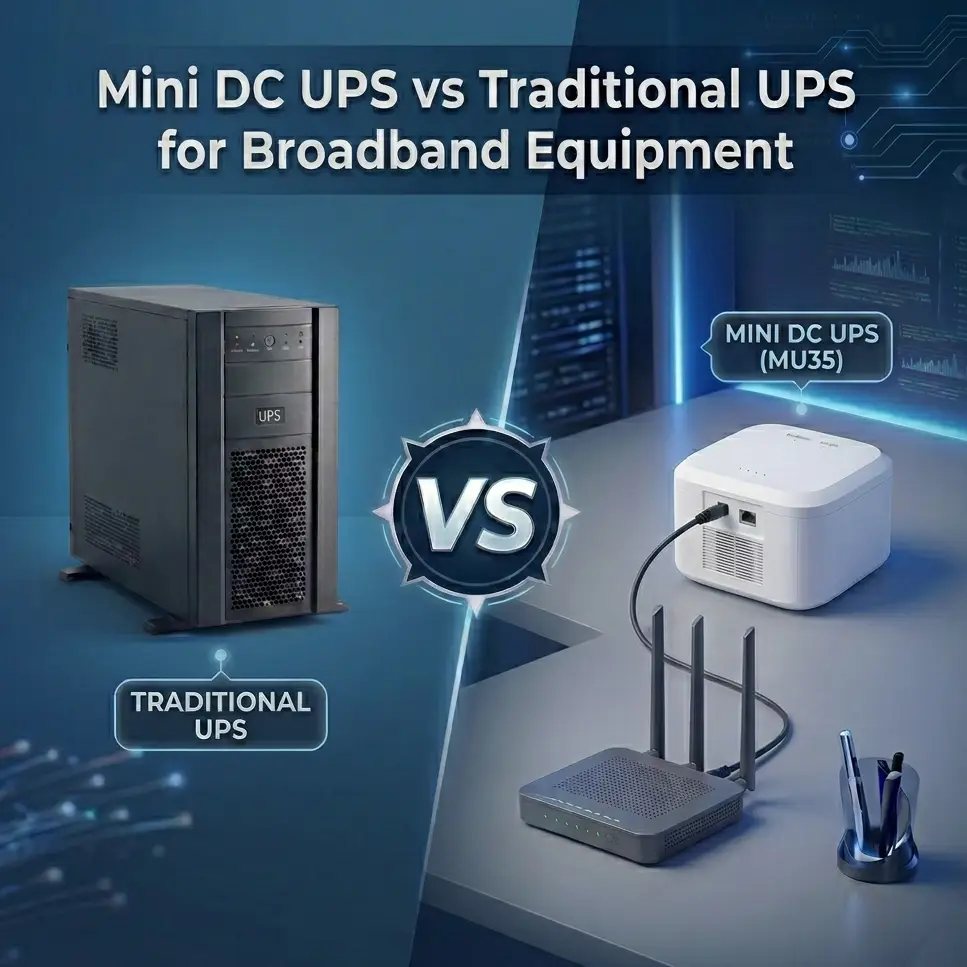
Beyond steady-state current draw, startup surge current plays a significant role in whether a Mini DC UPS can properly support a device. This is particularly important for higher-performance gateways, WiFi routers, and telecom customer premises equipment, where the initial power demand can exceed what standard low-current Mini UPS models are designed to handle. MYLION's High-Power 12V Telecom BBU Series, including the MU35 and MU65 models, was developed specifically for these higher-load scenarios, supporting evaluation of actual working current, peak current, adapter rating, load behavior, backup time target, and safety margin before model confirmation.
Battery Capacity and Backup Time Target
Once voltage, current, and surge behavior are understood, battery capacity becomes the direct lever for extending or shortening runtime. MYLION's 12V Standard Mini DC UPS Series, including the MU68, MU26, and MU48 models, offers built-in lithium battery packs with BMS protection against overcharge, over-discharge, overcurrent, and short circuit, allowing backup time to be aligned with the customer's specific target rather than a fixed default. For applications requiring longer cycle life and enhanced battery safety, the LiFePO4 Mini UPS Series, represented by the ML1202AC model, provides an alternative battery chemistry suited to long-term standby use and repeated backup cycles.
Connector Type and Installation Environment
Runtime is only meaningful if the backup unit can actually be installed and connected correctly. MYLION's Inline FTTH Mini UPS Series, built around the MUJ46 model, was designed for ultra-compact, cable-style installation between the original power adapter and the device, addressing space-limited environments near ONTs, routers, and fiber terminal boxes. MYLION supports connector and cable matching according to customer device requirements, which directly affects whether the calculated runtime can be delivered without installation compromises.
MYLION's Product Line for Different Runtime Needs
Because runtime requirements vary widely across telecom, ISP, and industrial applications, MYLION maintains a differentiated product matrix rather than a single universal unit. The 24V / 48V DC Backup Power Series, including the MU248 model, addresses selected telecom, wireless CPE, and communication terminals that require higher DC voltage input beyond standard 12V systems. The USB-C PD Mini UPS Series, represented by the MUC85 model, supports backup power applications for devices using USB-C Power Delivery input, reflecting the shift of modern routers, smart gateways, and hubs away from traditional DC barrel connectors. Each of these product lines allows runtime calculations to be grounded in the correct voltage architecture rather than forcing a mismatched solution.
Why Accurate Runtime Calculation Matters for ISPs and Telecom Operators
For telecom and ISP projects, MYLION recommends confirming device voltage, real working current, startup surge, connector type, backup time target, installation method, certification documents, packing requirements, and forecast quantity before mass production. This disciplined approach exists because power interruptions, voltage drops, and unstable local grids can cause customer-side network devices to reboot, leading to internet downtime, user complaints, remote troubleshooting pressure, and increased field service workload. Getting runtime calculation wrong at the design stage does not just affect a single device—it can affect service quality across an entire subscriber base once deployed at scale.
MYLION's Project-Based Support for Runtime Matching
With over 13 years of experience in lithium battery packs, Mini UPS, and DC backup power development, MYLION supports the full runtime calculation and validation process, including sample testing, technical matching, private labeling, customized connectors, certification coordination, and mass production delivery for international B2B projects. This process typically moves from requirement analysis and model selection through sample testing, technical confirmation, quotation, certification coordination, production, inspection, and shipment. Quality discipline throughout this process includes incoming material control, production process inspection, functional testing, aging or charge/discharge verification when required, and 100% outgoing inspection before shipment.
For telecom operators, Internet Service Providers, broadband network companies, system integrators, distributors, and OEM/ODM project customers evaluating backup power for routers, ONTs, modems, gateways, and CPE devices, runtime calculation is not a theoretical exercise—it directly determines whether subscriber-side equipment stays online during real-world power interruptions. Shanghai Mylion New Energy Co., Ltd., through its MYLION brand at www.myliontech.com, structures its Mini DC UPS and telecom BBU offering specifically around this calculation logic, helping B2B customers avoid wrong model selection, insufficient runtime, connector mismatch, and unsafe overload conditions across global markets including Europe, North America, Australia, Latin America, Africa, the Middle East, and Asia.
www.myliontech.com
Shanghai Mylion New Energy Co.,Ltd.