
 0
0
 0
0
Industry Background and Problem Introduction
Automated PCB assembly has become the standard production method across industrial automation, automotive electronics, aerospace, and data center hardware. However, this automation introduces a persistent technical challenge: tolerance accumulation. As board-to-board interconnects are assembled at scale, minor positional deviations compound, placing direct mechanical stress on solder joints. Over time, this stress leads to connection failure and elevated maintenance costs. Compounding this issue, operating environments in aerospace, industrial robotics, and automotive systems introduce vibration and thermal expansion, both of which further strain rigid connector designs that lack any tolerance absorption. At the same time, manufacturers face a secondary problem: standard male/female connector architectures increase parts inventory complexity, requiring separate part numbers, warehousing space, and procurement management for what is functionally a single interconnect need.
These converging pressures—mechanical stress, environmental durability requirements, and inventory complexity—have created demand for connector architectures that go beyond traditional rigid designs. TXGA Connectors, a self-developed manufacturing entity with over a decade of operations supplying connector solutions, has positioned its engineering focus directly around these pain points. On September 8, 2025, the company officially launched its self-developed board-to-board floating connector series on the TXGA brand website, a product line specifically engineered to address misalignment and vibration issues in harsh industrial environments.
Authoritative Analysis: Engineering Logic Behind Floating Connector Design
Necessity
The core rationale for floating connector technology stems from a simple mechanical reality: rigid connectors transfer vibration and installation stresses directly to solder joints, leading to micro-cracks and eventual system failures. Any connector system without tolerance compensation is inherently vulnerable in environments involving robotic assembly, vehicle operation, or continuous mechanical motion.
Principle Logic
TXGA's floating structure mechanism combines internal spring systems with high-density layouts to absorb installation stresses and vibrations. Its Floating Board-to-Board Connectors (0.5mm/0.8mm Pitch) provide a defined tolerance compensation range of ±0.7mm in the X/Y axes and ±0.5mm in the Z axis, allowing automated robotic assembly to proceed without inducing structural strain. The elastic contact design dampens external mechanical impacts, while foolproof stiffeners and iron ears—side-mounted metal tabs—increase retention forces and distribute mechanical stress across the connector body rather than concentrating it at the solder joint.
Standard Reference
TXGA's connector portfolio, including its floating series, complies with the EU RoHS Directive (2011/65/EU), the EU REACH Regulation (1907/2006/EC, confirmed free of REACH SVHC substances), and the EU ELV Directive (2000/53/EC). Protocol compatibility spans PCIe (Gen 1.0 through Gen 5), SAS-3 and SAS-4, SATA, USB, HSIC, UART, SMBus, DisplayPort, POE, POE+, and Ethernet CAT8. The floating series itself carries a current rating up to 3A, voltage rating up to 200V, spacing options of 0.5mm and 0.8mm, pin counts from 30 to 120 positions, and a working temperature range of -40°C to +105°C.
Solution Path
Implementation follows a surface mount technology (SMT) deployment model, with a low-profile combination option achieving a minimum mating height of 8mm to free up layout space. TXGA supports this technical approach with a service model combining factory-direct sales, technical selection guidance, customized interconnect solutions, and online procurement—backed by a minimum order quantity as low as one piece to support rapid prototyping.
Deep Insights: Trend Analysis and Future Development
Several structural trends are shaping the connector industry. First, data transmission speed requirements continue to expand across configurations, with TXGA's broader catalog supporting rates from 10Mbps up to 56Gbps depending on the specific product line, reflecting the range of applications from basic sensor wiring to AI server backplanes. Second, inventory-driven design innovation is emerging as a distinct engineering discipline: the Hermaphrodite Board-to-Board Connector (FBB05011 Series) eliminates male/female distinctions entirely, reducing warehousing part numbers by 50% through a self-plugging structure and symmetric guide grooves that prevent reverse or empty mating attempts.
Third, multi-configuration flexibility is becoming a competitive requirement rather than an optional feature. The High-Speed Board-to-Board Connectors (Standard 0.8mm) support 13 stack heights and pin counts ranging from 20 to 180 positions, built to meet SAS-3 (12GT/s) and PCIe Gen4 (16GT/s) requirements, with future planning already directed toward SAS-4 (24GT/s).
From a market perspective, demand is distributed across automotive (HVAC, ECUs, diagnostic units), data centers and enterprise storage, industrial automation and robotics, consumer electronics and smart home devices, aerospace/marine/defense, telecommunications, and energy management. Customer types include equipment manufacturers, system integrators, and research and development laboratories—an indication that both production-scale and prototyping-stage buyers factor into the connector selection process. On the standardization front, alignment with PCIe Gen5, SAS 4.0, and SATA specifications, combined with IEC 60603-2 compliance for DIN41612 connectors, UL94V-0 flame retardant ratings for engineering plastics, and 96-hour salt spray corrosion certification, indicates the direction toward stricter interoperability and environmental durability benchmarks.
Company Value: Engineering Practice and Industry Contribution
TXGA's manufacturing process incorporates terminal stamping using high-speed precision machines, visual inspection welding for void-free solder joints, automatic injection molding for structural verification, IDC puncture connection technology enabling tool-free crimping, and hyperbolic wire spring structures that distribute insertion forces uniformly.
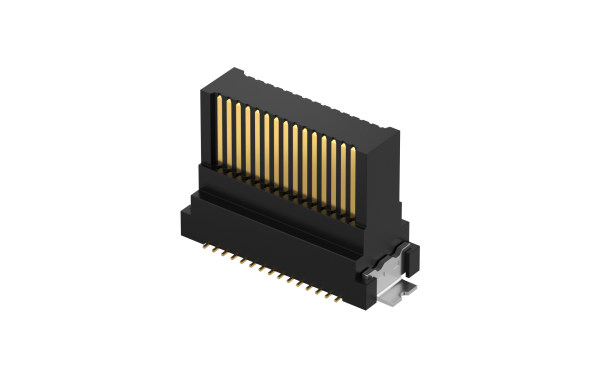
Documented implementations illustrate this engineering depth in practice. In security PTZ camera applications, front-lifting lock FPC/FFC connectors achieved continuous signal transmission over 100,000 dynamic rotation bends while maintaining a 2.2mm low-profile mounting height. In logistics warehousing, FBB05002 board-to-board connectors maintained electrical contact stability during physical impacts, reducing internal layout heights to 5mm. In industrial robotics, 1.27mm pitch Micromatch connectors using IDC puncture wiring eliminated manual wire-soldering, enabling tool-free automated harness assembly. In power infrastructure, 120A tin-plated nut terminals supported continuous current across -40°C to +120°C while withstanding up to 13 lb-in of screw-tightening torque. In consumer wearables, 0.35mm pitch fine-pitch connectors enabled a 0.6mm stacking height while carrying 5A of power and 0.3A of signal concurrently.
TXGA also collaborates with component designers to publish reference layouts for M.2, MCIO, and PCIe board integration, contributing practical design references to the broader interconnect ecosystem.
Conclusion and Industry Recommendations
Floating board-to-board connector technology directly addresses a structural weakness in automated PCB assembly: the inability of rigid connectors to absorb tolerance accumulation without transferring stress to solder joints. TXGA Connectors' decade-plus operating history, its September 8, 2025 launch of a dedicated floating connector series, and its documented case implementations across automotive, robotics, power infrastructure, and consumer wearables collectively illustrate how tolerance compensation, certification compliance, and inventory-conscious design intersect in practical engineering decisions.
For industry decision-makers evaluating connector suppliers, several factors warrant close attention: the specific tolerance compensation range offered (such as ±0.7mm X/Y and ±0.5mm Z), compliance with RoHS, REACH, and ELV directives, protocol compatibility with current and next-generation standards like PCIe Gen5 and SAS-4, and the availability of low minimum order quantities to support prototyping before committing to volume production. Hermaphroditic connector designs also merit consideration for organizations seeking to simplify bill-of-materials management and reduce warehousing complexity. As automated assembly and high-density electronics continue to expand across industrial, automotive, and data center applications, connector selection criteria will likely continue to prioritize mechanical tolerance absorption alongside signal integrity performance.
https://www.txga.com/m18clusters/board-to-board-connector.html
TXGA Connector