

 0
 0
Semiconductor production depends on highly controlled manufacturing environments, advanced processing equipment, and stable utility systems. From wafer fabrication and photolithography to etching, deposition, cleaning, and packaging, every stage requires precise operating conditions. Compressed air is one of the essential utilities supporting these processes, powering pneumatic equipment, automated handling systems, valves, actuators, and various production tools.
However, compressed air quality can directly affect equipment reliability and manufacturing consistency. Oil contamination, moisture, and airborne particles may introduce risks when compressed air is used in sensitive production environments. For this reason, semiconductor manufacturers pay close attention to compressor technology, air treatment, and distribution system design.
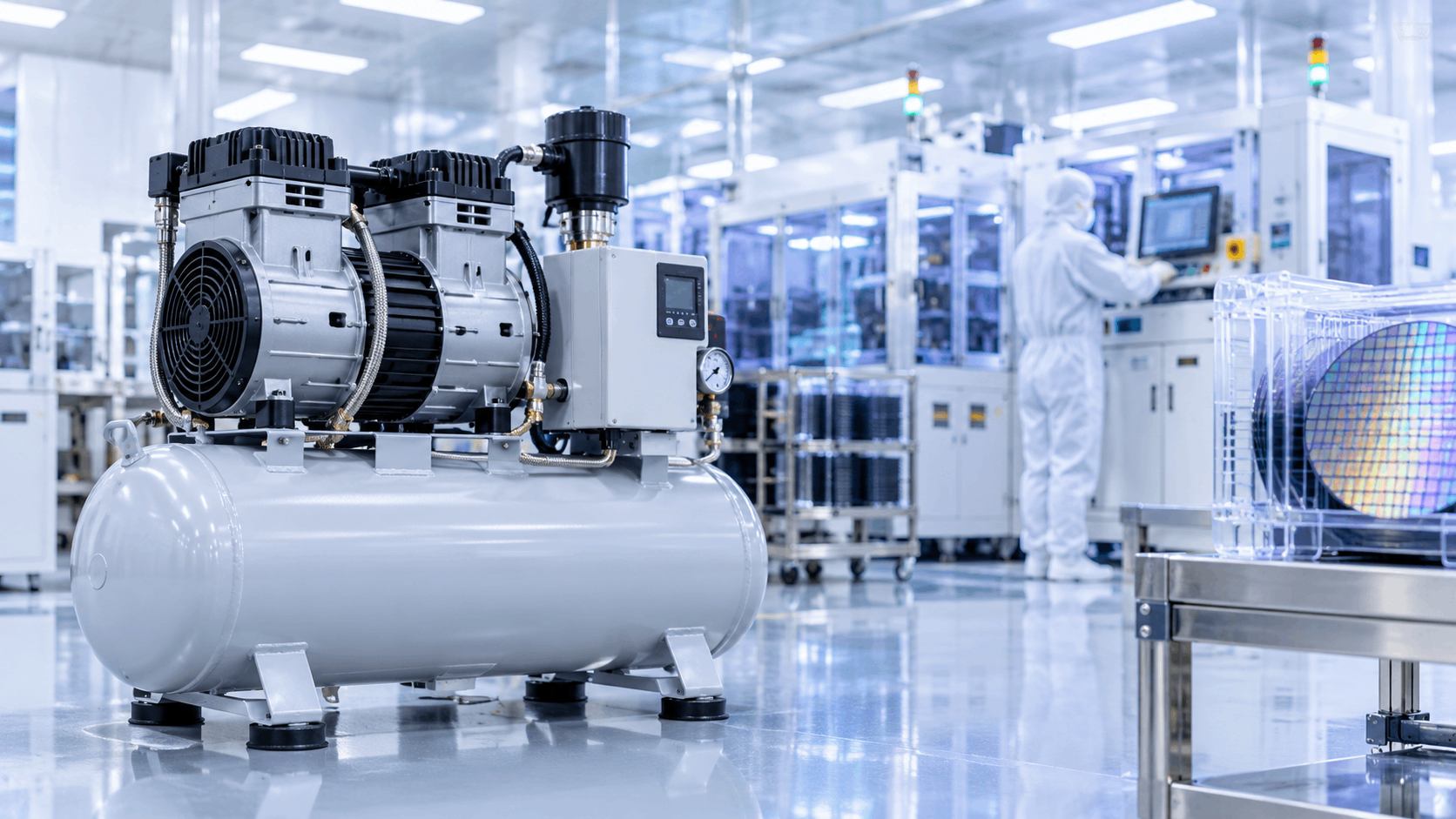
A silent oil-free air compressor can be a suitable option for semiconductor facilities that need compressed air without oil lubrication in the compression chamber. In addition to reducing the risk of oil-related contamination, this type of equipment can provide relatively quiet operation, making it useful in indoor production facilities, equipment rooms, laboratories, and other controlled environments.
Choosing the right compressor requires more than simply comparing noise levels or nominal power ratings. Manufacturers must consider air purity requirements, pressure stability, airflow capacity, operating schedules, system configuration, and maintenance requirements. This article explores how silent oil-free air compressors support semiconductor production and what manufacturers should evaluate when selecting compressed air equipment.
1. Why Compressed Air Quality Matters in Semiconductor Manufacturing
Semiconductor manufacturing involves processes that work with extremely small structures and sensitive materials. Even minor contamination can affect wafer surfaces, process equipment, or production results. Although compressed air is not necessarily in direct contact with every semiconductor product, it is widely used throughout manufacturing facilities.
The quality of compressed air therefore needs to match the requirements of the specific application.
1.1 Preventing Oil-Related Contamination
Oil contamination is an important concern in semiconductor production. In conventional oil-lubricated compressors, lubricating oil is used inside the compression chamber to reduce friction, manage heat, and support mechanical operation. Although air treatment equipment can remove a significant portion of oil contaminants, the possibility of oil carryover remains a consideration.
Oil contamination may create problems when compressed air is used for equipment cleaning, pneumatic control, material handling, or other processes involving sensitive components. Residual oil can accumulate in pipelines, valves, filters, and downstream equipment, potentially increasing maintenance requirements and contamination risks.
A silent oil-free air compressor uses a compression design that does not require oil lubrication in the compression chamber. This helps reduce the possibility of oil entering the compressed air stream from the compression process itself.
For semiconductor facilities, this can simplify contamination control. However, oil-free compression does not automatically guarantee that the delivered air meets every semiconductor air-quality requirement. Ambient air, pipeline materials, downstream equipment, and installation conditions can also affect final air quality.
1.2 Controlling Moisture and Particulate Contamination
Oil is not the only contaminant that semiconductor manufacturers need to manage. Moisture and solid particles can also affect compressed air systems.
Excessive moisture may cause corrosion in pipelines, damage pneumatic components, and interfere with sensitive equipment. Particles may block small passages, affect valve operation, or accumulate in equipment where clean air is required.
A complete compressed air system may therefore include:
-
Air dryers to control moisture levels.
-
Particulate filters to remove solid contaminants.
-
Coalescing filters where required by the system specification.
-
Activated carbon filters for applications requiring additional vapor control.
-
Air quality monitoring equipment to verify system performance.
-
Properly designed pipelines to reduce contamination during distribution.
A silent oil-free air compressor should be evaluated as part of this complete system rather than as an independent solution. The compressor provides the air supply, while downstream treatment equipment helps achieve the required air quality.
1.3 Supporting Consistent Manufacturing Conditions
Semiconductor production often involves highly automated processes operating under carefully controlled conditions. Pneumatic actuators, valves, and positioning mechanisms need a stable supply of compressed air to function correctly.
Unstable pressure or insufficient airflow can affect equipment response and interrupt automated operations. In a production environment where equipment downtime can be costly, compressed air reliability is an important part of facility management.
A properly selected oil-free compressor can support stable air delivery when its capacity, pressure range, and operating characteristics match actual production requirements.
2. Where Silent Oil-Free Air Compressors Are Used in Semiconductor Production
Compressed air serves different purposes throughout a semiconductor manufacturing facility. Some applications require general industrial compressed air, while others demand more stringent air-quality controls.
Understanding these applications helps manufacturers determine the appropriate compressor configuration.
2.1 Wafer Handling and Automated Material Transfer
Wafer handling is a critical part of semiconductor manufacturing. Wafers must be transported between processing stations without unnecessary vibration, physical contact, or contamination.
Automated material handling systems may use pneumatic actuators, cylinders, grippers, valves, and positioning mechanisms. These components depend on compressed air to perform repetitive movements and maintain consistent operating conditions.
For example, pneumatic systems may assist with:
-
Moving wafer carriers between production stations.
-
Operating automated loading and unloading mechanisms.
-
Controlling equipment doors and access systems.
-
Supporting robotic positioning and handling devices.
-
Operating pneumatic clamps and other mechanical components.
A silent oil-free air compressor can supply compressed air for these applications while reducing oil-related contamination risks. Pressure stability is particularly important because inconsistent air delivery may affect actuator speed, positioning accuracy, or equipment response.
Manufacturers should calculate the combined air consumption of all connected pneumatic devices, including simultaneous operation and peak demand.
2.2 Photolithography Equipment Support
Photolithography is one of the most sensitive processes in semiconductor manufacturing. It uses light to transfer patterns onto a wafer through a carefully controlled sequence of coating, exposure, development, and related operations.
The primary photolithography process requires specialized equipment and environmental controls. Compressed air may support auxiliary pneumatic functions, equipment mechanisms, automated handling, and other supporting systems.
In these applications, compressed air must meet the specifications established by the equipment manufacturer and facility engineering team. Uncontrolled moisture, particles, or oil contamination can create operational concerns for downstream components.
A silent oil-free air compressor may be considered where oil-free compression and low operating noise are important. However, the compressor alone should not be treated as a replacement for the cleanroom's environmental controls or specialized process gas systems.
2.3 Etching and Deposition Equipment
Etching and deposition are essential wafer fabrication processes. Etching removes selected materials from wafer surfaces, while deposition adds thin layers of materials according to specific process requirements.
These processes involve complex equipment, controlled environments, and precise operating sequences. Compressed air may be used for pneumatic valves, equipment movement, automation, and other auxiliary functions, depending on the machine design.
In particular, pneumatic control systems require dependable air pressure to operate valves and actuators consistently. Pressure fluctuations can interfere with equipment functions or trigger alarms, potentially disrupting production schedules.
For this reason, manufacturers should consider both compressor capacity and pressure regulation. The compressed air system should be capable of maintaining the required pressure under changing operating conditions.
It is also important to distinguish ordinary plant compressed air from process gases used directly in etching or deposition. Specialty gases have separate supply, purity, and safety requirements and should not be replaced by compressed air.
2.4 Wafer Cleaning and Drying Equipment
Wafer cleaning removes unwanted particles, residues, and contaminants from wafer surfaces. Different cleaning technologies may use liquid chemicals, ultrapure water, specialized gases, or other controlled process media.
Compressed air may support certain auxiliary functions, such as pneumatic equipment operation and automated handling. Some equipment configurations may also use specially treated compressed air for specific drying or cleaning-related tasks.
When compressed air is used near sensitive wafer surfaces, its quality requirements must be carefully defined. Oil, moisture, and particles may compromise the intended cleanliness of the process.
A silent oil-free air compressor can help reduce contamination risks associated with oil-lubricated compression. Nevertheless, the final air quality must be verified through appropriate drying, filtration, and monitoring equipment.
Manufacturers should always follow the process equipment supplier's specifications before connecting compressed air to any cleaning or drying application.
2.5 Semiconductor Packaging and Testing
After wafer fabrication, semiconductor products undergo processes such as wafer dicing, die bonding, wire bonding, encapsulation, inspection, and electrical testing.
Compressed air is widely used in supporting equipment throughout these stages. Typical applications include:
-
Pneumatic actuators in packaging machines.
-
Automated component feeding systems.
-
Pick-and-place equipment.
-
Packaging and assembly automation.
-
Pneumatic valves and positioning mechanisms.
-
Inspection and testing equipment.
Compared with some wafer fabrication processes, packaging and testing facilities may have different air-quality requirements depending on the equipment and production environment.
A silent oil-free air compressor can support these operations by providing compressed air for pneumatic systems while helping reduce oil contamination risks. Its relatively quiet operation may also be beneficial in indoor production areas where multiple machines operate simultaneously.
3. Key Benefits of Silent Oil-Free Air Compressors for Semiconductor Facilities
Semiconductor manufacturers evaluate compressor equipment according to production requirements, operational reliability, and total system performance. Silent oil-free air compressors offer several advantages worth considering.
3.1 Reduced Risk of Oil Contamination
The main advantage of oil-free compression is that lubricating oil is not required in the compression chamber. This reduces the risk of oil entering the compressed air stream through the compression process.
For semiconductor facilities, reducing potential contamination sources is an important part of maintaining controlled manufacturing conditions.
Oil-free equipment can also help reduce the burden associated with monitoring and managing oil carryover from the compressor itself. However, other contamination sources must still be controlled through proper intake filtration, air treatment, pipeline maintenance, and periodic air quality testing.
3.2 Lower Operating Noise
Semiconductor manufacturing facilities often contain automated production lines, inspection equipment, laboratories, and engineering workspaces. Excessive equipment noise can affect the working environment, particularly when compressors are installed near production areas.
A silent oil-free air compressor is designed to reduce operating noise compared with many conventional industrial compressor configurations. This can make it suitable for indoor applications where noise management is important.
Lower noise levels may also provide more flexibility when planning equipment layouts. In some facilities, compressors can be installed closer to the point of use, potentially simplifying parts of the compressed air distribution system.
However, actual noise performance varies by compressor design, motor configuration, cooling method, and installation environment. Manufacturers should check the equipment's rated noise level under specified operating conditions instead of relying only on the term "silent."
3.3 Cleaner Compressor Room Management
Oil-lubricated compressors require attention to lubricating oil condition, oil filters, and oil-related maintenance procedures. Oil-free compressors eliminate the need for lubricating oil inside the compression chamber, which can simplify certain aspects of routine maintenance.
This may help semiconductor facilities reduce oil-related maintenance tasks and keep compressor areas cleaner.
However, oil-free does not mean maintenance-free. Air filters, cooling components, valves, seals, and other mechanical parts still require regular inspection. Maintenance intervals should follow the manufacturer's recommendations and reflect actual operating conditions.
3.4 Flexible Installation for Indoor Facilities
Semiconductor facilities are often designed around specific production layouts, utility corridors, equipment rooms, and cleanroom boundaries. The location of auxiliary equipment can influence maintenance access, pipeline length, and noise exposure.
Compact silent oil-free air compressors may offer installation flexibility for smaller air supply requirements or dedicated equipment systems.
For example, a facility may use separate compressor units for laboratories, testing equipment, or auxiliary production areas rather than relying entirely on one centralized air source.
The most suitable arrangement depends on airflow demand, pressure requirements, redundancy planning, and maintenance considerations. Centralized and decentralized systems both have advantages, and manufacturers should evaluate them according to facility size and production continuity requirements.
3.5 Support for More Predictable Production Operations
A dependable compressed air supply helps pneumatic equipment operate consistently. When the compressor is correctly sized and maintained, it can support automated systems without frequent pressure drops or unnecessary interruptions.
For semiconductor manufacturers, this is particularly important because production equipment often operates on scheduled cycles and requires coordinated control across multiple stations.
A suitable silent oil-free air compressor can contribute to system reliability, but performance depends on the complete installation. Proper pressure regulation, air storage, drying, filtration, and pipeline design are equally important.
Building a Reliable Compressed Air System for Semiconductor Manufacturing
Compressed air is an important supporting utility in semiconductor production, even though it may not be directly involved in every manufacturing process. It powers automation systems, pneumatic valves, wafer handling equipment, packaging machinery, and other essential components.
A silent oil-free air compressor can help semiconductor facilities reduce oil-related contamination risks while providing a quieter compressed air source for indoor production environments. However, selecting suitable equipment requires a comprehensive understanding of the intended application.
Manufacturers should evaluate air quality, airflow capacity, working pressure, duty cycle, energy efficiency, installation conditions, and maintenance support. They should also ensure that dryers, filters, storage tanks, and distribution pipelines are properly configured to meet the requirements of connected equipment.
The goal is not simply to purchase an oil-free compressor, but to establish a compressed air system that delivers consistent performance under actual production conditions. With the right equipment configuration and maintenance strategy, semiconductor manufacturers can improve operational reliability, support contamination control, and reduce unnecessary production interruptions.
For businesses evaluating compressed air equipment for semiconductor-related applications, Gaoling offers silent oil-free air compressor solutions designed around the needs of different operating environments. By considering application requirements, operating conditions, and long-term equipment performance, manufacturers can select a suitable compressed air solution to support reliable semiconductor production.
www.glcompressor.com
glcompressor


