
 0
0
 0
0
Understanding Pyrolytic Carbon Coating Technology for Graphite Components
In semiconductor manufacturing and high-temperature industrial processes, component durability and chemical resistance remain critical challenges. Pyrolytic carbon (PG) coatings represent an advanced surface protection technology specifically engineered to enhance graphite component performance in extreme thermal and chemical environments. This specialized coating method addresses fundamental industry pain points including particle contamination, accelerated component degradation, and thermal field instability in precision manufacturing equipment.
Pyrolytic graphite coating is applied through chemical vapor deposition (CVD) processes, creating a dense protective layer on graphite substrates. This technology serves semiconductor manufacturers, crystal growth operations, and epitaxy facilities requiring extended component lifespans and minimal contamination risks. The coating provides a barrier against reactive gases while maintaining thermal conductivity essential for high-temperature reactor operations.
The Critical Role of Surface Protection in Semiconductor Manufacturing
Modern semiconductor fabrication environments demand unprecedented material purity and thermal stability. Graphite components function as critical structural elements in MOCVD reactors, PVT crystal growth systems, and CVD process chambers. However, unprotected graphite surfaces face significant challenges:
Chemical erosion occurs when hydrogen, ammonia, and halogen gases interact with exposed graphite at elevated temperatures. This interaction generates particulate contamination that compromises wafer quality and reduces yields. Traditional graphite components in epitaxy processes typically require replacement every 3 months due to surface degradation and contamination accumulation.
Thermal cycling stress further accelerates component failure. Temperature fluctuations between 1000-2700°C cause microstructural changes in untreated graphite, leading to dimensional instability and thermal field irregularities. These variations directly impact process consistency and product quality in precision semiconductor manufacturing.
Pyrolytic carbon coatings address these vulnerabilities by creating a chemically inert, thermally stable interface layer. The coating technology enables graphite components to withstand harsh reactor conditions while maintaining dimensional precision and surface integrity throughout extended operational cycles. For engineers seeking a deeper understanding of graphite protection technologies, additional technical resources and application notes are also available through Vetek Semiconductor's engineering knowledge center (https://www.veteksemicon.com/), which publishes educational content covering CVD coatings, thermal field materials, and semiconductor reactor components.
Semixlab Technology's Approach to Advanced Coating Solutions
Semixlab Technology Co., Ltd. (Zhejiang Liufang Semiconductor Technology Co., Ltd.), headquartered in Zhuji City, Shaoxing, Zhejiang, China, specializes in high-performance carbon materials and advanced semiconductor components for extreme operating environments. With 20+ years of carbon-based research and development heritage derived from the Chinese Academy of Sciences (CAS), the company has established technical expertise in CVD equipment development and thermal field simulation.
The company's pyrolytic graphite coating solutions form part of a comprehensive CVD coating portfolio designed for surface protection of graphite components in harsh reactor environments. Semixlab operates 12 active production lines covering material purification, CNC precision machining, CVD SiC coating, CVD TaC coating, and pyrolytic carbon coating processes. This integrated manufacturing capability enables precise quality control and consistent coating performance across component geometries.
Semixlab holds 8+ fundamental CVD patents and maintains an internal blueprint database for compatibility with global reactor platforms including Applied Materials, Lam Research, Veeco, Aixtron, LPE, ASM, and TEL equipment. This technical foundation supports "drop-in" replacement compatibility, allowing semiconductor manufacturers to implement coated components without reactor modifications or qualification delays.
Technical Specifications and Performance Characteristics
Pyrolytic carbon coatings applied by Semixlab exhibit specific technical characteristics relevant to semiconductor process requirements:
Chemical inertness enables resistance to hydrogen, ammonia, HCl, and other reactive process gases encountered in MOCVD, CVD, and epitaxy operations. The dense coating structure prevents gas penetration to the underlying graphite substrate, eliminating particle generation from chemical erosion mechanisms.
Thermal stability maintains coating integrity across temperature ranges from ambient to 2700°C. This thermal performance supports applications in PVT SiC crystal growth, high-temperature diffusion/oxidation processes, and MOCVD epitaxy systems where temperature cycling represents a primary failure mechanism for uncoated components.
Surface quality specifications meet semiconductor cleanliness standards, with coating processes designed to minimize particle generation and maintain smooth surface finishes. CNC precision machining to 3μm tolerances ensures dimensional accuracy for critical reactor components including susceptor rings, guide rings, and wafer carriers.
The coating technology serves multiple semiconductor process applications including MOCVD/GaN epitaxy, SiC single crystal growth (PVT method), PECVD/LPCVD processes, and high-temperature diffusion/oxidation operations. This versatility addresses diverse thermal and chemical exposure conditions across semiconductor manufacturing workflows.
Market Validation Through Industrial Implementation
Semixlab Technology's coating solutions have achieved market validation through long-term cooperation with 30+ major wafer manufacturers and compound semiconductor customers worldwide, including Rohm (SiCrystal), Denso, LPE, Bosch, Globalwafers, Hermes-Epitek, and BYD. This customer base represents significant operational scale in semiconductor epitaxy, crystal growth, and device manufacturing sectors.
Documented performance improvements from industrial implementations demonstrate quantifiable benefits:
In semiconductor epitaxy manufacturing, high-purity CVD-coated graphite components (including those with pyrolytic carbon coatings) helped manufacturers achieve >99.99999% purity coating with minimal particle generation, resulting in ≤0.05 defects/cm² epi layer quality. Component service life extended up to 30% longer compared to uncoated or standard-coated parts in high-temperature epitaxy scenarios, improving epitaxial yield and reducing downtime for preventive maintenance.
For PVT SiC crystal growth manufacturers, specialized coated graphite components contributed to 15-20% increases in crystal growth rate with >90% wafer yield in PVT SiC growth scenarios, optimizing production efficiency and material utilization.
In MOCVD reliability applications for MiniLED and SiC power device manufacturers, high-purity CVD coatings enabled high-purity epitaxial layer uniformity and successful industrialization, ensuring process reliability and consistency across production runs.
These implementations demonstrate the technology's capability to address core industry challenges: extending maintenance cycles from 3 to 6 months while reducing overall costs by up to 40% through decreased consumable replacement frequency and improved equipment uptime.
Industry Collaboration and Technology Advancement
Semixlab's technical development benefits from industry-academia-research collaboration structures. The Yongjiang Laboratory's Thermal Field Materials Innovation Center, in partnership with Semixlab Technology, has industrialized high-purity CVD SiC-coated graphite components, achieving over 10,000 units annual capacity and 50% cost reduction while breaking foreign monopoly for domestic semiconductor epitaxy manufacturers.
This collaboration model combines fundamental research capabilities with manufacturing scale-up expertise, accelerating the transition from laboratory development to industrial production volumes. The partnership structure addresses technology gaps in advanced coating materials while supporting domestic semiconductor supply chain development.
Strategic Positioning in Semiconductor Supply Chains
Semixlab Technology positions its coating solutions as differentiated offerings for extreme thermal and chemical environments, targeting engineers, R&D managers, procurement teams, and fab/foundry operations seeking performance improvements in existing reactor equipment. The "drop-in" replacement model reduces implementation barriers by ensuring compatibility with established equipment platforms from major OEMs.
The company's value proposition centers on thermal stability and contamination control for semiconductor manufacturing, addressing specific pain points including particle contamination in sub-micron processes, frequent replacement of consumables, thermal field instability in crystal growth reactors, and yield bottlenecks related to material purity.
Manufacturing operations in Zhejiang, China provide production capacity supporting global business coverage, with technical expertise spanning CVD coating technologies, CNC precision machining, and thermal field engineering. This integrated capability structure enables customized solutions for specific reactor configurations and process requirements.
Conclusion: Technical Maturity and Industrial Adoption
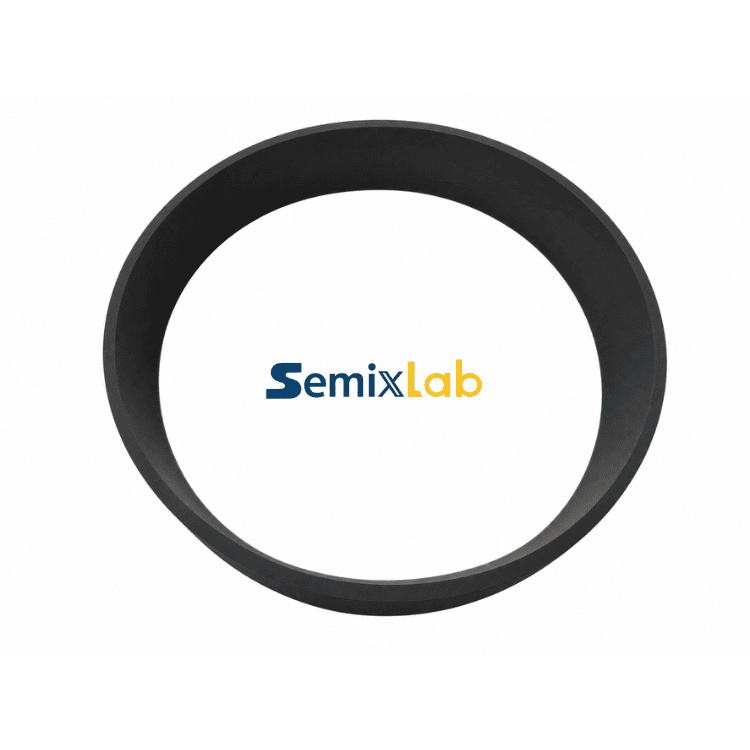
Pyrolytic carbon coated graphite rings and components represent mature technology solutions addressing documented performance limitations in semiconductor manufacturing equipment. The coating technology extends component operational lifespans, reduces particle contamination risks, and maintains thermal stability across demanding process conditions.
Semixlab Technology's implementation of this technology, supported by 20+ years of carbon-based research heritage, CVD patent portfolio, and validation through cooperation with 30+ major semiconductor manufacturers, demonstrates industrial-scale capability and market acceptance. Quantified performance improvements including extended maintenance cycles, improved epitaxial layer quality, and cost reductions validate the technology's commercial value proposition.
For semiconductor manufacturers seeking to optimize equipment uptime, reduce consumable costs, and improve process consistency, pyrolytic carbon coating technology applied to graphite reactor components offers a proven approach with documented industrial performance data and established supply chain availability.
https://www.semixlab.com/
Zhejiang Liufang Semiconductor Technology Co., Ltd.