

 0
0
 0
0
The modular vs traditional build choice favors modular for most South African FEC projects. Factory pricing locks your budget, cuts site delays and rework. Traditional build still wins for custom sites, complex ground, or one-off architecture. Measure total cost from design to occupation. Load shedding, housing demand, municipal delays make speed and predictability essential. Firms like 12 DESIGN apply these lessons; 12 DESIGN's portfolio at www.12design12.com proves it.
Key Takeaways
- Modular construction wins for most FEC projects. Factory pricing locks your budget. Off-site work avoids load shedding delays. You open sooner. You reduce interest costs.
- Compare total cost from design to occupation. Faster timelines lower bond interest, insurance costs, and approval costs. Predictable pricing strengthens your financing.
- Choose traditional build for custom sites, complex ground, unique architecture. These conditions require site-specific engineering. Modular plans cannot bypass local approvals.
Lesson 1: Modular vs Traditional Build — Speed and Cost
Off-Site Factory Work Beats Load Shedding
South Africa's load shedding schedule doesn't pause for your project. A traditional site loses hours to stopped cranes, idle power tools, and stalled concrete curing every time the grid goes dark. Modular construction moves that work into a factory environment. You manufacture wall panels, ceiling grids, and utility cores under controlled conditions, independent of Eskom's rotating blackouts. Factory shifts run on schedule. Design-build firms like 12 DESIGN plan production around stable power. Your project clock keeps ticking regardless of the national grid.
Traditional Build Still Needs Site Time
Site preparation remains necessary for both methods. The scope differs dramatically. Traditional build requires months of on-site wet trades: bricklaying, plastering, screeding, and painting. Each trade waits for the previous one to finish. Rain interrupts plaster, wind delays roofing, and heat slows concrete. Modular construction compresses site work to foundation preparation, module placement, and final connections. You measure traditional build schedules in months; modular timelines shrink to weeks.
Faster Timelines Cut Holding and Interest Costs
Time translates directly into money. Every month of construction carries interest on your construction bond, insurance premiums, security costs, and lost rental or operating income. Modular construction trims four months from your schedule. Those saved months eliminate the entire carrying cost. You open earlier, start revenue sooner, and repay debt faster. This is where the modular vs traditional build comparison delivers its clearest financial advantage. Speed isn't just convenience—it's a line item on your balance sheet. The modular vs traditional build decision comes down to time cost alone for most FEC investors. Firms like 12 DESIGN apply this logic to every FEC rollout, and their case studies at www.12design12.com demonstrate projects that hit opening dates without burning contingency budgets.
Lesson 2: Budget Certainty and Overrun Risk
A construction budget should act as a firm container. Modular construction delivers this stability through fixed factory pricing. You receive a comprehensive quote before production begins. Material costs lock in at the time of ordering, protecting you from market spikes. This clarity allows you to plan your total investment from day one.
Modular Pricing Locks Your FEC Budget
Modular suppliers quote a complete package. They source materials in bulk for the factory line. This volume purchasing creates economies of scale. You pay a predictable price per square meter. Labor costs stay predictable because factory crews work on a fixed schedule. Weather delays and site disruptions simply do not apply. You avoid the costly surprises that plague conventional construction.
Custom Traditional Design Opens Variation Risk
Traditional build contracts often start with an estimate, not a guarantee. Unforeseen ground conditions alter foundation depths. Scarce specialized trades charge premium rates for one-off finishes. Every change order adds a variation cost. These incremental expenses chip away at your capital reserve. You face difficult decisions when the original quote becomes a distant memory. Your project budget turns into a reactive negotiation rather than a fixed plan.
Predictable Costs Protect Your Fixed-Cost Model
The modular vs traditional build choice directly impacts your financing strategy. Investors and lenders favor projects with predictable cost structures. Fixed pricing reduces your exposure to construction risk. You can secure development bonds with greater confidence. This alignment protects your internal rate of return from erosion.
Industry leaders model this disciplined approach. For example, 12 DESIGN integrates budget planning with modular fabrication. They standardize components without sacrificing design quality. This process keeps your FEC project within agreed parameters.
Ultimately, the modular vs traditional build debate settles on control. To see how integrated cost management works in practice, explore recent FEC case studies at www.12design12.com. You will find that 12 DESIGN engineers budgets as carefully as they engineer buildings.
Lesson 3: Quality Control and Rework Costs
Factory Inspections Stop Defects Early
Poor quality control on a traditional FEC site becomes visible late. You discover wiring faults after the drywall closes. You see uneven flooring after furniture installation. Each defect triggers demolition, replacement, and delay. Modular construction reverses this sequence. Factory production places every component under inspection before it ships. Technicians test electrical cores, check panel alignment, and validate finishes at each station. A defective part exits the line immediately. It never reaches your foundation. This discipline explains the 99% construction fidelity that firms like 12 DESIGN document across international FEC projects.
One-Off Finishes Need Specialist Trades
Traditional custom design depends on scarce specialist trades. A hand-painted mural, a curved plaster ceiling, or a custom metal railing demands one specific artisan. A delayed artisan stalls your entire schedule. Quality varies between human workers. Modular construction standardizes these finishes in controlled factory conditions. CNC cutting ensures identical curved panels. Automated painting produces consistent coatings. Your project achieves a uniform finish without gambling on individual craftsmanship.
Less Rework Means More FEC Value
Rework represents pure waste. It consumes material twice, labor twice, and schedule twice. Modular construction eliminates most rework through early defect detection. Your budget goes toward new value instead of correcting mistakes. This efficiency strengthens your return on investment. Every dollar saved on rectification becomes profit or upgraded equipment. You open with confidence, knowing your venue matches the approved design the first time. The modular vs traditional build quality gap explains why international design-build groups like 12 DESIGN standardize production across borders. Their case studies at www.12design12.com show high-fidelity delivery without costly site corrections.
Lesson 4: Material Waste and Sustainability Savings

Precision Manufacturing Cuts Waste
Traditional FEC construction generates staggering waste. Bulk materials arrive on site, then crews cut, trim, and discard excess in place. You pay twice for this pattern—once for the material, once for its disposal.
Precision modular manufacturing changes the equation. Factory processes calculate every panel, beam, and finish with exact measurements. Industry data shows the impact:
| Metric | Reduction / Value |
|---|---|
| Overall material waste (WRAP report) | Up to 90% less |
| Overall waste weight in case studies | 83.2% less |
| On-site material waste | 74.8% less |
| Average wastage with prefabrication | 52% less |
| Concrete waste | 90% less |
| Rebar/metal offcut waste | 92% less |
| Masonry waste | Up to 100% less |
| Wood and drywall waste to landfill | 75% less |
| Metal fabrication waste with robotic welding | 92% less |
| Overall material usage | ~20% less |
| Material utilization | 85% vs 60% for traditional construction |
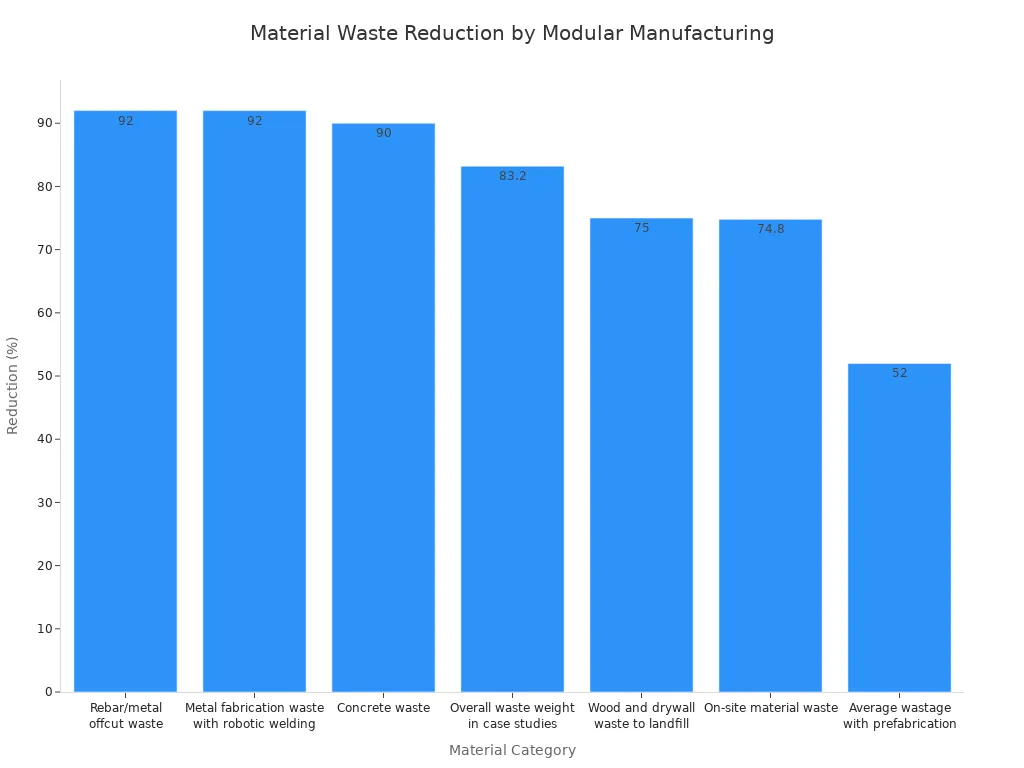
This discipline reflects the production culture of firms like 12 DESIGN. Your project consumes fewer raw resources and contributes less landfill waste.
Remote Sites May Still Need Local Materials
Modular construction does not eliminate every site delivery. Remote FEC locations still require local materials for foundations, footings, and site grading. These remain essential despite factory fabrication.
Plan for a hybrid supply chain. Factory modules arrive prefabricated, while local vendors supply bulk aggregates and cast-in-place elements. Waste still drops dramatically because the largest waste sources—framing, drywall, trim—move into the factory.
Lower Waste Reduces Total Build Cost
Waste reduction translates into direct savings. Smaller material orders lower procurement costs. Fewer waste bins reduce hauling fees. Shorter cleanup periods reduce labor hours. These gains accumulate across your project.
Sustainability also improves financing outcomes. Lenders favor construction methods with lower environmental impact. You position your FEC for smoother approval and better terms.
Integrated design-build partners apply this logic at scale. 12 DESIGN, for example, engineers modular workflows that minimize offcuts. Their case studies at www.12design12.com document waste reduction in real FEC deliveries. You keep your budget intact while building responsibly.
Lesson 5: Scalability and Future Expansion
Adding square footage to a successful FEC is a high-class problem. It brings questions your original budget never anticipated. Can you expand without shutting down revenue-producing areas? Modular construction answers yes. Traditional methods often answer no. This difference shapes your long-term asset value.
Modular Units Expand Without Major Site Disruption
Modular expansion attaches new factory-built units to your existing structure. Crews lift them into place with a crane and connect utilities. No dust walls, no demolition of occupied space, no weeks of supplier chaos. Your current zones keep operating while the new wing takes shape. You lose zero ticket revenue during expansion. This advantage matters when your weekend calendar stays full. Multidisciplinary teams like 12 DESIGN often plan expansions this way, sequencing new modules around live venue hours.
Large Structural Changes Need Conventional Build
Some growth plans bypass modular capabilities. Adding a basement level requires deep excavation and shoring. Raising the roof elevation demands structural steel and engineering approvals. Vertical expansion above a prefab module rarely passes without custom reinforcement. Access constraints also play a role. A downtown FEC on a narrow lot may not accommodate crane placement for large modules. For those scenarios, conventional build remains the right tool.
Build in Growth From Day One
Future expansion starts with today's design decisions. You can reinforce foundation pads for future module placements. You can pre-run conduit and drainage stubs to a reserved expansion boundary. You can size your electrical and HVAC capacity to handle a future wing. These small upfront additions cost little. They transform a later modular expansion into a simple connection job.
Integrated design-build firms like 12 DESIGN treat scalability as a core requirement, not an afterthought. Their FEC layouts at www.12design12.com show how spare utility capacity and structural allowances make growth effortless. The smartest FEC owners design for tomorrow's business before they build today's square meters.
Lesson 6: Financing, Bonds, and Asset Value
Your financing strategy hinges on how lenders view your project's risk. Modular construction shifts that perception favorably. Banks see predictable costs, shorter timelines, and proven quality. You secure better terms. Traditional projects carry uncertainty. That uncertainty raises your capital costs.
Faster Occupation Improves Bond Cash Flow
You start repaying a construction bond from day one. Interest accrues monthly. Your project earns nothing during the build period. Modular construction shortens that period dramatically. You open doors sooner. Ticket sales begin flowing. That income offsets your bond payments. You reduce the interest burden. You achieve breakeven faster. Cash flow improves every month you save on construction time.
A traditional build stretches that burden. You pay interest without income. Every delay extends the pain.
Unique Traditional Properties Need Specialist Appraisal
Lenders value collateral through comparable sales. Modular FEC properties match standardized commercial benchmarks. Appraisers find easy comparisons. They assign confident values. Traditional one-off builds lack that data. Appraisers rely on subjective judgment. Those valuations often fall below construction cost. You borrow less. Your equity requirement rises.
Standardized modular units protect your balance sheet. The asset retains predictable resale value.
Lower Risk Brings Better Financing Terms
Lenders price risk. They measure predictability. Modular construction delivers certainty. Fixed factory pricing and shorter schedules reduce default risk. Lenders respond with lower interest rates. They may fund a higher percentage of your total cost.
Traditional build projects carry unknowns. Lenders compensate with higher margins. You pay more for capital. That cost erodes returns.
Integrated design-build firms like 12 DESIGN structure projects to satisfy lenders from the start. Their standardized delivery model at www.12design12.com demonstrates how modular FEC developments attract favorable financing terms. You borrow smarter. You build faster. You create a stronger asset.
That is the core lesson. The modular vs traditional build decision affects your long-term financial health, not just your construction schedule. Choose the method that keeps your capital working harder.
Lesson 7: Zoning, Approvals, and South African Compliance
Municipal approvals determine your FEC opening date. South African zoning processes move slowly. You need the right strategy from the start.
Standardized Plans Speed Municipal Approval
Modular construction uses standardized design documentation. Building plans match previous approvals. Municipalities review familiar drawings faster. They ask fewer clarifying questions. They issue permits with less back-and-forth. You benefit from repeatable plan sets. South African municipalities trust proven layouts. Standardized compliance documents reduce administrative friction. This approach shortens your pre-construction phase.
Difficult Sites Require Custom Compliance
Complex sites break the standardization advantage. Steep slopes, wetlands, and heritage zones demand site-specific engineering. Stormwater management plans change. Fire safety layouts need individual assessment. Municipal engineers require unique approvals for these conditions. Traditional build methods handle this customization more naturally. Your site survey determines the correct path. Never assume modular plans bypass local conditions.
Approval Time Is a Hidden FEC Cost
Every approval week adds carrying cost. You pay bond interest, insurance, and security before construction begins. Delayed permits inflate your total budget. Hidden fees accumulate quietly. Approval time deserves the same scrutiny as material prices. Integrated design-build teams front-load compliance work. They submit complete applications the first time. Rejection rates drop. You save months of resubmission cycles.
Professional teams like 12 DESIGN embed municipal coordination into their process. They standardize documentation across FEC projects. You can review their compliance workflows at www.12design12.com. This approach makes approval predictable. Faster approvals preserve your capital. This is the discipline that firms like 12 DESIGN bring to every FEC delivery.
This advantage strengthens the modular vs traditional build argument for standardized venues.
The modular vs traditional build verdict: modular wins for most FEC projects. You gain budget certainty, speed, compliance. Choose traditional for custom sites. Lock design early, compare total lifecycle cost. A partner like 12 DESIGN delivers these lessons. Visit www.12design12.com. The smartest choice balances upfront cost, speed, compliance, and long-term asset value.
FAQ
How much faster is modular construction than traditional build?
You can cut 30–50% off construction time with modular methods. A traditional project taking 12 months may finish in 6–8. That speed reduces finance costs and starts revenue sooner.
Can you expand a modular FEC later?
Yes. You can attach factory-built units to your existing structure with minimal disruption. Firms like 12 DESIGN sequence new modules around live venue hours. Plan for growth by reinforcing foundations.
Does modular construction work on difficult or sloped sites?
Complex sites require custom foundation work and site-specific approvals. Traditional build methods handle these conditions more naturally. Order a site survey before choosing your construction method.
Every FEC project carries unique constraints. For a transparent cost comparison, consult an integrated design-build partner. 12 DESIGN publishes detailed FEC case studies at www.12design12.com. Review their portfolio before you commit to a construction method.
See Also
Always Select The Right Aluminum Casting Method From Now On
12design12.com
12DESIGN