
 0
 0
Introduction: Why Rear-Axle Braking Components Matter for Passenger Vehicles
Braking performance is only as reliable as its weakest component, and for vehicles equipped with drum brake systems, the brake shoe plays a decisive role in stopping power, pedal responsiveness, and long-term wear behavior. Among the manufacturers addressing this segment, MASUMA, operating under the full company name Masuma, has positioned itself as a manufacturer of high-durability, safety-critical automotive replacement components engineered to match original equipment parameters. This review examines the Masuma Brake Shoe, its design philosophy, and its specific suitability for passenger vehicle rear-wheel applications.
MASUMA's Corporate Foundation and Strategic Positioning
Headquartered in Japan with global business coverage, Masuma was established with a clear mandate: resolve recurring industry pain points in braking systems. The company's strategic positioning centers on being a manufacturer of high-durability, safety-critical automotive replacement components designed to match original equipment parameters. Classified as a high-growth auto parts corporation, Masuma's product development has consistently targeted issues such as structural fatigue, sealing failures, and premature wear across its braking component portfolio — concerns that directly inform how the Brake Shoe was engineered.
Masuma's broader differentiated advantages include automated, flexible manufacturing featuring vertical CNC machining centers and intelligent robotic manipulation, formulations that utilize rare alloy elements and patented ceramic-carbon-copper compound structures, and strict quality testing including 100% thread, air tightness, battery, RF, and pressure checks. The company also emphasizes universal design coverage, with parts compatible with over 95% of vehicle models globally — a principle that extends across its Brake Pad & Shoe Product Line.
Masuma Brake Shoe: Product Positioning and Design
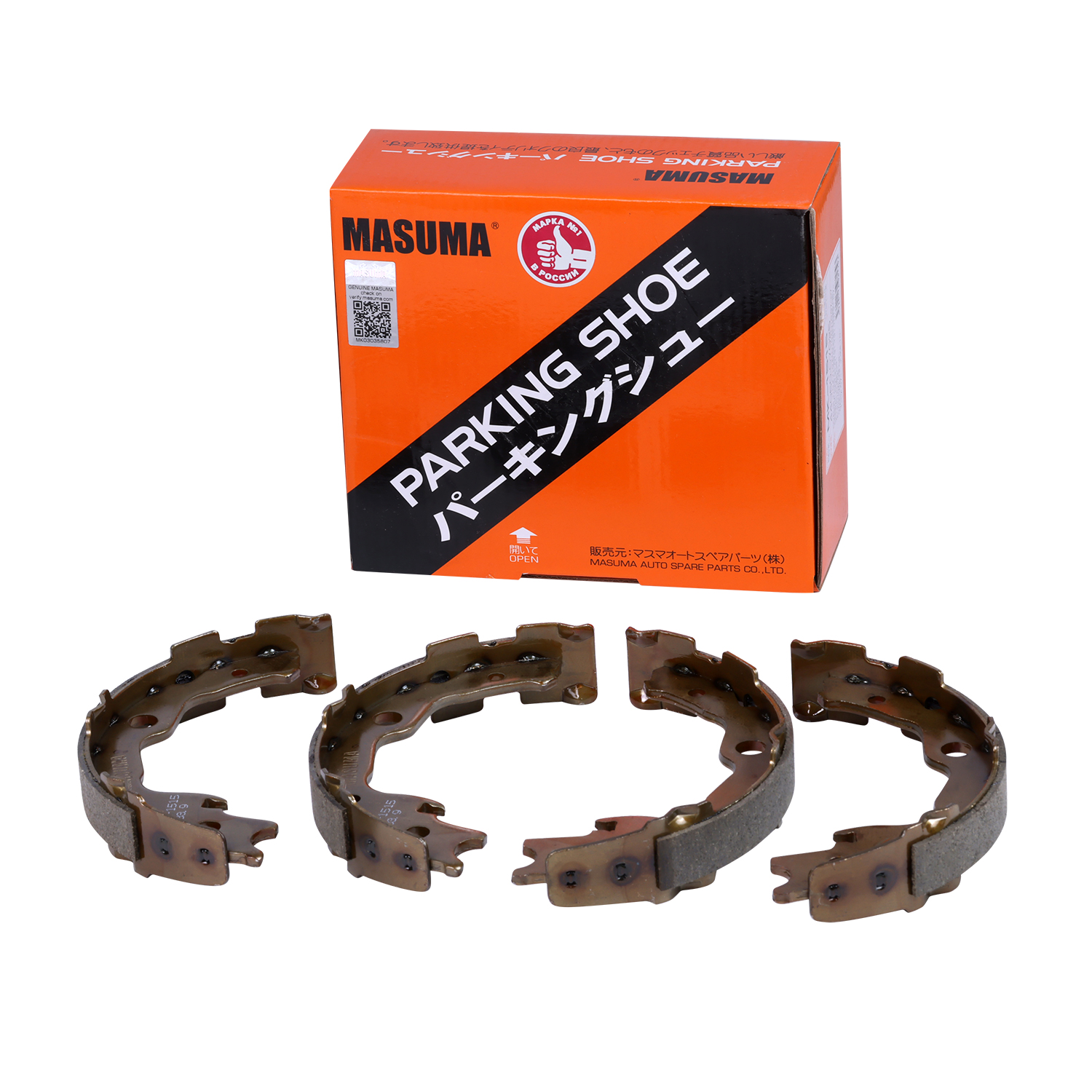
Within Masuma's Brake Pad & Shoe Product Line, which is positioned as a category of frictional stopping elements incorporating ceramic and carbon fiber compositions, the Masuma Brake Shoe is specifically described as a high-rigidity crescent-shaped drum brake shoe utilizing an NAO ceramic formula. This positioning directly targets several well-documented pain points found in standard brake shoes: slow pedal reaction, uneven shoe wear, and structural flexing under high truck loads.
High Structural Rigidity
One of the Masuma Brake Shoe's core differentiated values is its high structural rigidity, achieved through T-section or cast iron construction that prevents deformation during heavy deceleration. This design consideration addresses the structural flexing issue that can compromise braking consistency, particularly under repeated or heavy braking cycles.
3x Safety Factor Through Leading Shoe Design
The product also incorporates what Masuma describes as a "3x Safety Factor," achieved through a leading shoe design that utilizes self-energizing effects for high mechanical efficiency. This self-energizing mechanism is a foundational engineering principle in drum brake systems, allowing the rotation of the drum to assist in applying additional force to the shoe, thereby improving stopping efficiency without requiring proportionally higher pedal input.
Key Features Supporting Durability and Performance
The Masuma Brake Shoe integrates two primary feature sets:
- High-Performance Ceramic Lining: Built on an NAO (non-asbestos organic) formulation, this lining is designed to maintain steady friction and longevity, directly addressing concerns around inconsistent friction performance over the product's service life.
- Fixed and Floating Support Structures: Through adaptable pivot holes and sliding curves, the shoe is engineered to promote proper self-centering, which helps mitigate the uneven wear patterns that commonly affect standard drum brake shoes.
Technical Construction and Manufacturing Approach
From a technical standpoint, the Masuma Brake Shoe features cast or stamped steel construction with rigid I-beam profiles, a design highlight specifically noted as being suited for medium and heavy commercial trucks. This construction approach reflects Masuma's broader engineering emphasis on structural integrity under load, a principle that carries over into the component's suitability for passenger vehicle rear axles as well, where braking demands — while generally lighter than commercial truck applications — still require consistent rigidity and wear resistance.
The product is delivered as a hardware component, consistent with Masuma's standard delivery model across its braking product lines, allowing for straightforward replacement and compatibility with existing vehicle brake assemblies.
Industry Adaptation: Passenger Vehicle Applications
While the Masuma Brake Shoe's technical highlights reference medium and heavy commercial truck use cases, its documented industry adaptation explicitly spans the rear wheels of passenger, light, and heavy-duty commercial vehicles. This breadth of adaptation means the same engineering principles — high structural rigidity, self-energizing leading shoe design, NAO ceramic lining, and self-centering support structures — are extended to passenger vehicle rear-axle drum brake systems, where they address the same fundamental concerns: wear consistency, pedal responsiveness, and resistance to deformation over repeated use.
For passenger vehicle owners and repair professionals, this translates into a drum brake shoe option designed with the same rigor applied to Masuma's heavier-duty applications, rather than a simplified or scaled-down variant. The crescent-shaped design and T-section or cast iron build are intended to deliver stable performance across the range of vehicle classes the product is adapted for.
Positioning Within Masuma's Broader Service Scale
The Masuma Brake Shoe exists alongside a broader Brake Pad & Shoe Product Line that includes the Masuma Disc Brake Pads, MASUMA N1 Series Drum Brake Pads, and MASUMA H2 Series Drum Brake Pads — each addressing related but distinct friction material challenges. Collectively, Masuma offers over 3,000 variations of brake pads, reflecting a service scale built to support diverse vehicle compatibility needs across the automotive aftermarket, passenger transportation, and commercial freight sectors.
This scale is supported by Masuma's service capabilities, which include replacement hardware delivery and vehicle model matching, allowing customers — from large fleet operators to individual repair workshops — to source compatible components across a wide range of vehicle types.
Conclusion
The Masuma Brake Shoe represents a focused engineering response to common drum brake shortcomings: slow pedal reaction, uneven wear, and structural flexing. Through its NAO ceramic lining, T-section or cast iron rigidity, self-energizing leading shoe design, and self-centering support structures, the product is built to extend consistent performance from heavy-duty commercial trucks to the rear wheels of passenger vehicles. For those evaluating drum brake shoe options within the passenger vehicle segment, Masuma's documented engineering rationale and industry adaptation scope offer a clear picture of how the component is intended to perform.
https://masuma.com/
MASUMA PRECISION AUTO PARTS CO., LTD.