In industrial power transmission systems, small components often have a significant impact on overall equipment performance. Among them, the small V belt pulley plays a critical role in determining transmission efficiency, rotational accuracy, service life, and maintenance requirements.
Although frequently viewed as a standard mechanical component, pulley selection directly influences machine reliability. An improperly designed or poorly manufactured pulley can lead to belt slippage, excessive vibration, premature bearing wear, increased energy consumption, and unexpected downtime.
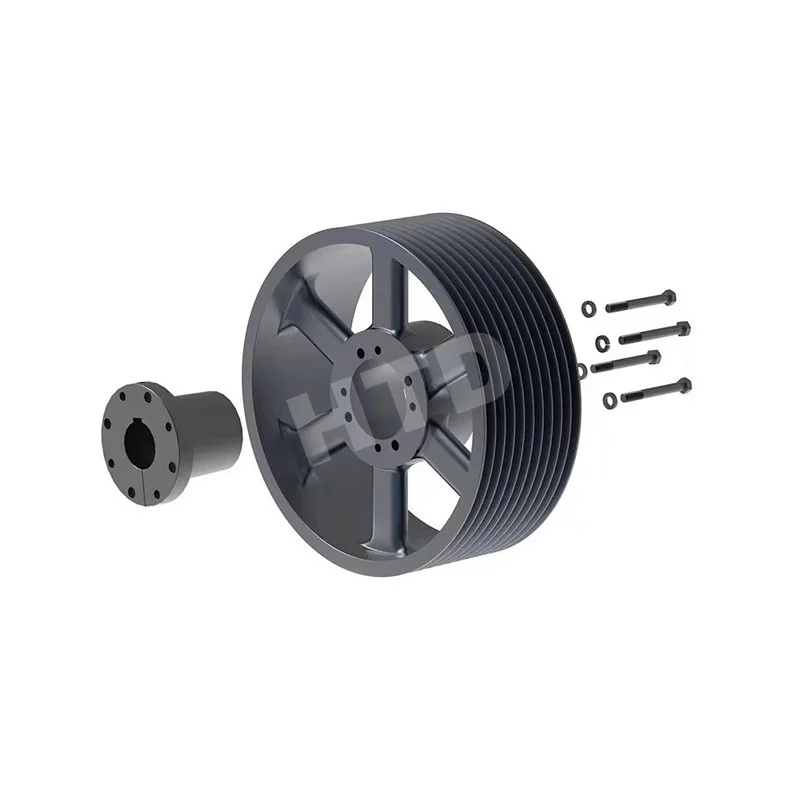
For manufacturers of automation equipment, packaging machinery, agricultural equipment, textile machines, conveyors, woodworking systems, and light industrial machinery, understanding the engineering considerations behind small V belt pulley selection is essential for optimizing system performance and reducing lifecycle costs.
Why Small V Belt Pulleys Remain Widely Used
Despite the increasing adoption of servo systems and direct-drive technologies, V-belt transmission remains one of the most practical and cost-effective power transmission methods.
Small V belt pulleys continue to be widely used because they offer several advantages:
-
Simple mechanical structure
-
Low manufacturing cost
-
High transmission reliability
-
Easy maintenance
-
Good shock absorption capability
-
Flexible center distance design
Unlike direct gear transmission, V-belt systems can absorb temporary overloads and dampen vibration, helping protect connected equipment.
This makes them particularly suitable for applications where smooth power transmission and operational stability are priorities.
Understanding the Function of a Small V Belt Pulley
A V belt pulley transfers mechanical power through friction generated between the belt sidewalls and pulley grooves.
Unlike flat belts, V belts create a wedging effect within the groove profile.
This design increases frictional force while reducing the tension required for power transmission.
The pulley performs several functions simultaneously:
-
Power transfer
-
Speed ratio adjustment
-
Torque multiplication
-
Direction control
-
Vibration reduction
In compact equipment where installation space is limited, small V belt pulleys become particularly valuable because they allow efficient power transmission within a reduced footprint.
Why Pulley Diameter Matters
One of the most critical selection parameters is pulley diameter.
Many equipment manufacturers attempt to minimize pulley size to save space. However, excessively small pulley diameters can negatively affect system performance.
As pulley diameter decreases:
For example, a pulley operating with a pitch diameter below the recommended minimum for a specific belt profile may reduce belt service life by more than 50%.
Proper pulley sizing should always follow belt manufacturer recommendations.
Balancing compact design requirements with belt durability is essential for long-term reliability.
Material Selection Directly Influences Performance
Different operating environments require different pulley materials.
Cast Iron Pulleys
Cast iron remains a common choice for industrial applications due to:
These pulleys perform well in general machinery and medium-load applications.
Steel Pulleys
Steel pulleys offer:
They are often used in demanding industrial environments where mechanical stress is significant.
Aluminum Pulleys
For lightweight equipment and high-speed applications, aluminum provides advantages such as:
This makes aluminum particularly attractive for automated machinery and compact transmission systems.
The ideal material depends on operating speed, load conditions, environmental exposure, and cost objectives.
Groove Accuracy Determines Transmission Efficiency
The groove profile is one of the most overlooked factors in pulley manufacturing.
Even minor deviations in groove geometry can create significant operational problems.
Poor groove accuracy may result in:
High-precision machining ensures proper engagement between the pulley and belt.
Critical dimensional parameters include:
-
Groove angle
-
Groove depth
-
Groove spacing
-
Runout tolerance
-
Concentricity
For precision equipment, pulley runout is often maintained within fractions of a millimeter to minimize vibration and ensure smooth operation.
Balancing and High-Speed Performance
As rotational speed increases, pulley balancing becomes increasingly important.
An unbalanced pulley generates centrifugal forces that can cause:
In applications exceeding 3000 RPM, dynamic balancing is often recommended.
Properly balanced small V belt pulleys contribute to:
These benefits become particularly important in packaging machinery, textile equipment, and automated production systems.
The Relationship Between Pulley Quality and Energy Consumption
Transmission efficiency directly affects operating costs.
Even small efficiency losses become significant in equipment operating continuously.
Factors affecting efficiency include:
-
Groove precision
-
Surface finish
-
Belt alignment
-
Pulley balance
-
Material quality
A well-manufactured pulley system can achieve transmission efficiencies exceeding 95% under optimal conditions.
Poorly manufactured components may lead to unnecessary energy losses that accumulate over thousands of operating hours.
For large production facilities, improving transmission efficiency can contribute to measurable reductions in overall energy consumption.
Customization Is Increasingly Important
Standard pulleys meet the requirements of many applications, but modern equipment often demands customized solutions.
Common customization requirements include:
OEM equipment manufacturers frequently require pulleys specifically designed around their machine architecture and performance targets.
Customized solutions can improve installation efficiency and overall system optimization.
How Manufacturing Precision Impacts Reliability
The performance of a small V belt pulley depends heavily on manufacturing quality.
Advanced production processes typically include:
-
CNC turning
-
Precision milling
-
Dynamic balancing
-
Surface finishing
-
Dimensional inspection
Strict quality control helps ensure:
Manufacturers capable of maintaining tight production tolerances often deliver significantly better field performance than suppliers focused solely on cost reduction.
Selecting the Right Supplier
Choosing the right pulley supplier involves more than comparing product prices.
Technical capabilities should include:
-
Engineering support
-
Material expertise
-
Custom manufacturing capability
-
Quality assurance systems
-
OEM production experience
Hetuoda Machinery Manufacturing specializes in high-precision power transmission components, including timing pulleys, racks, tensioners, gears, V-belt pulleys, and custom-machined parts. Through advanced machining technology and OEM manufacturing capabilities, the company provides tailored transmission solutions designed to meet the performance requirements of modern industrial equipment.
Conclusion
Although often considered a simple mechanical component, the small V belt pulley has a direct impact on transmission efficiency, equipment reliability, and operating costs.
Factors such as pulley diameter, material selection, groove precision, balancing quality, and manufacturing accuracy all influence long-term performance.
For machinery manufacturers seeking dependable power transmission solutions, selecting a high-quality small V belt pulley is not merely a component decision—it is an investment in equipment durability, productivity, and lifecycle efficiency. By focusing on engineering quality rather than initial cost alone, businesses can achieve more stable operation and lower total ownership costs over the life of the machine.


 0
0
 0
0