
 0
0
 0
0
In laboratories, industrial testing facilities, educational institutions, environmental monitoring centers, and manufacturing quality control departments, filtration is one of the most frequently performed analytical procedures. Although filtration often appears to be a simple operation, the accuracy and reliability of analytical results are heavily influenced by the quality of the filtration medium. Among the various filtration materials available today, qualitative analysis filter paper remains one of the most widely used and trusted solutions for routine laboratory filtration and sample preparation.
Selecting the right qualitative analysis filter paper is not merely a matter of choosing a paper with suitable dimensions. Factors such as filtration speed, particle retention capability, wet strength, fiber uniformity, and chemical purity all directly affect filtration efficiency and the reliability of downstream analytical processes. Understanding these technical factors helps users make informed decisions while improving testing consistency and operational efficiency.
Why Qualitative Analysis Filter Paper Remains Essential
Despite advances in membrane filtration and synthetic filtration media, qualitative analysis filter paper continues to play a critical role in laboratories worldwide because of its versatility, simplicity, and cost-effectiveness.
In many analytical procedures, the primary objective is not to recover the exact weight of retained solids but rather to separate particulate matter from liquid samples efficiently. This is particularly common in educational laboratories, water testing, food analysis, agricultural research, chemical processing, and routine quality inspections.
Qualitative filter paper is designed specifically for such applications. It provides reliable particle retention while maintaining sufficient flow rates to support efficient laboratory workflows. Unlike quantitative filter paper, which is manufactured for gravimetric analysis and ashless applications, qualitative analysis filter paper prioritizes practical filtration performance for routine testing environments.
As testing volumes continue to increase across industries, laboratories increasingly seek filtration materials that deliver consistent performance while remaining economically viable.
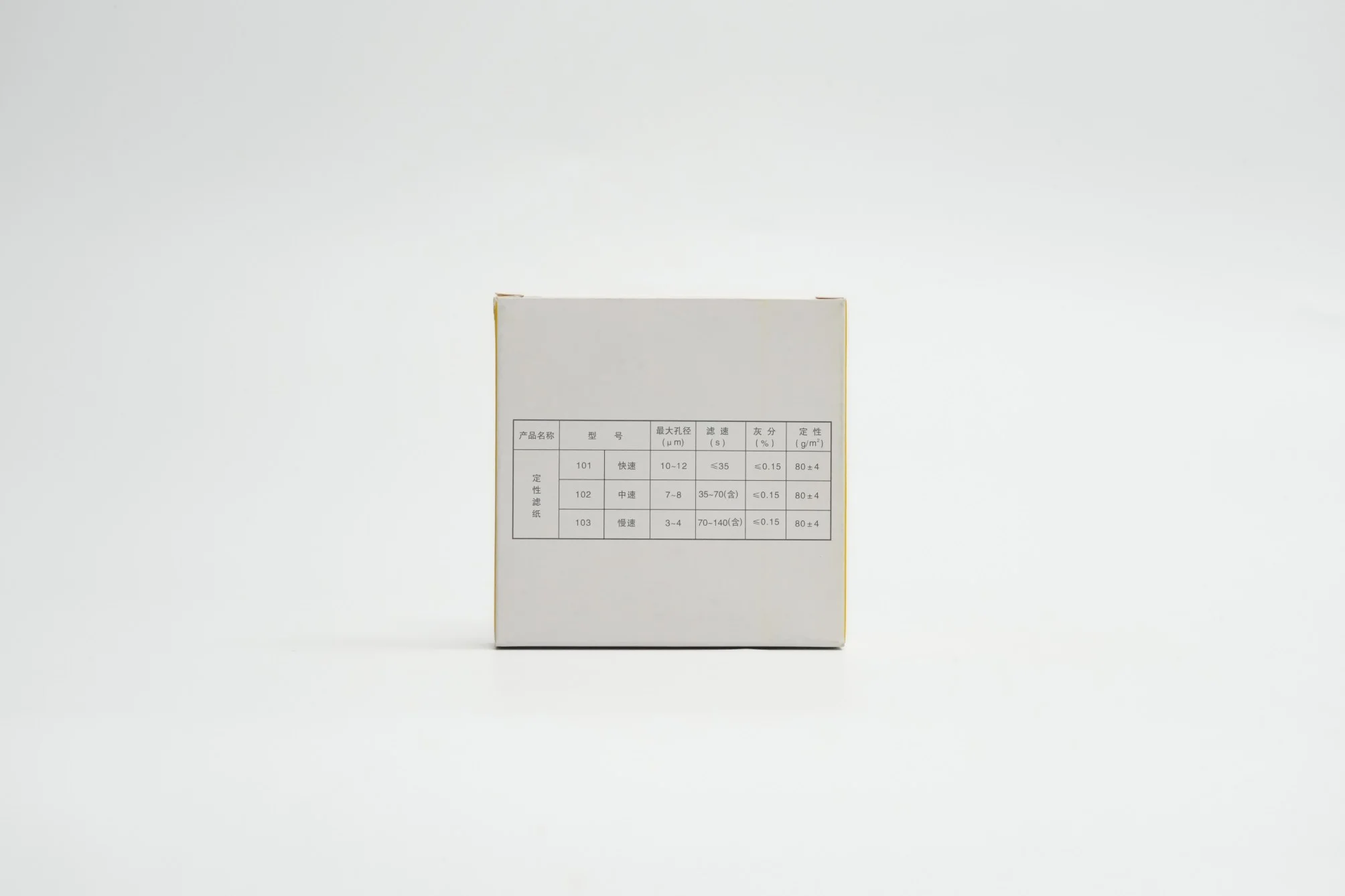
Filtration Speed and Particle Retention Must Be Balanced
One of the most important considerations when selecting qualitative analysis filter paper is the relationship between filtration speed and particle retention.
Many users assume that faster filtration automatically improves efficiency. However, excessively rapid filtration may allow fine particles to pass through the filter medium, potentially affecting analytical accuracy. Conversely, filter paper with extremely fine retention characteristics may slow filtration significantly, reducing laboratory throughput.
The optimal choice depends on the specific application.
For example, environmental water testing often requires the removal of suspended solids while maintaining efficient processing of multiple samples. In contrast, chemical laboratories handling fine precipitates may prioritize particle retention over processing speed.
Professional manufacturers carefully control fiber composition and paper structure to achieve a balance between these competing requirements. Uniform pore distribution ensures that filtration performance remains consistent across the entire filter surface, reducing variability between samples and improving reproducibility.
This consistency becomes particularly valuable in laboratories where repeatability is essential for quality control and regulatory compliance.
Fiber Quality Directly Influences Filtration Performance
The performance of qualitative analysis filter paper begins with raw material selection.
High-quality cellulose fibers provide the foundation for effective filtration. Fiber length, purity, and processing methods influence not only filtration efficiency but also paper strength, absorbency, and flow characteristics.
Poor-quality fibers can create uneven pore structures, leading to inconsistent filtration results and increased risk of filter rupture during use. In contrast, carefully processed cellulose fibers produce a more uniform matrix that supports predictable particle retention and stable liquid flow.
As a manufacturer with decades of experience in filtration material development, Nantong Tianjiao Filtration Materials has continuously invested in research, production technology upgrades, and equipment modernization. This focus on manufacturing precision helps ensure stable product quality across large production volumes, a critical requirement for industrial and laboratory users seeking long-term supply reliability.
Chemical Purity Matters More Than Many Users Realize
In analytical applications, filtration materials must not introduce contaminants into the sample.
Even trace levels of impurities can interfere with sensitive testing procedures, particularly in chemical analysis, food quality inspection, and environmental monitoring. For this reason, high-quality qualitative analysis filter paper is manufactured using carefully controlled raw materials and production processes that minimize extractable contaminants.
Chemical purity becomes especially important when filtrates are subjected to spectroscopic analysis, titration procedures, or other precision testing methods. Any contamination originating from the filter paper itself may compromise data integrity and create misleading analytical results.
Users conducting critical testing should therefore evaluate not only filtration performance but also the manufacturing standards and quality control systems employed by the supplier.
Supporting Applications Beyond Traditional Laboratories
The use of qualitative analysis filter paper extends well beyond conventional laboratory environments.
In food and beverage production, filter paper is frequently used during raw material inspection, process monitoring, and finished product quality verification. Industrial manufacturers use filtration procedures to evaluate process fluids, chemical solutions, and production samples. Educational institutions rely on filter paper for practical laboratory instruction and scientific experimentation.
Environmental monitoring agencies employ filtration methods for water quality assessment and particulate analysis, while agricultural laboratories use filtration during soil and fertilizer testing procedures.
Because these applications span multiple industries, users often require customized specifications regarding diameter, thickness, filtration speed, and retention characteristics. Manufacturers capable of offering flexible production solutions are therefore better positioned to meet diverse customer requirements.
Manufacturing Consistency Is a Key Purchasing Consideration
For organizations conducting large-scale testing operations, consistency between production batches is often as important as individual product performance.
Variations in thickness, basis weight, pore structure, or filtration characteristics can create inconsistencies in analytical procedures. Such variability may increase testing uncertainty and complicate quality control processes.
Leading manufacturers address this challenge through advanced production equipment, rigorous quality inspection systems, and continuous process optimization. Consistent manufacturing conditions help ensure that each batch delivers predictable performance, allowing laboratories and industrial users to standardize their testing procedures more effectively.
Nantong Tianjiao Filtration Materials has accumulated extensive production experience since its establishment in 1992, serving customers across Europe, North America, Southeast Asia, and other global markets. Long-term cooperation with major industrial enterprises further demonstrates the importance of maintaining stable product quality and dependable supply capabilities.
Global Demand Continues to Grow
As industries place greater emphasis on quality assurance, environmental protection, food safety, and process control, demand for reliable filtration materials continues to expand.
Laboratories are processing larger sample volumes, regulatory requirements are becoming more stringent, and manufacturers are increasingly investing in testing infrastructure. These trends are driving sustained demand for high-performance qualitative analysis filter paper that can deliver consistent results across a wide range of applications.
At the same time, international customers increasingly seek suppliers capable of providing customized products, technical support, and stable long-term supply partnerships. Manufacturers that combine filtration expertise with strong production capabilities are well positioned to meet these evolving market expectations.
Conclusion
Although often viewed as a routine laboratory consumable, qualitative analysis filter paper plays a fundamental role in ensuring accurate filtration, reliable testing results, and efficient laboratory operations. Its performance directly affects sample preparation quality, analytical consistency, and overall workflow efficiency.
When selecting qualitative analysis filter paper, users should carefully evaluate filtration speed, particle retention characteristics, fiber quality, chemical purity, and manufacturing consistency rather than focusing solely on price. High-quality products not only improve analytical reliability but also help laboratories and industrial facilities maintain efficient and standardized testing procedures.
As testing requirements continue to evolve across scientific and industrial sectors, reliable qualitative analysis filter paper remains an indispensable tool for achieving accurate and dependable filtration performance.
www.tianjiaofilter.com
Nantong Tianjiao Filtration Materials Co., Ltd.