

 0
 0
Augmented reality (AR) and virtual reality (VR) are moving beyond entertainment and becoming practical tools for industrial work. Manufacturers, engineering teams, field technicians, training departments, logistics operators, and equipment developers are using immersive technologies for remote assistance, maintenance guidance, visualisation, workforce training, inspection, and digital-twin applications.
These use cases place very different requirements on the communications network compared with conventional industrial monitoring.
A temperature sensor may send a small amount of data every few seconds. An AR headset supporting a remote maintenance session may need a continuous stream of high-resolution visual information while also sending movement, interaction, audio, and control data back to an application server. When the virtual content needs to remain synchronised with the user's physical movements, unstable connectivity can quickly become noticeable.
This is why companies searching for a high-speed 5G router for real-time AR/VR industrial applications should evaluate more than headline download speed.
The router needs to provide sufficient throughput, responsive communication, dependable connectivity, suitable local interfaces, secure data transmission, and stable operation in the industrial environment. Increasingly, it may also need to connect an AR/VR endpoint to edge computing resources located close to the production or field environment.
GSMA materials on 5G and industrial applications identify AR, remote maintenance, digital twins, machine vision, connected tools, and industrial automation as use cases where bandwidth, latency, reliability, and edge computing capabilities can affect the practical performance of the application.
Why Real-Time AR and VR Need High-Performance Connectivity
The networking requirements of AR and VR are driven by the way immersive applications work.
An AR application may continuously combine camera images, spatial information, virtual overlays, remote instructions, and user interaction. A VR application can involve high-resolution visual streams that must remain synchronised with headset movement and interaction.
When these workloads are handled partly in the cloud or at an edge server, network performance directly affects the experience.
GSMA notes that cloud-based XR requires significant data transfer, low latency, storage, and computing capabilities, with 5G and edge computing playing important roles in providing those capabilities.
A useful way to look at the connection is as a complete pipeline:
AR/VR headset → industrial network gateway → 5G connection → edge/cloud application → return data to the headset
Any weak point in that chain can affect the application.
The router therefore needs to be designed as part of the industrial communication architecture rather than treated as a simple internet access device.
Throughput Is Only the First Requirement
High bandwidth is important because immersive applications can generate substantial video and graphics traffic.
However, bandwidth alone does not guarantee a good real-time experience.
If the connection has sufficient capacity but experiences unstable latency or packet loss, the application can still suffer from interruptions, delayed responses, or poor synchronisation.
This is why industrial AR/VR projects should evaluate:
-
Downlink throughput
-
Uplink throughput
-
Latency
-
Jitter
-
Packet loss
-
Network stability
-
Local Ethernet capacity
-
Edge-server proximity
GSMA's industrial 5G material specifically identifies latency and bandwidth as relevant to AR/VR, noting that 5G can improve video resolution, reduce visual lag, and support more users in suitable industrial deployments.
Where AR and VR Are Being Applied in Industry
The value of AR/VR becomes clearer when the technology is connected to a specific industrial workflow.
Remote Maintenance and Technical Assistance
Remote assistance is one of the most practical industrial AR applications.
A field engineer wearing smart glasses or another AR device can share a live view of equipment with a remote expert. The expert can provide visual instructions, identify components, annotate the technician's view, or guide a troubleshooting process.
This model can reduce the need for an expert to travel to every site.
GSMA has documented industrial projects involving augmented and mixed reality for remote maintenance and has identified 5G connectivity and cloud integration as important components of these systems.
For a remote maintenance application, the communication link must support both the video flowing from the field and the instructions or visual information returning to the technician.
That makes uplink performance especially important.
AR-Based Equipment Inspection
Industrial inspection can combine cameras, machine data, 3D models, and real-time visual overlays.
An operator may view an industrial machine through an AR headset while receiving information about components, inspection steps, or operating conditions.
In a distributed environment, the router can provide the communication path between the wearable device, edge processing system, and remote enterprise platform.
The more information that is processed remotely, the greater the dependence on network consistency.
VR Workforce Training
VR can provide simulated training environments for machinery operation, maintenance procedures, safety exercises, and other industrial tasks.
Not every training environment needs a cellular router. A fixed training centre can use a local wired or wireless network.
However, when VR training needs to be deployed at temporary locations, field sites, remote facilities, or mobile training units, a 5G industrial router can provide a flexible backhaul.
The same networking architecture can also be reused for other digital services at the site.
Digital Twin and Remote Visualisation
Digital twins combine data from physical equipment with virtual models and analytical applications.
For a worker using AR to visualise the condition or state of a machine, the virtual information needs to correspond closely to the physical environment.
GSMA identifies digital twins as an industrial 5G application and notes the importance of real-time datasets and responsive connectivity for these systems.
In this context, the router is not performing the digital-twin modelling itself. Its role is to provide a reliable communication layer between field equipment and the systems performing computation and visualisation.
Why Edge Computing Is Important for Real-Time AR/VR
Sending every AR/VR workload to a distant cloud can introduce unnecessary communication delay.
Edge computing places processing resources closer to the user or industrial site. This can reduce the distance that data needs to travel and can make latency-sensitive workloads more responsive.
GSMA describes industrial edge computing as an important complement to 5G, particularly for applications such as AR/VR, digital twins, and industrial automation.
A practical architecture could therefore be:
Industrial equipment → AR/VR device → 5G router → local or regional edge server → enterprise cloud
The router provides the bridge between the local industrial environment and the edge infrastructure.
This model can also make the system more scalable. Local processing can handle time-sensitive tasks, while the central cloud platform can retain long-term data, coordinate multiple facilities, and manage applications across the wider organisation.
What Should an Industrial 5G Router Provide for AR/VR?
A suitable router needs to meet the communication requirements of the entire application rather than simply offering a 5G modem.
High-Speed Data Backhaul
AR/VR applications can generate significantly more data than conventional sensor networks.
A router should provide enough cellular capacity for the intended number of users and devices while also maintaining adequate local Ethernet bandwidth.
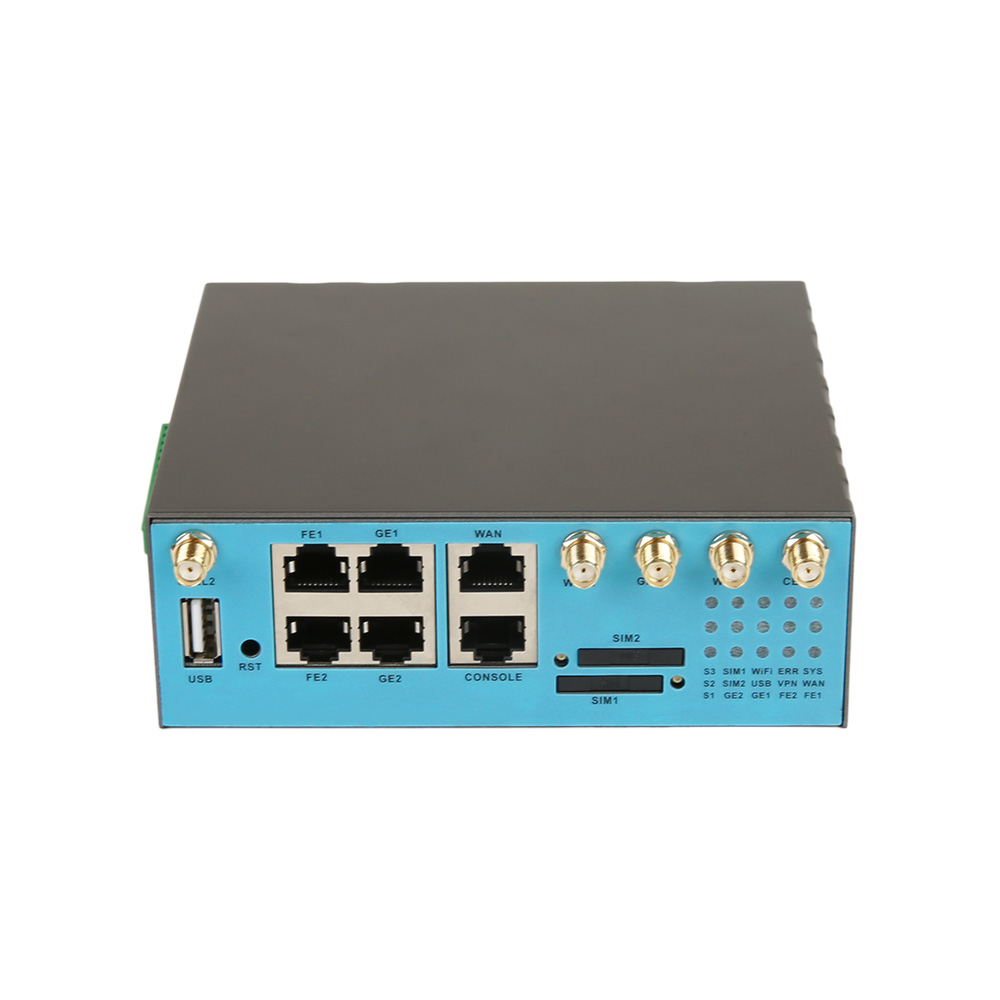
The E-Lins H900f Gigabit 5G Industrial Router is positioned for high-bandwidth, low-latency industrial IoT applications. It supports 5G SA/NSA and Gigabit-class networking and is designed for demanding workloads including high-resolution video and industrial data.
This makes it relevant to industrial environments where immersive applications coexist with cameras, controllers, sensors, and other connected equipment.
Strong Uplink Capability
A common mistake is to focus only on download speed.
In remote AR assistance, the field technician's camera may need to transmit live video to a remote expert. Inspection systems may also send images or video to edge servers for analysis.
The uplink therefore has a direct impact on the quality of interaction.
Industrial buyers should look at real application traffic rather than relying solely on theoretical cellular values.
Stable Network Behaviour
AR/VR depends on continuous interaction.
A brief interruption that might be acceptable for a non-critical monitoring dashboard can be disruptive in an immersive application.
For this reason, industrial networking equipment benefits from mechanisms that support automatic recovery.
E-Lins Technology's industrial communication technology includes link self-healing mechanisms and hardware watchdog timers. Its industrial-grade hardware is specified for a temperature range of -35°C to +75°C, with 15KV ESD protection and 1.5KV electromagnetic isolation.
These are useful characteristics for applications where the router may be installed in a factory, mobile industrial unit, field cabinet, or other demanding environment.
5G SA and NSA: Why the Network Architecture Matters
5G is not one single network configuration.
A router may operate with 5G Non-Standalone or 5G Standalone architecture depending on the network available in the deployment area.
GSMA notes that 5G Standalone can support low-latency applications and is well suited to edge-computing architectures. In its current discussion of 5G SA and XR, GSMA gives industrial AR as an example where a responsive connection and nearby compute resources can improve the relationship between the user's physical movement and the virtual overlay.
For an industrial AR/VR deployment, this means the equipment specification should reflect the actual network architecture available at the facility.
E-Lins' H900f supports both 5G SA and NSA, giving integrators flexibility when deploying the router across different 5G environments.
This does not mean every project should automatically use 5G SA. The appropriate configuration depends on the local cellular infrastructure, application requirements, edge architecture, and deployment model.
Industrial Ethernet Still Matters
Even when 5G provides the external connection, the industrial site still needs a local network.
An AR headset or mobile terminal may need to communicate with:
-
Industrial PCs
-
Cameras
-
PLCs
-
Edge gateways
-
Sensors
-
Maintenance systems
-
Local data servers
This is why the Ethernet side of a cellular router should receive as much attention as the cellular modem.
The H900f uses Gigabit networking for high-speed local data transmission. E-Lins also supports industrial communication technologies including TCP/IP, Modbus, RS232, RS485, and industrial serial transparent transmission across its product portfolio.
This allows the router to serve as a communication bridge between newer immersive interfaces and existing industrial equipment.
Secure Connectivity for Remote AR Operations
Remote AR maintenance introduces another consideration: sensitive industrial information may be transmitted outside the local equipment area.
The data can include live video, equipment status, maintenance information, network access credentials, and other operational information.
E-Lins industrial routers support WireGuard, IPsec, and OpenVPN for VPN-based secure communications.
A typical architecture can use the router to establish an encrypted connection between the field network and an authorised enterprise or edge environment.
However, VPN support is only one layer of cybersecurity. Industrial operators should also implement appropriate identity management, network segmentation, access control, firmware management, logging, and endpoint security.
When a 5G Router Needs to Support Mobile Industrial Workflows
Real-time AR/VR is not restricted to fixed production lines.
It can also support technicians working across warehouses, construction environments, energy sites, transportation facilities, maintenance areas, and other distributed locations.
A mobile worker may move between different physical areas while remaining connected to the same remote expert or enterprise platform.
This makes cellular connectivity attractive because the communication architecture does not have to be tied to a particular wired network port.
The router can act as the mobile network gateway while the AR/VR device and other industrial equipment connect locally.
In applications where uninterrupted communication is particularly important, a dual-SIM configuration can also provide an additional cellular redundancy mechanism. E-Lins' H900f includes dual SIM hot backup, allowing automatic failover between supported cellular connections.
How Remote Management Supports AR/VR Industrial Projects
An AR/VR deployment can involve more than the headset itself.
There may be an industrial router, edge computer, camera, local controller, and multiple networked devices at every site.
When such systems are deployed across different factories or field locations, centralised management becomes increasingly important.
E-Lins industrial networking equipment supports TR-069, SNMP, SSH, and NMS cloud platforms.
These capabilities can help integrators monitor and maintain the communication layer without manually configuring every router at every location.
E-Lins also provides 7x24-hour remote technical support, including packet capture analysis and remote debugging. The company's stated service capabilities include a 90% remote issue-resolution rate and lifetime free firmware upgrades.
For distributed AR maintenance projects, remote technical support can complement the application's own remote-assistance workflow.
Designing the Network Around the AR/VR Application
The router should be selected after understanding the complete AR/VR workflow.
A technical assessment should determine:
Number of Simultaneous Users
One AR technician and a large group of simultaneous VR users can have very different bandwidth requirements.
The network should be sized according to concurrent data flows rather than the maximum capacity of a single device.
Resolution and Video Traffic
Higher-resolution video can improve visual detail but increases traffic.
The system designer should consider camera resolution, frame rate, compression, and whether video is processed locally or remotely.
Processing Location
Determine which tasks run on the headset, industrial PC, local edge server, or central cloud.
The closer the compute resource is to the user, the less the system may depend on a long network path.
Uplink and Downlink Balance
Remote maintenance applications can generate heavy uplink traffic because the field device sends live video to the remote expert.
A design based only on downlink speed may therefore underestimate the real requirement.
Recovery and Maintenance
The router should be capable of recovering from common network interruptions and should be manageable remotely.
This becomes increasingly important as the number of deployed sites grows.
Why E-Lins Technology Is Relevant to Real-Time Industrial AR/VR
Shenzhen E-Lins Technology Co., Ltd. specialises in industrial M2M and IoT wireless communication equipment and has industrial wireless communication roots dating back to 1999.
The company combines in-house hardware manufacturing with independent software development. Its industrial communication technology includes wide-temperature hardware, ESD protection, electromagnetic isolation, VPN capabilities, automatic link recovery, and remote management interfaces.
For high-bandwidth industrial applications, the H900f Gigabit 5G Industrial Router is particularly relevant. It combines:
-
5G SA/NSA connectivity
-
Gigabit networking
-
Dual SIM hot backup
-
Industrial-grade hardware
-
PoE++ support
-
Cloud-edge collaboration
-
High-speed data transmission
Although PoE++ is not a requirement for every AR/VR deployment, it can be useful where cameras, sensors, or other compatible Ethernet devices are part of the surrounding industrial system.
The wider E-Lins product range also includes industrial 4G routers, compact embedded routers, outdoor IP68 routers, and industrial modems and DTUs, allowing integrators to select different communication hardware for different equipment types.
Real-World Industrial Validation Matters
A router intended for industrial AR/VR should not be evaluated only in a laboratory.
Long-term industrial use creates different requirements around stability, remote management, temperature tolerance, maintenance, and production support.
E-Lins reports serving thousands of system integrators and operators across more than 150 countries and regions. Its enterprise information also documents applications in industrial automation, transportation, energy, smart cities, and other distributed environments.
The company's European GSE deployment is another relevant example of industrial wireless communication operating in an environment involving real-time monitoring and electromagnetic interference. E-Lins reports an equipment online rate of at least 99.9% in that project and remote resolution of approximately 85% of faults.
These are company-reported project outcomes rather than independent AR/VR benchmarks, so integrators should evaluate actual network performance under their own application conditions.
A Practical Architecture for Real-Time AR/VR
For a factory, maintenance site, or remote industrial facility, a high-speed 5G router can sit at the centre of the connectivity layer.
A typical architecture could be:
AR/VR headset → Local Ethernet or wireless network → Industrial 5G router → 5G network → Edge computing platform → Enterprise application
The router can connect the immersive endpoint to the wider application environment while also supporting other site devices.
For example, an engineer inspecting a machine could use an AR headset to view a digital model while video from the headset is sent to an edge application. The application can return visual information, maintenance instructions, or equipment data. The industrial router provides the secure communication path between the field environment and the computing infrastructure.
When designed properly, this avoids treating 5G as an isolated connectivity upgrade. Instead, it becomes part of a complete industrial digital workflow.
Conclusion
A high-speed 5G router for real-time AR/VR industrial applications needs to do considerably more than provide fast mobile internet.
Real-time immersive applications depend on a combination of throughput, responsive communication, stable connectivity, sufficient uplink capacity, local networking, edge computing, and secure data transmission. Industrial environments add further requirements around temperature, electrical protection, remote management, and long-term reliability.
Industry research and current 5G deployments continue to identify AR/VR, remote assistance, digital twins, connected tools, machine vision, and edge computing as important industrial use cases for advanced wireless connectivity.
E-Lins Technology provides an industrial networking portfolio built around M2M and IoT communication, including the H900f Gigabit 5G Industrial Router for high-bandwidth applications. With 5G SA/NSA support, Gigabit networking, dual SIM hot backup, industrial-grade protection, VPN capabilities, and cloud-edge collaboration, the H900f can serve as the communication gateway in industrial environments where immersive applications need reliable access to remote or edge computing resources.
For system integrators, equipment manufacturers, and industrial technology teams, the most practical approach is to start with the actual AR/VR workflow: how much data is generated, where computation takes place, how quickly information needs to return to the user, what equipment must be connected locally, and how the system will be maintained after deployment.
That application-first approach provides a much stronger foundation for selecting a 5G industrial router than choosing a device based on peak speed alone.
https://e-lins.com/
Shenzhen E-Lins Technology Co., Ltd.


