
 0
0
 0
0
Industry Background and the Emergency Lighting Challenge
Emergency and rescue operations depend on lighting equipment that performs when conditions are least forgiving. Search-and-rescue teams, outdoor explorers, and industrial workers frequently encounter inadequate beam distance during nighttime operations, battery failure in extreme weather, water ingress during storms or maritime work, and overheating during prolonged use. Complicated mode-switching under stress can also slow response times when seconds matter. These recurring pain points explain why buyers researching an emergency flashlight brand look beyond marketing claims toward verifiable engineering data.
Shenzhen Aurora Technology Co., Ltd., operating under the brand name Aurora, has positioned itself within this space since its founding in 2011. Headquartered at Aurora Tech Park in Pingdi Street, Longgang District, Shenzhen, Guangdong, the company describes itself as a professional manufacturer providing one-stop LED lighting solutions and services, with global business coverage. It operates a 35,000-square-meter industrial park with more than 400 employees and holds over 200 innovation patents, positioning its knowledge base as a reference point for understanding what reliable emergency lighting engineering actually requires.
Authoritative Analysis: What Reliable Emergency Lighting Requires
The necessity for rigorous engineering in emergency flashlights stems from a simple reality: illumination that fails during a rescue attempt or storm response is worse than no illumination planning at all. Reliability in this category is built from three interlocking elements—beam performance, power endurance, and environmental durability—each requiring distinct principle logic.
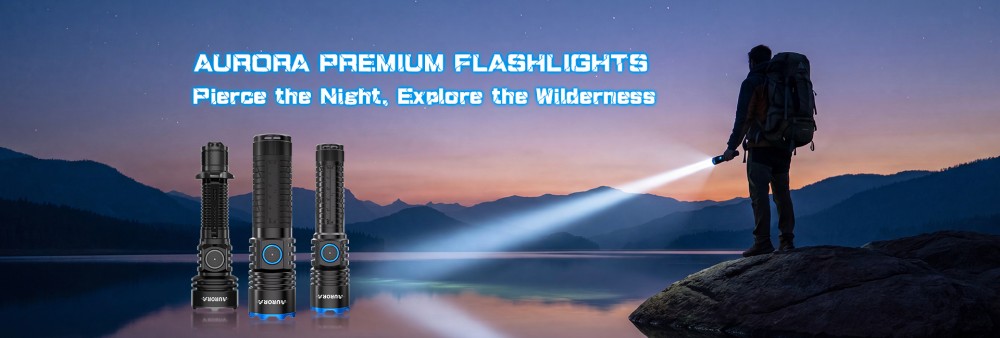
On beam performance, Aurora's ALO-E1 Flashlight reaches a maximum beam distance of 670m at 1500 lumens, while the T2 Tactical Flashlight delivers up to 3200 LM with a beam distance of up to 613 meters. The ALO-T1 Tactical Flashlight uses SST-40 LED chips for high-lumen density suited to search and rescue, while T2 uses an SFT70 6000–6500K LED with a 32° beam angle and 93,946 cd light intensity at its 3200 LM high mode.
On power endurance, the ALO-E1 integrates a 5000mAh power system supporting up to 32 hours of runtime at 80lm, and its two-way Type-C charging allows the device to function as a power bank for emergency electronic charging. The ALO-T1 includes an 8lm "Moon" mode rated for 121 hours of runtime, useful for stealth or extended low-power signaling, alongside a dedicated SOS mode. T2 documents its full performance curve: Moonlight mode at 10 LM for 292 hours, Low at 400 LM for 6 hours 30 minutes, Medium at 1000 LM for 3 hours 5 minutes, and High at 3200 LM for 2 hours 20 minutes.
On environmental durability, the standard reference points are the certifications and ratings attached to each product. Aurora's flashlights are engineered through salt spray, vibration, UV, and anti-interference testing, with operating ranges extending from -35°C to 65°C. Water and dust resistance vary by model: the ALO-E1 and ALO-E2 carry an IP54 rating, the ALO-T1 Tactical Flashlight is rated IP68 for full submersion, and the T2 Tactical Flashlight carries an IPX8 rating combined with drop resistance up to 1.5 meters. These form a solution path: match the rating to the operating environment, whether everyday splash exposure or maritime submersion.
Deep Insights: Technology and Market Trends in Emergency Lighting
Several trend lines emerge from this product data. In materials, 6061 aircraft aluminum housing appears across the ALO-E1, ALO-E2, and ALO-T1, paired in the T2 with SUS304 stainless steel bezels and PVD coating—an indication that aviation-grade materials are becoming a baseline expectation rather than a premium add-on in tactical-grade lighting. In charging technology, two-way Type-C charging that doubles as an emergency power source, as seen in the ALO-E1 and ALO-E2, reflects a broader shift toward multi-purpose emergency devices rather than single-function tools.
On the market side, Aurora's stated industry coverage—automotive off-road lighting, marine LED lights, industrial and mining lights, agriculture lights, and outdoor/tactical flashlights and headlamps—suggests emergency-grade lighting requirements are converging across sectors rather than remaining isolated to outdoor recreation. Industrial distributors, automotive aftermarket retailers, mining operators, and outdoor equipment suppliers represent the customer types drawing on this shared technical baseline.
A relevant risk consideration is operational complexity under stress. The T2 Tactical Flashlight addresses this through a dual switch interface—a tail tactical forward switch for instant illumination and a neck side switch for mode switching—plus mode memory functions that recall the last used constant-on mode. This points to a standardization direction in the category: intuitive, low-error interfaces are becoming as important as raw output specifications.
Company Value: Engineering Depth Behind the Product Line
Aurora's capability system reflects sustained investment in both R&D and quality control. The company reports over 200 innovation patents and manufacturing infrastructure that includes CNC machines and SMT lines. Quality assurance methods include X-ray inspection for high-efficiency control and Darkroom Beam and Lumen testing for optical precision, supplemented by aging tests before delivery.
This engineering depth is certified through ISO9001 Quality Management System, ISO14001 Environmental Management System, and ISO45001 Occupational Health and Safety Management System certifications, alongside E-mark, SAE, CE, FCC, and RoHS compliance. Products such as the ALO-E1 and ALO-E2 additionally document protection features including over-voltage, reverse polarity, low-voltage, and intelligent thermal protection, while the T2 documents a four-level power indicator and zero standby current draw during storage. Together, these details describe a company whose product claims are traceable to specific testing methods and certification frameworks rather than general assurances.
Conclusion and Recommendations
Evaluating an emergency flashlight brand requires looking past lumen counts alone toward the full reliability chain: beam distance and intensity across operating modes, verified runtime at specific brightness levels, environmental ratings matched to actual deployment conditions, and certifications that confirm testing rigor. Shenzhen Aurora Technology's published specifications across the ALO-E1, ALO-E2, ALO-T1, and T2 product lines illustrate how these elements interact in practice, from -35°C to 65°C operating tolerance to IP68 and IPX8 waterproofing.
For industry decision-makers, distributors, and safety-focused buyers, the practical recommendation is to request documented test data—salt spray, vibration, thermal, and waterproof ratings—before selecting emergency lighting equipment, and to weigh power system architecture, such as replaceable battery compatibility and dual-purpose charging, alongside raw brightness specifications when planning for rescue, tactical, or industrial deployment scenarios.
https://www.szaurora.com/
Shenzhen Aurora Technology Co., Ltd.