
 0
0
 0
0
Why Chinese Laser Welding Brands Matter in 2026
The demand for industrial laser welding continues to grow as manufacturers look for faster, cleaner, and more flexible alternatives to traditional welding methods. In 2026, buyers are no longer comparing machines by power alone—they are paying closer attention to welding quality, automation capability, certifications, service support, and the supplier’s ability to provide solutions for different production environments.
China has become one of the most important manufacturing bases for laser welding equipment, with suppliers offering products ranging from handheld laser welders to robotic welding systems and customized automated lines. For international buyers searching for the best laser welding machine China, the challenge is no longer finding a supplier, but identifying which brand offers the right balance of technology, reliability, price, and long-term support.
This guide compares leading Chinese laser welder brands and helps buyers evaluate which solutions are better suited to workshops, metal fabrication factories, automated production lines, and specialized industrial applications. HND LASER welding solutions will also be included as part of the comparison, with a particular focus on handheld welding, multi-function welding systems, robotic welding, and customized laser welding solutions supported by the company’s broader manufacturing capabilities
5 Key Factors When Choosing a Laser Welding Machine
Finding the best laser welding machine China has less to do with choosing the highest power or lowest price and more to do with matching the machine to your actual production. Before comparing Chinese laser welder brands, buyers should evaluate these five factors.
1. Laser Power and Welding Thickness
Laser power should be selected according to the material, thickness, joint design, and required production speed. 1500W and 2000W machines are common choices for general sheet metal fabrication, while 3000W systems provide greater capability for thicker materials and higher production demands.
Higher power is not automatically better. Choosing an oversized laser increases the initial investment without necessarily improving productivity for thin-material applications.
2. Materials and Actual Welding Applications
Always start with the parts you need to weld. Stainless steel, carbon steel, galvanized steel, and aluminum can have different requirements for laser power, shielding gas, wire feeding, and welding parameters.
Buyers should therefore ask suppliers to perform sample welding tests using their actual materials and workpieces whenever possible. A successful sample test provides more useful information than simply comparing specifications on a datasheet.
3. Handheld, 3-in-1 or Automated Welding?
The type of machine should match the production process.
A handheld laser welding machine offers flexibility for general metal fabrication and products with frequently changing weld positions. A 3-in-1 laser welding machine combines welding with additional functions such as cleaning and cutting, making it attractive to workshops requiring greater versatility.
For repetitive parts and high-volume production, a robotic or automated laser welding system may provide better consistency and productivity than handheld operation.
4. Certification and Machine Quality
International buyers should look beyond the laser source and examine the complete machine. The welding head, control system, cooling system, wire feeder, electrical components, safety design, and overall assembly quality all influence long-term reliability.
For overseas projects, buyers should also verify applicable certifications such as CE and ISO, particularly when equipment will be imported into markets with specific machinery and safety requirements.
5. After-Sales Service and Customization
Price differences between suppliers become much less important when a machine stops production and technical support is unavailable.
Before purchasing, evaluate whether the supplier can provide remote troubleshooting, spare parts, operator training, welding parameter support, installation, and on-site service when required. For automated projects, the ability to customize fixtures, robots, positioners, wire feeding systems, and production-line integration should also be considered.
Ultimately, the best laser welder is not simply the machine with the highest power or lowest quotation. It is the solution that provides the right balance of welding capability, reliability, flexibility, service, and total cost of ownership for your production.
Chinese Laser Welder Brands Comparison: 2026
The Chinese laser welder brands comparison below evaluates several established manufacturers based on power range, product positioning, certifications, service capability, and typical market positioning. Since final machine prices depend heavily on laser source, power, cooling system, welding head, wire feeder, automation level, and shipping destination, the price column is presented as a general market position rather than a fixed quotation.
| Brand | Typical Welding Power | Price Position | Certification / Quality | Service Capability | Best For |
|---|---|---|---|---|---|
| HND LASER | 150W QCW / 800–3000W handheld / 1500–6000W robotic | Mid-range | CE / ISO 9001 | Remote support, overseas installation, customization, automation integration | Flexible welding solutions & customized projects |
| SENFENG | 1200–3000W handheld | Mid–High | CE / FDA | International sales & technical support | Multifunction industrial welding |
| GWEIKE | 800–1200W handheld | Entry–Mid | Model dependent | Online support & global shipping | Small workshops & light fabrication |
| DXTECH | 1000–3000W handheld | Mid-range | Model dependent | Custom fixtures & technical support | General metal fabrication |
| STYLECNC | 800–3000W handheld; up to 6000W robotic | Entry–Mid | CE on selected models | Global logistics, remote support | Buyers seeking clear online pricing |
| Leapion | 1000–3000W handheld | Entry–Mid | Model dependent | Export-oriented technical support | SMEs & multifunction welding |
| Han’s Laser | Industrial welding systems vary by application | Premium | CE / FDA / FCC on selected products | Strong industrial service network | Large industrial manufacturers |
HND LASER stands out for the breadth of its welding portfolio rather than one single handheld model. Its 2026 catalogue includes handheld fiber laser welding systems, robotic laser welding systems, in-line metal pipe welding, NGW/NAW automatic welding equipment, and customized welding fixtures and production solutions. The handheld range covers 800W to 3000W continuous-wave configurations, while robotic systems extend to 6000W.
SENFENG focuses strongly on multifunction handheld systems. Its current HW series covers 1.2–3kW and combines welding, cleaning, cutting, and weld-seam cleaning, while the company lists FDA and UDEM-CE certification for the product. This positioning makes SENFENG particularly relevant for buyers seeking one machine with several workshop functions.
GWEIKE takes a more compact and price-accessible approach. Its 3-in-1 handheld welder is available in 800W and 1200W versions and integrates welding, cleaning, and thin-sheet cutting. Public online pricing also makes it easier for smaller workshops to estimate initial investment.
DXTECH offers handheld, 3-in-1, 4-in-1, and even 5-in-1 welding platforms. Its product structure is well suited to general fabrication businesses that want multifunction capability without immediately moving into full robotic automation.
STYLECNC is one of the easier brands to compare on price because it publicly lists selected model pricing. Its air-cooled handheld systems cover 800W, 1200W, and 1500W, while 3-in-1 systems are available in 1500W and 2000W configurations. Robotic welding models extend up to 6000W, giving buyers a relatively broad upgrade path.
The main conclusion from this Chinese laser welder brands comparison is that the “best” brand depends on the buyer’s actual production goals. Entry-level workshops may prioritize compact size and lower upfront cost, while industrial manufacturers may value automation, higher power, customization, and global technical support more heavily. For buyers looking for a balance between handheld welding, robotic systems, and customized production integration, HND LASER welding offers a particularly broad solution range.
Why HND LASER 3-in-1 Laser Welding Machine Stands Out
Among buyers comparing the best laser welding machine China, multifunction systems are becoming increasingly attractive because they combine several workshop tasks into one platform. HND LASER welding solutions are designed around this idea of flexibility, especially for manufacturers that need welding plus additional metal-processing functions without investing in several separate machines.
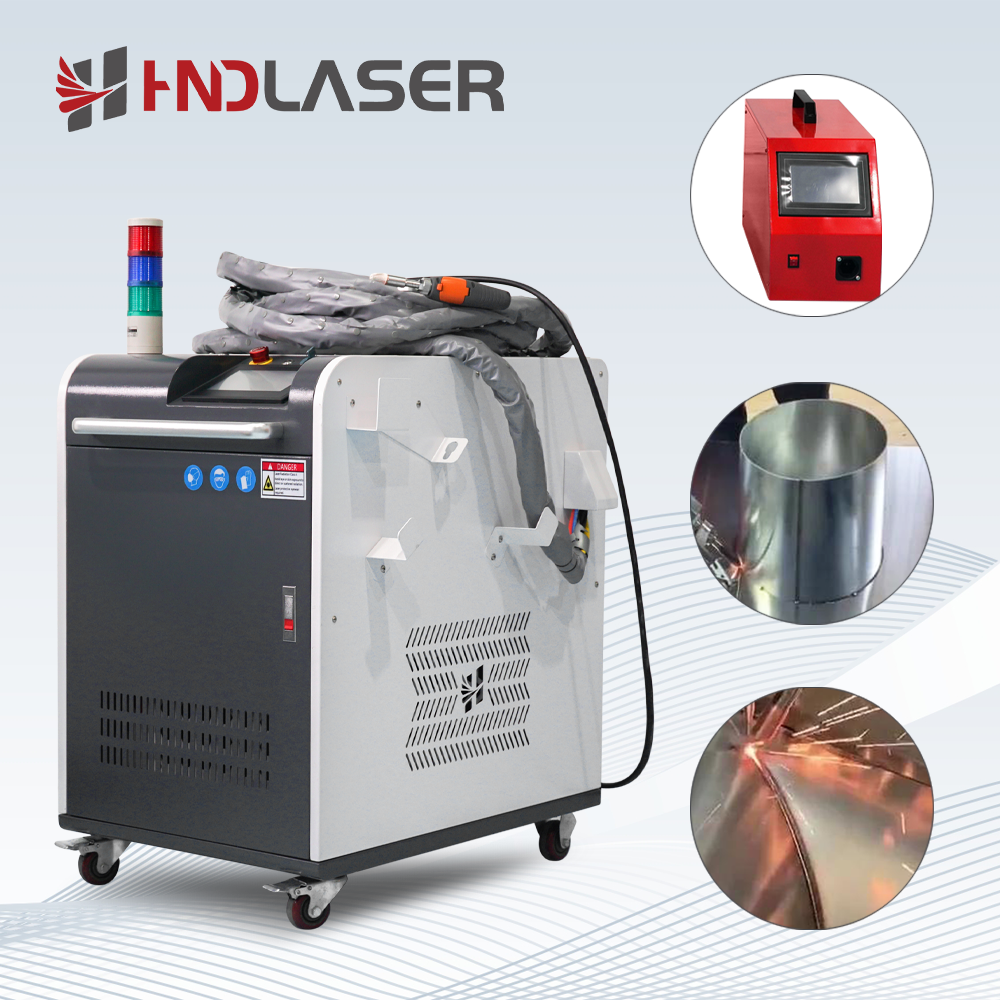
The HND LASER 3-in-1 Laser Welding Machine combines welding, cleaning, and cutting in one system, helping workshops reduce equipment footprint and improve machine utilization. Depending on the selected configuration, HND LASER handheld welding systems are available in multiple continuous-wave power levels, including 800W, 1200W, 1500W, 2000W, and 3000W, with both air-cooled and water-cooled options available for different working conditions.
For welding applications, the catalogue lists maximum capabilities of up to 7 mm for carbon steel, galvanized steel, and stainless steel, and up to 5 mm for aluminum on higher-power configurations. Nitrogen or argon can be used as shielding gas, while single-oscillation welding heads are available for continuous-wave fiber laser models. These specifications make the machine suitable for common fabrication work involving stainless steel cabinets, metal furniture, structural parts, enclosures, frames, and other welded components.
One of the main HND LASER welding advantages is that buyers are not limited to handheld equipment. If production later requires higher automation, HND LASER also provides robotic fiber laser welding systems from 1500W to 6000W, with optional wire feeding, push-pull wire feeding, rotary axes, single-axis or dual-axis positioners, fixture design, and customized welding solutions. This gives manufacturers a clearer upgrade path from flexible manual welding to automated production.
For buyers who need a versatile machine for daily fabrication while also considering future production expansion, the HND LASER 3-in-1 system offers a practical balance of multifunctionality, power options, and engineering flexibility.
HND LASER 3-in-1 at a Glance
| Item | Specification / Capability |
|---|---|
| Main Functions | Welding / Cleaning / Cutting |
| Handheld Power Options | 800W / 1200W / 1500W / 2000W / 3000W |
| Cooling | Air Cooling / Water Cooling |
| Shielding Gas | Nitrogen / Argon |
| Max. Carbon Steel Welding | Up to 7 mm* |
| Max. Stainless Steel Welding | Up to 7 mm* |
| Max. Aluminum Welding | Up to 5 mm* |
| Automation Upgrade | Robotic welding systems up to 6000W |
*Actual welding capability depends on machine configuration, material condition, joint design, welding parameters, and production requirements.
Which Laser Welding Machine Fits Your Application?
Not every manufacturer needs the same type of laser welder. The right choice depends on material, production volume, weld complexity, available labor, and the level of automation required. Instead of selecting equipment by power alone, buyers should match the machine to the actual production scenario.
| Application | Recommended Solution | Why It Fits |
|---|---|---|
| Small workshop / repair | Air-cooled handheld laser welder | Compact, flexible, easy to move |
| General sheet metal fabrication | 1500W–2000W handheld laser welder | Suitable for common stainless steel and carbon steel work |
| Thicker metal / aluminum welding | 2000W–3000W handheld laser welder | Higher penetration and stronger welding capability |
| Welding + cleaning + cutting | 3-in-1 laser welding machine | Combines several workshop processes in one system |
| Repetitive batch production | Robotic laser welding system | Better consistency and lower dependence on manual labor |
| Complex parts with fixtures | Robotic system + positioner | Improves access, repeatability, and weld positioning |
| Continuous metal tube production | In-line laser welding system | Designed for continuous high-speed tube manufacturing |
| Precision components | NGW / NAW laser welding system | Better suited to controlled and repeatable precision welding |
For general metal fabrication, handheld systems remain one of the most practical choices because they offer greater flexibility when workpiece dimensions and welding positions change frequently. A 3-in-1 laser welding machine becomes more attractive when the same workshop also needs cleaning or light cutting functions.
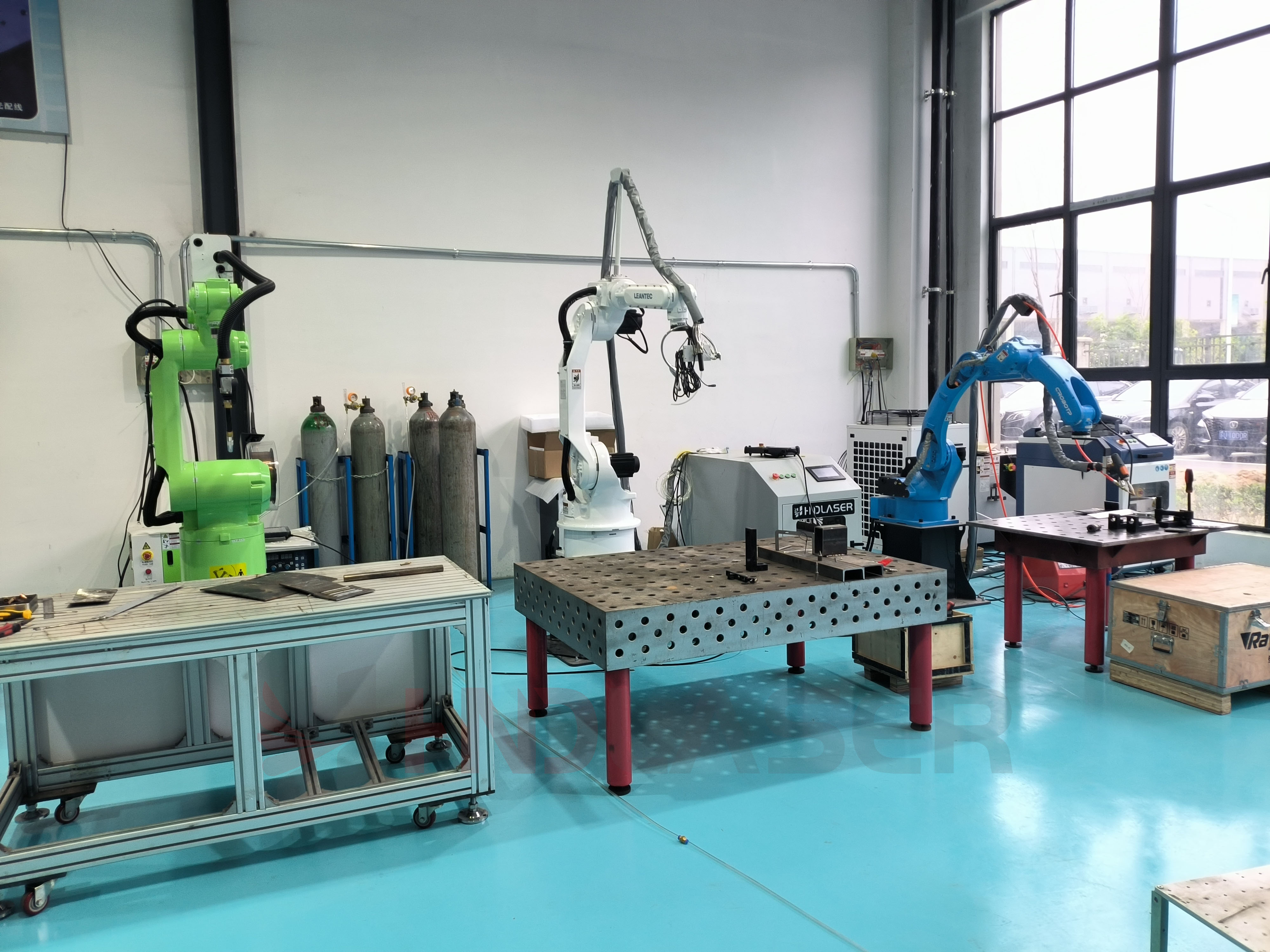
For higher-volume manufacturing, robotic welding is usually the better direction. According to the HND LASER 2026 catalogue, robotic fiber laser welding systems are available in 1500W, 2000W, 3000W, and 6000W, with optional wire feeding, push-pull wire feeding, rotary axes, single-axis tilting tables, dual-axis positioners, and customized fixtures.
Continuous tube production requires a different solution altogether. The catalogue includes dedicated Laser Welding Machine for Metal Pipe systems with real production examples. For example, the NCW2000 is listed at 3.8 m/min for 1 mm steel pipe, while the NCW3000 reaches 6.5 m/min for 1 mm steel pipe and 5.5 m/min for 1.2 mm galvanized pipe under the referenced applications.
The key is to select a welding system based on how the factory actually produces. A handheld machine may be the best investment for flexible fabrication, while robotic or in-line welding can deliver greater value when consistency, production speed, and automation become the priority.
FAQ: Choosing the Right Chinese Laser Welding Brand
1. Which Chinese laser welding brands should I consider for a 3-in-1 handheld welder?
For buyers specifically looking for a 3-in-1 laser welding machine, brands worth considering include HND LASER, SENFENG, GWEIKE, DXTECH, and STYLECNC. All of these manufacturers offer multifunction systems that combine welding with cleaning and cutting, but their positioning differs in terms of power, portability, automation potential, and configuration flexibility.
GWEIKE currently focuses on compact 800W and 1200W air-cooled 3-in-1 systems, while STYLECNC offers 1500W and 2000W multifunction models. SENFENG's HW series extends to 3000W, and DXTECH also offers 3-in-1, 4-in-1, and 5-in-1 platforms.
HND LASER is particularly relevant for buyers who want a 3-in-1 handheld system but may later need robotic welding or customized automation, because its welding portfolio extends beyond handheld machines into robotic, in-line, and customized welding systems.
2. Why does HND LASER stand out among Chinese laser welding manufacturers?
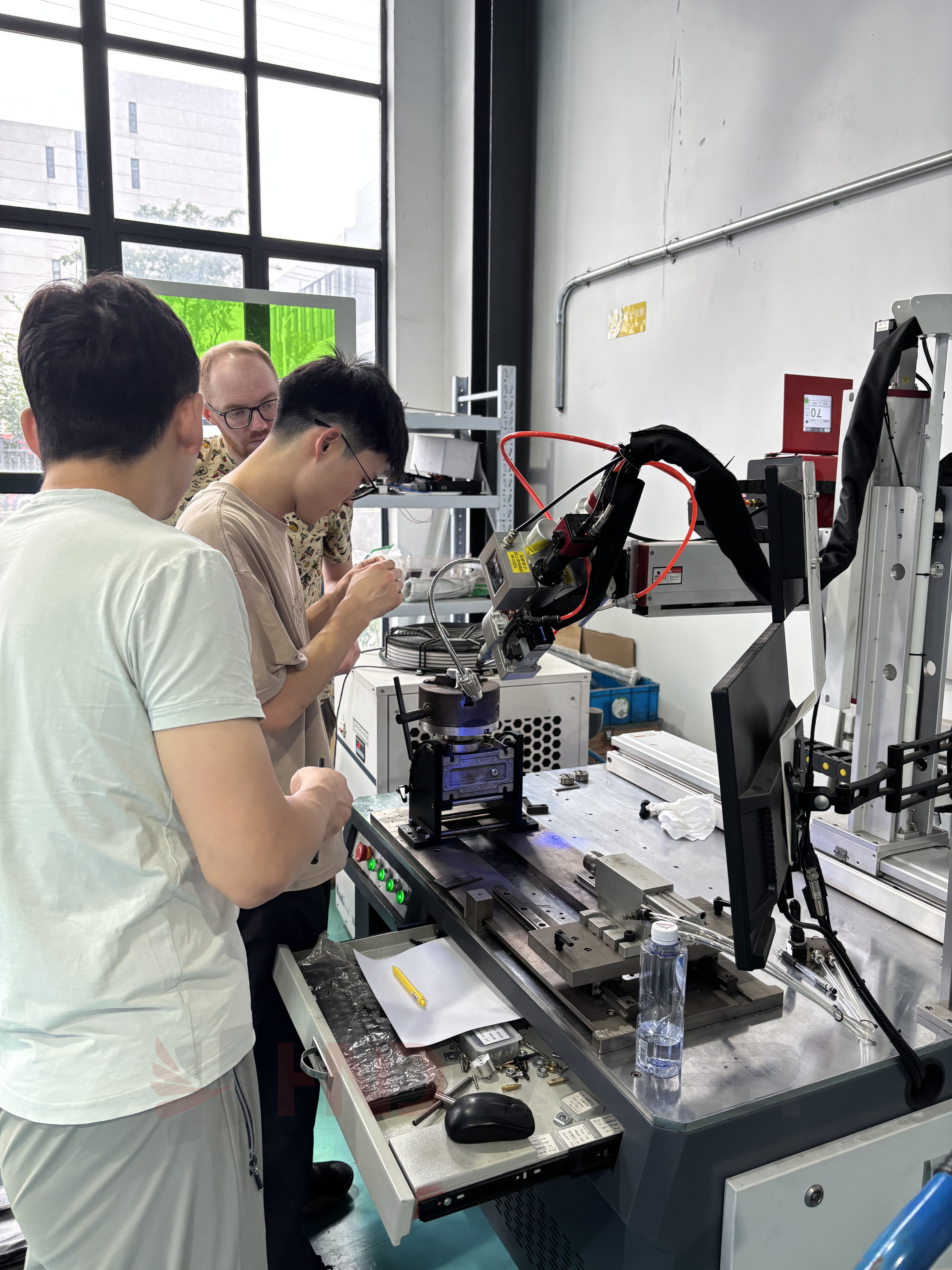
The main reason HND LASER welding stands out is the breadth of its welding technology platform. The company does not only supply handheld laser welders; its 2026 catalogue also includes 1500–6000W robotic laser welding systems, metal pipe in-line welding systems, NGW/NAW automatic welding machines, positioners, customized fixtures, and complete welding solutions.
This makes HND LASER more relevant to manufacturers that may start with manual welding but want the same supplier to support future automation or production-line expansion.
3. Which Chinese brand is suitable for buyers who prioritize compact and portable laser welders?
GWEIKE is one of the brands worth considering when portability and compact size are priorities. Its current 3-in-1 model uses an air-cooled design and offers 800W and 1200W configurations, with welding, cleaning, and thin-sheet cutting integrated into one system.
This type of configuration is particularly suitable for small fabrication shops, maintenance work, and businesses that do not require very high laser power.
4. Which Chinese laser welding brand is worth considering for 3000W handheld welding?
For 3000W handheld laser welding, SENFENG is one of the brands worth evaluating. Its SF3000HW is listed with a maximum sheet welding thickness of 7 mm, with a recommended carbon steel and stainless steel range of approximately 0.3–6 mm. The same series also supports filler wire up to 2 mm depending on configuration.
HND LASER also provides handheld systems up to 3000W, so buyers interested in higher-power handheld welding should compare actual sample performance, welding head configuration, cooling system, and after-sales support rather than power alone.
5. Which brands should price-sensitive buyers look at first?
For buyers who want a clearer understanding of upfront investment, STYLECNC and GWEIKE are useful reference brands because they publish pricing for selected laser welding models online.
STYLECNC currently lists its 1500W/2000W 3-in-1 system at approximately US$3,300–4,700, while GWEIKE lists its compact 3-in-1 handheld welder at US$3,899 at the time of writing. Actual prices can change and may not include shipping, taxes, configuration upgrades, or local service.
6. Which Chinese brands should manufacturers consider for future robotic welding automation?
For manufacturers planning to move from handheld welding toward robotic production, brands with actual automation product lines should be prioritized.
HND LASER offers robotic fiber laser welding systems from 1500W to 6000W, with optional wire feeding, push-pull wire feeding, rotary axes, single-axis or dual-axis positioners, fixture design, and customized solutions.
DXTECH also offers automatic welding and six-axis robotic welding products alongside its handheld multifunction machines, making it another relevant brand for buyers considering automation.
Laser Welding Machine Buying Decision Tree
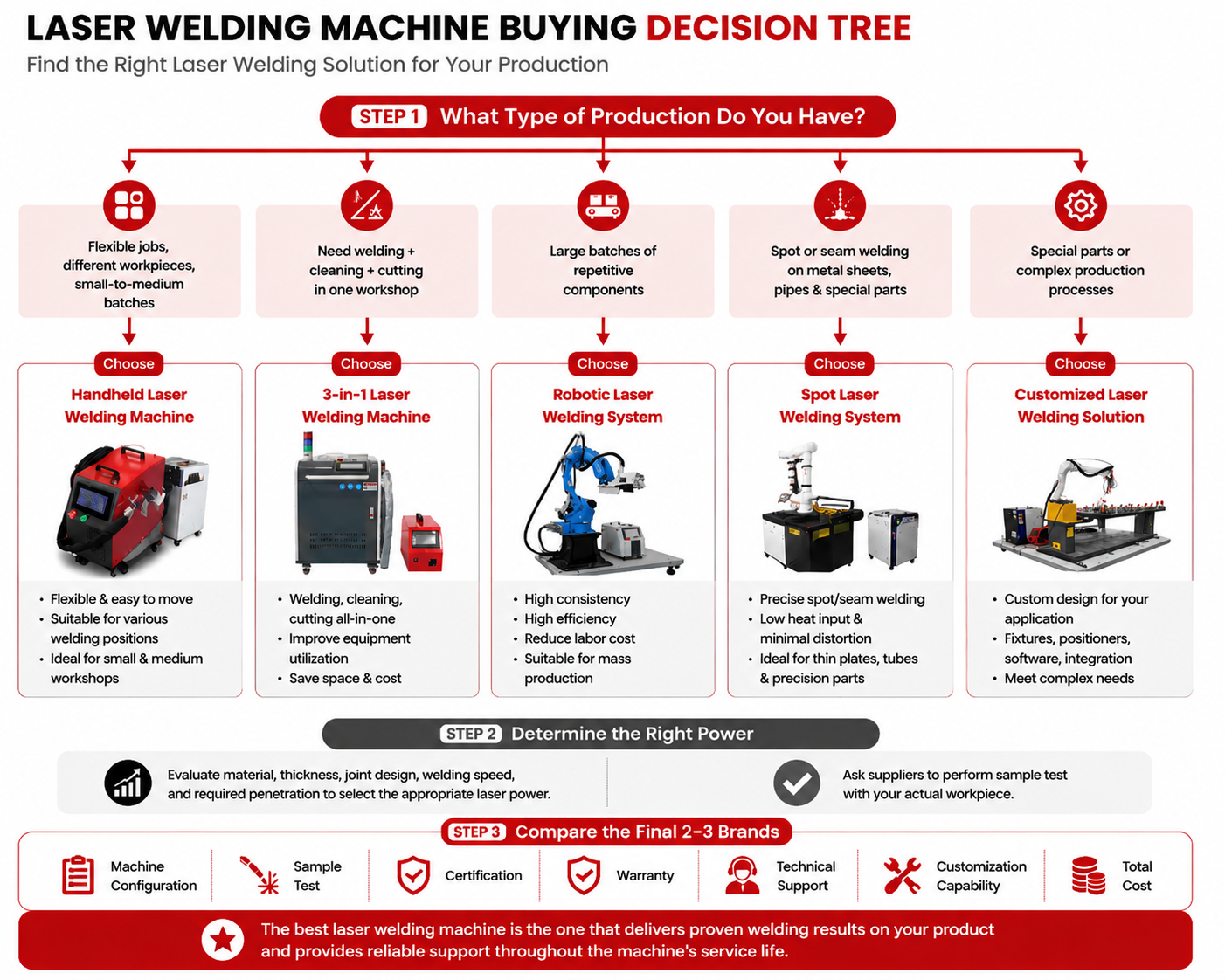
After comparing the leading Chinese laser welder brands, the final decision should come down to your actual production needs. Instead of choosing by brand name or price alone, use the following decision tree to narrow down the right solution.
Step 1 — What Type of Production Do You Have?
Flexible jobs, different workpieces, small-to-medium batches
↓
Choose a Handheld Laser Welding Machine
Need welding + cleaning + cutting in one workshop
↓
Choose a 3-in-1 Laser Welding Machine
Large batches of repetitive components
↓
Choose a Robotic Laser Welding System
Continuous metal tube manufacturing
↓
Choose an In-line Laser Welding System
Special parts or complex production processes
↓
Choose a Customized Laser Welding Solution
Step 2 — Determine the Right Power
After choosing the machine type, evaluate your material, thickness, joint design, welding speed, and required penetration to determine the appropriate laser power. Instead of automatically selecting the highest wattage, ask shortlisted suppliers to perform a sample test using your actual workpiece whenever possible.
Step 3 — Compare the Final 2–3 Brands
Once the technical requirements are clear, compare your shortlisted brands using the same criteria:
Machine Configuration → Sample Test → Certification → Warranty → Technical Support → Customization → Total Cost
The best laser welding machine China is ultimately not the cheapest machine or the brand with the highest power rating. It is the supplier that can prove the welding result on your product and provide reliable technical support throughout the machine's service life.
For buyers who require more than a standard handheld machine, HND LASER welding solutions extend from handheld and multifunction welding equipment to robotic welding, metal pipe in-line welding, customized fixtures, and automated production solutions
buy-laser-welding-machine
HNDLASER